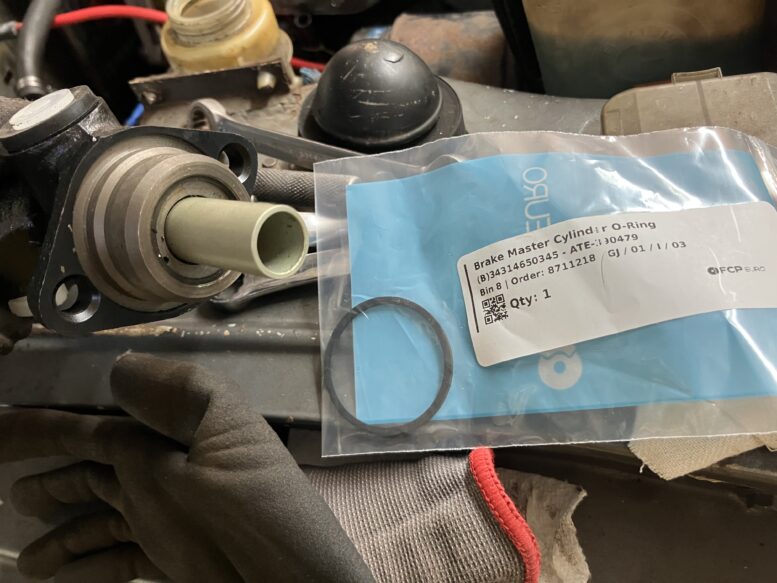
Last week, I was less than thrilled to find that Bertha’s low brake fluid was caused by it leaking out the master cylinder’s rear seal and into the brake booster, but that disappointment was nicely mitigated by remembering that one of the parts hoards I’d inherited a few years back contained a tii brake master cylinder with “23” (the bore size in millimeters) unambiguously embossed on the side. I was about to install it when I realized that it was missing the rubber O-ring on the back that forms the vacuum seal for the booster. I thought about re-using the old O-ring, or using a generic one that appeared to be about the right size, but the part was only about $3 on FCPEuro, and since they’re just down in CT, if I order something in the morning, it usually gets here in two or three days. I do, however, balk when I’m ordering something small and flat like an O-ring and they still charge me $6.99 for shipping when they could just slip it into a first-class envelope, but this is not a hill I’m going to die on. So I clicked, ordered, and waited. Sure enough, the 12-pack-sized box arrived on Tuesday.
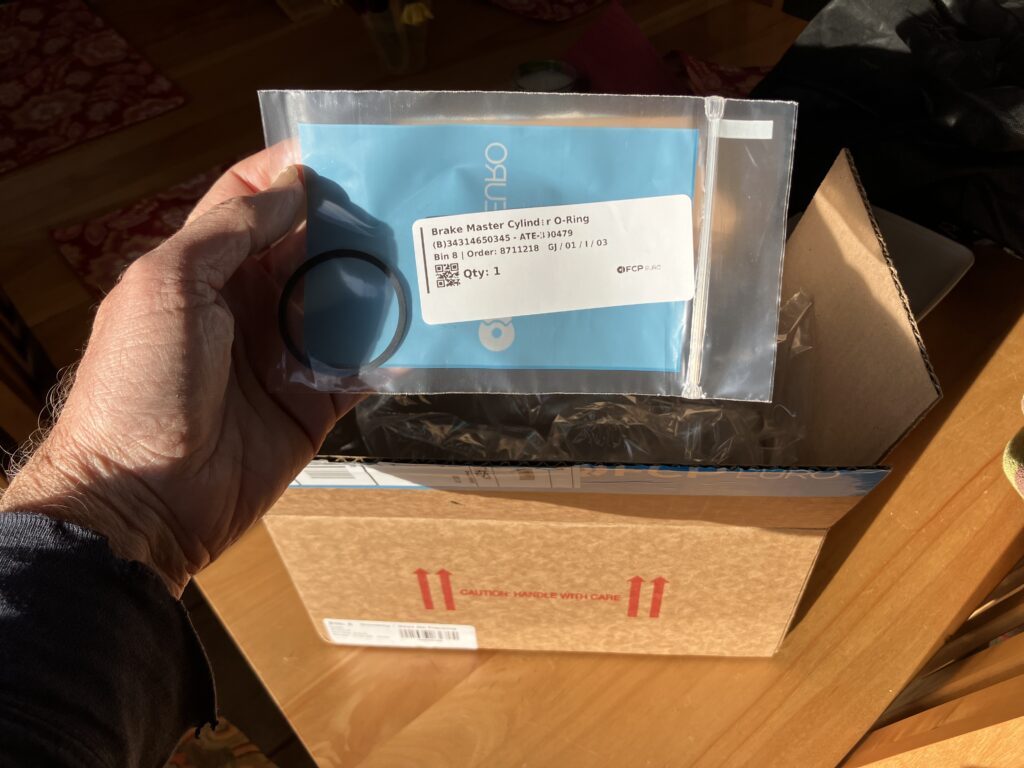
FCP, I love you folks, but you don’t need to compete with Amazon for maximum ratio of box size to purchased goods.
I placed the o-ring in position, slid the brake master cylinder onto its studs on the booster, tightened the nuts, and one at a time, removed the plastic plugs and carefully threaded the brake line fittings into their holes in the master. Then I very carefully snugged them all down (you don’t want to go through all this work only to feel a 50-year-old brake fitting strip or snap).
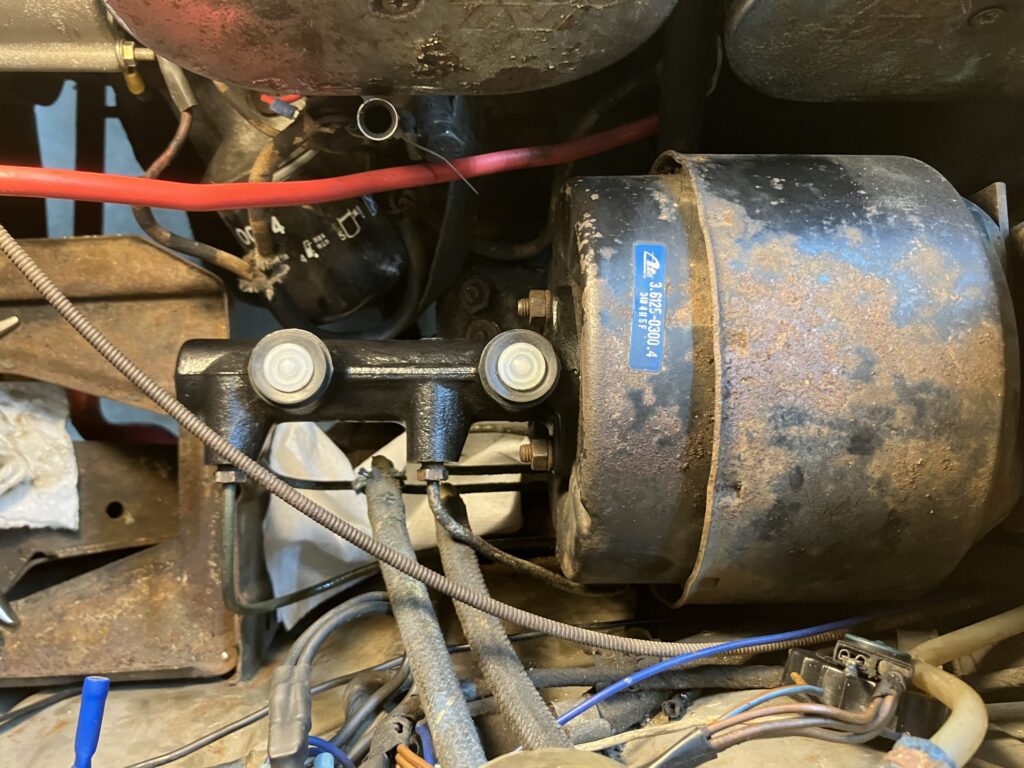
Hard part’s over. Whew!
Although neither of the braided cloth hoses were leaking, they were different colors (one blue, the other black), so it’s possible that I’d replaced one of them when I resurrected the car six years ago. I had a piece of the correct hose in the garage, so I cut two pieces to length, carefully extracted the plastic elbows from the old hoses, and pressed them into the new hoses.
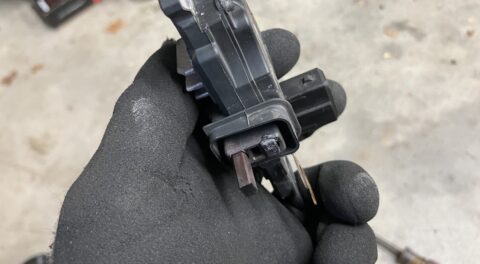
The only pre-brake-fluid part of the job remaining was to insert the elbows into the rubber grommets in the top of the master. So I pulled the plastic plugs out of the grommets, and immediately saw that the holes in them were waaaaay too big to received the elbows. I would’ve sworn I took a photo of it in situ, but maybe not. Here’s a comparison between the grommet that was in the master cylinder I removed versus the ones in the just-installed one.
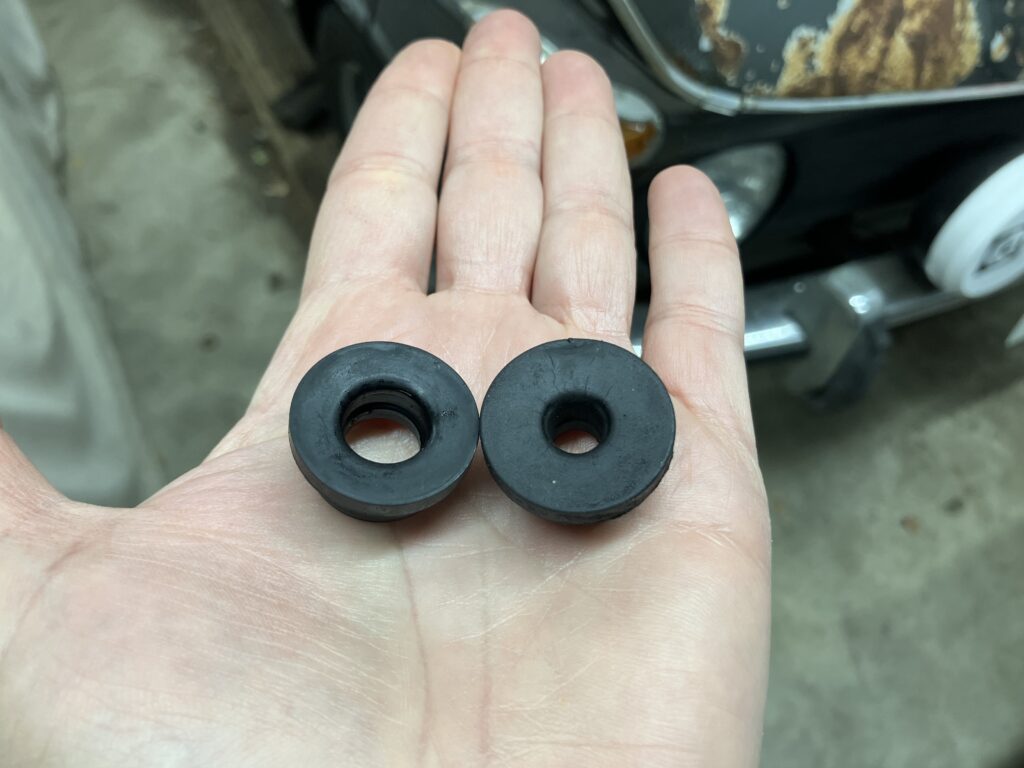
Old and correct right, new and useless, left.
Back I went onto the FCPEuro website. They had the grommets in stock, they were less than $4 each, and for another $6.99, another oversized box could be shipped and be at my door in two or three days. I felt like an idiot for not having checked this when I ordered the o-ring, but I was intentionally leaving all those plastic plugs in place until the last moment to keep dirt out of the new unused master cylinder. I entertained simply re-using the old grommets, but when I examined them closely, I could see small cracks in the rubber.
Then the grommets being too big rang a bell. I remembered that I encountered the same thing when I replaced the brake master in Louie (the Ran When Parked 2002tii). Sometimes in these situations I order extras. The garage is, in general, not a terribly well-organized place, but every once in in a while, I’ll play the came of Concentration with like parts and consolidate them in the same container, so I did in fact have a tray-o-grommets and related rubber parts. Sure enough, in it was an apparently new and unused pair of brake master cylinder grommets. Sometimes we get an outsized amount of joy from not having to spend another $6.99 in shipping and wait another two to three days, even though neither the cost nor the waiting time will make any difference in our lives whatsoever. This was one of those times.
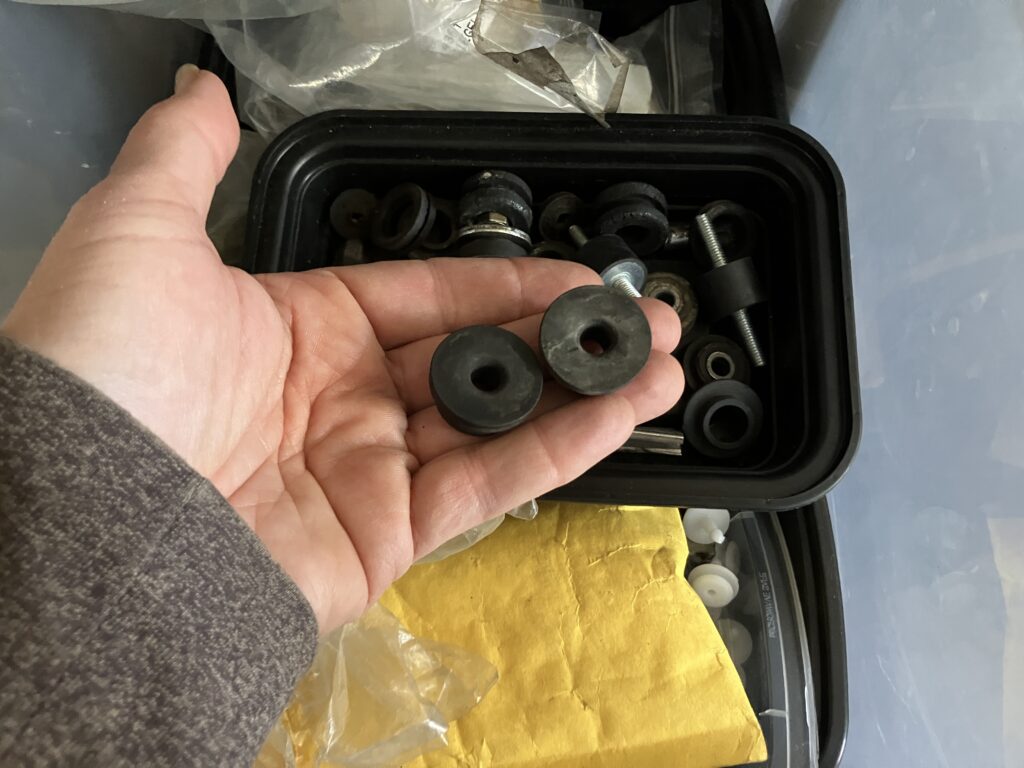
Praise be to The Great Automotive Creator! It’s a holiday miracle!
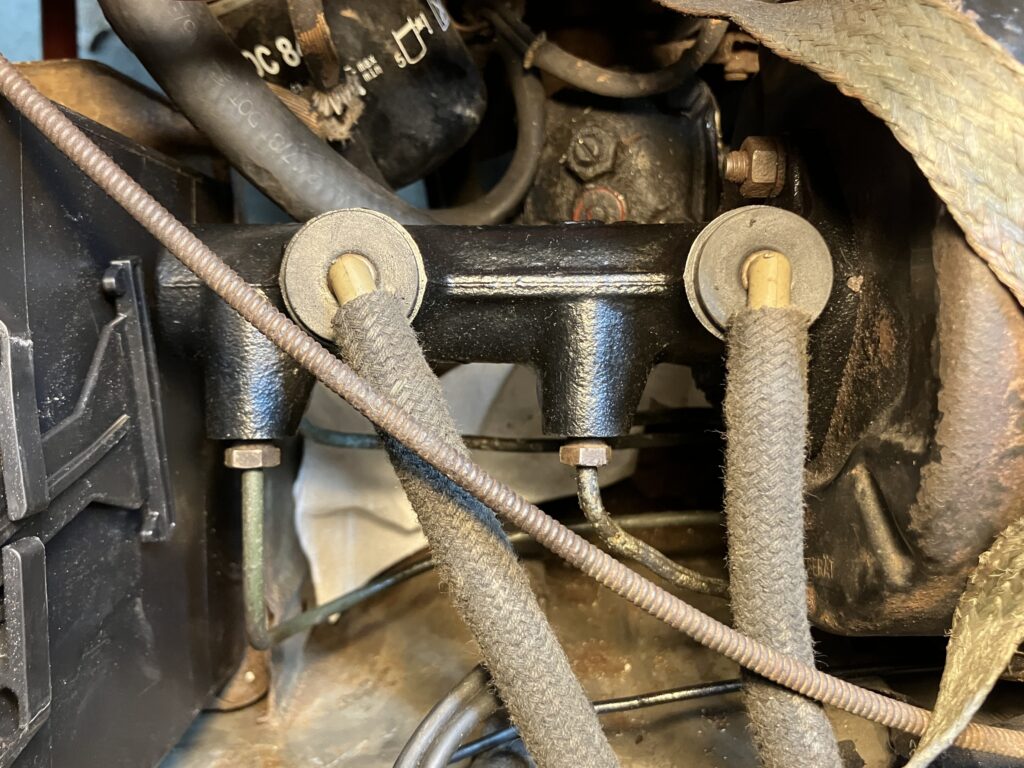
Saved by being a pack rat.
That left only filling and bleeding. I’ve never found bench-bleeding necessary; master cylinders usually bleed fine as long as you don’t completely drain the fluid out of both it and the brake lines, and do the bleeding thoroughly and systematically. Besides, as I said last week, I hate dealing with brake fluid, and I’d rather get a colonoscopy than fill a container with brake fluid and submerge a master cylinder in it and pump it until the air bubbles stop as if I’m drowning a demonic cat. I’ve used a Motive power bleeder for years, and wonder how I ever survived without it.
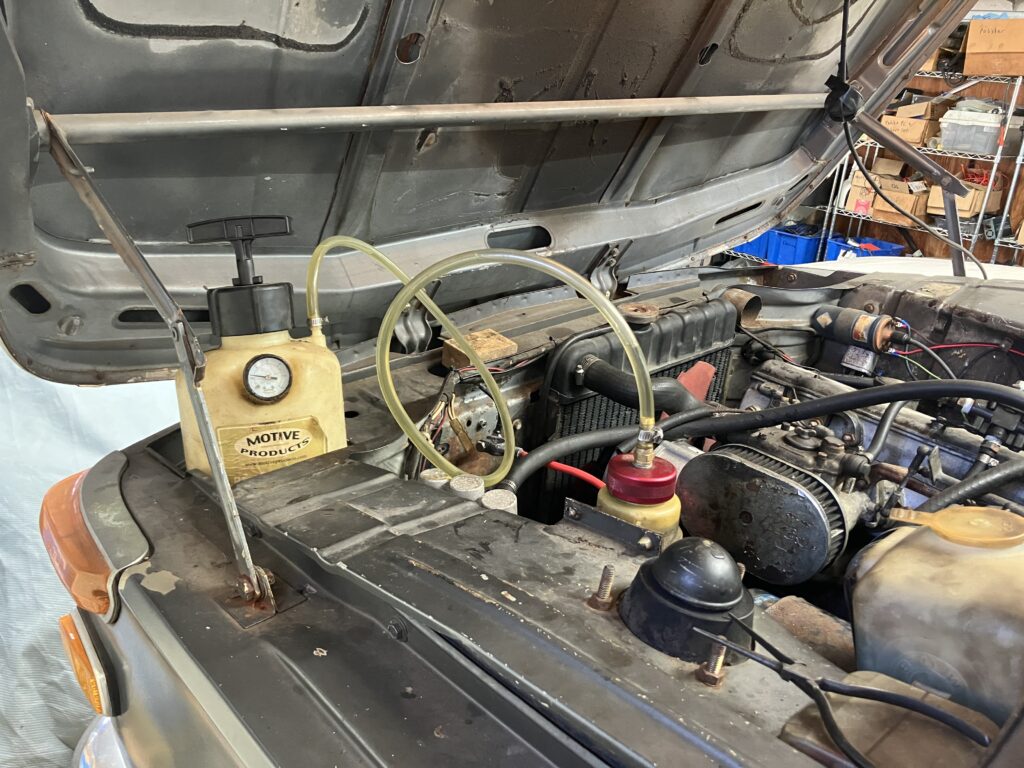
The Motive gets pressed into service.
After one round of bleeding, the brake pedal came up nice and firm. I thought I’d beat the imminent snow and take the car for a test drive, but then realized that with it still up on the mid-rise lift, I can see if I can loosen the splines on the steering column and replace the balky steering box (one of the things on my list). So I think I’ll let it hang out in the Garage Space of Honor for a bit longer.
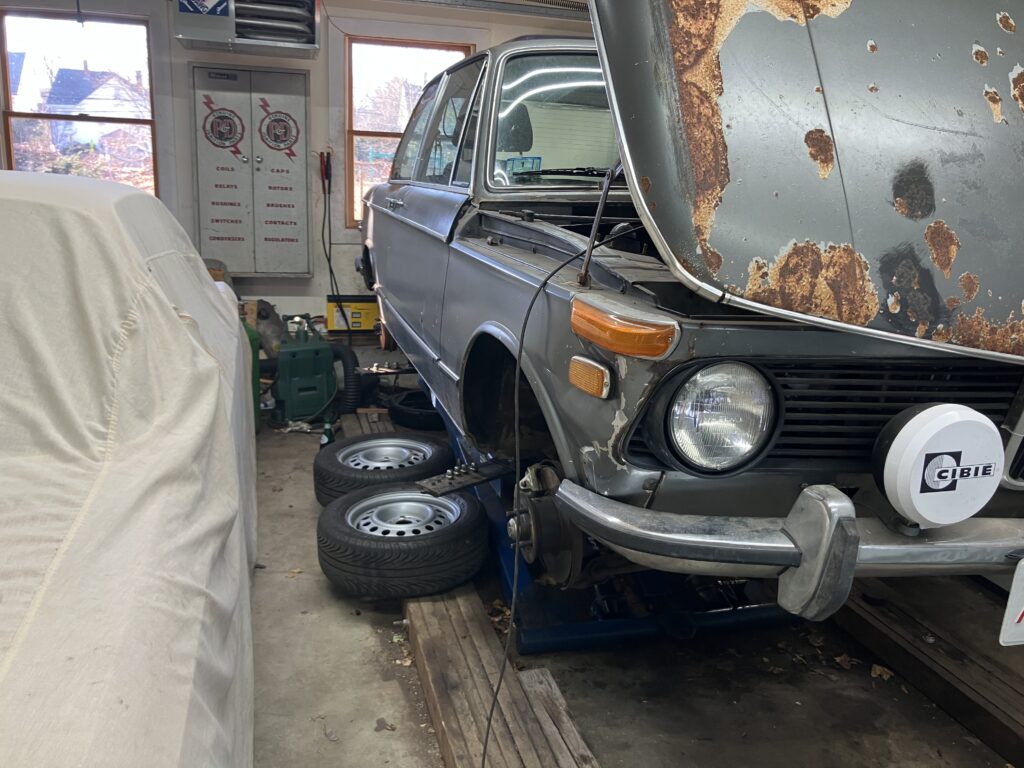
Don’t get used to it.
—Rob Siegel