
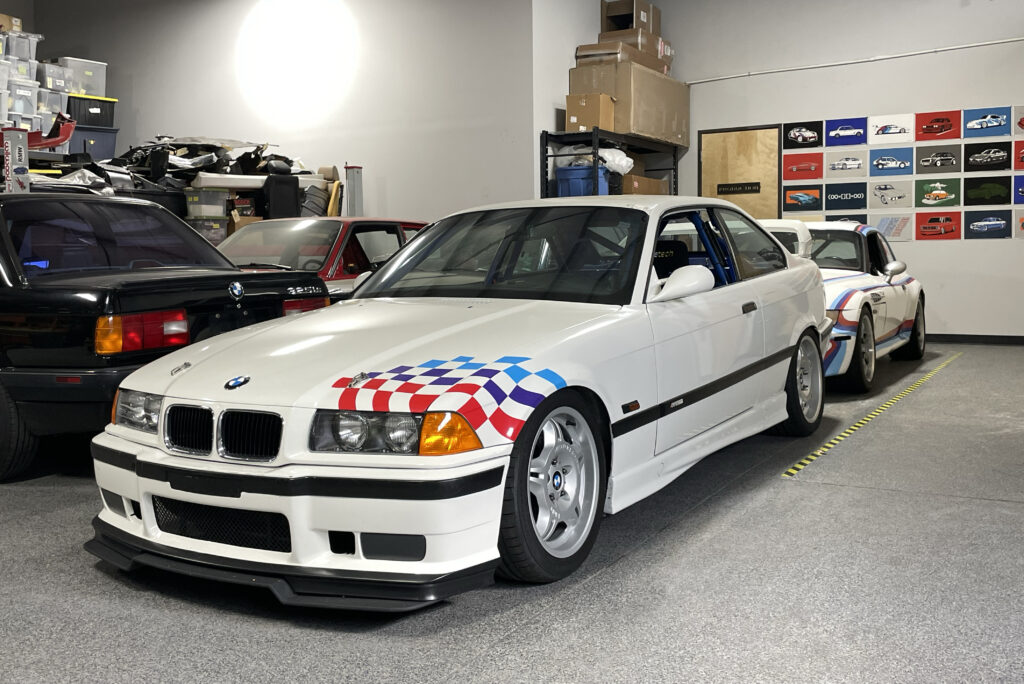
I have two cars remaining at my business, the 2001 740i M Sport which I wrote about in March and the E36 M3 Lightweight race car. Once those are gone, I’ll suspend my dealer license, officially close the dealership, and in words any fan of The Wire will recognize, be out of the game; when it comes to selling cars, I’ll just be a citizen again.
Of course, my business was less about the hustle and more about sharing the experience—maybe a little too much, or perhaps I’d still be in business.
The E38 740i M Sport is one of the top three cars I’ve ever had. Along with the E39 M5 generation, I would describe it as a pinnacle BMW. Before it, every BMW was getting better, and after it—if you like that old-school BMW DNA—every BMW only got worse. The E38 occurred at the shift of BMW’s transition from a smaller, driver-focused marque in the 1990s to an industry-leading luxury brand in the 2000s. While the E39 M5 was a manual-transmission fire-breathing monster, the most driver-centric E38 7 Series, the 740i “short sport,” was a little more refined; it had a softer suspension, an automatic gearbox, and an open differential—but the styling was so sleek it made the E39 M5 look bulbous by comparison. My 55,000-mile Anthracite 740i closed the gap with the E39 M5 considerably thanks to KW V1 coil-overs, a Vortec supercharger, and a quad-tipped M5-style exhaust.
Early this summer, it did what BMWs tend to do: it broke. I had loaned it to my friends at FCP Euro to take to the Pikes Peak International Hill Climb to display during the weekend’s festivities. FCP Euro has always been generous to me, both in the car business and sponsoring episodes of Life’s Too Short for Boring Cars. What better way to repay them than to give them a proper vehicle for the hillclimb weekend? No friends of mine will spend the weekend in a sterile appliance of a rental car when I have one of the world’s best BMWs at my disposal!
Of course, no good deed goes unpunished. When I started the 740i that morning to pick up the FCP Euro boys, the supercharger sounded slightly more marble-ish than I had remembered. It wasn’t the bag-of-marbles sound some other Vortec owners had described on the Interwebs, and they do have a tendency to make a little noise, so I chalked it up to normal operation. However, over the weekend, the ominous noises worsened, eventually putting it into limp-home mode, so I swapped it for my F31 wagon. The supercharger bearings had failed—but fortunately, we caught it before it self-destructed and damaged the engine. It’s been a few months to get a replacement unit, but I should have that installed and the 740i sold by the time this goes to print. Phew!
Will that happen before I find a home for the E36 M3 Lightweight?
The M3 LTW arrived at my doorstep two years ago, and it was one of those cars I just couldn’t turn away. One of 126 M3 Lightweights made, it originally featured aluminum doors, no sunroof, a stiffer suspension, shorter final drive, and the adjustable front splitter from the Euro M3 GT. The rear wing was conspicuously elevated, and the interior lacked such luxurious appointments as a radio and air conditioning. What you did get was an M-cloth interior garnished with red-weave carbon-fiber trim and BMW Motorsport International badging. For an original MSRP of $47,000, you could have your M3 Lightweight in any color you wanted, as long as it was Alpine White with a Motorsport flag decal. In the current market, a sorted M3 Lightweight will sell for north of six figures, and significantly more with low miles or provenance, such as Paul Walker’s example.
This Lightweight was on the opposite end of that spectrum. It had been hacked into a race car very early in its life. Stripped of its now collectable interior and fully caged, there is virtually no collectability left to it. Dozens of people have lusted after restoring it into a stock example, but I’ve turned them all away—it’s simply too far gone. The engine is noticeably tuned, and I’m not sure if its numbers are matching. I added triple-adjustable Motion Control coil-overs and StopTech ST40 brakes, which render the stock forged Style 42 wheels all but useless; in their place are forged Apex Arc-8 wheels.
However, my Lightweight is one of the fastest, most pure BMW M cars I’ve ever driven. Unlike its collectible siblings, my Lightweight is paradoxically the purest expression of—and also completely unencumbered by—its legacy. On our local track, which favors horsepower, it’ll hunt down more powerful cars with even my paltry talent. And the best part about doing it is that you’re doing it in a real Lightweight!
It pains me to see it go, but with all I have left to show from the business being an enormous financial crater, there is no way I can responsibly keep it. The problem is that I’m too stubborn to let it go for a steal, and you could build a similar-spec E36 M3 track car for half of what I’d want for it. So it is, in essence, a car with no home: It’s too far gone to sit in a car collection, and too raw (and potentially illegal) to drive on the street.
In the race for the last car sold, it’s probably going to do what M3s tend to do: win.