Last week, I punted the issue of brake fluid loss in Bertha, my ratty ’75 2002ti tribute car that had seen little road time since returning from The Vintage in 2019, and instead, inexplicably focused on replacing its Momo Jackie Stewart steering wheel with a slightly larger, slightly thinner $54 Momo knock-off from Amazon (hey, it made sense at the time). This week, I realized how silly this was, and delved into finding the source of the brake fluid loss.
I put the car back up on the mid-rise lift again and gave the undercarriage another look. There was no wetness around the clutch slave cylinder, the hose between it and the clutch master, or any of the metal or rubber brake lines, so I pulled the rear drums off to check if the rear wheel cylinders were leaking. They were bone-dry. This was as expected, as I was pretty sure I’d replaced these when I resurrected the car in 2018–2019, but with the low quality of parts these days, anything can happen.


Good…
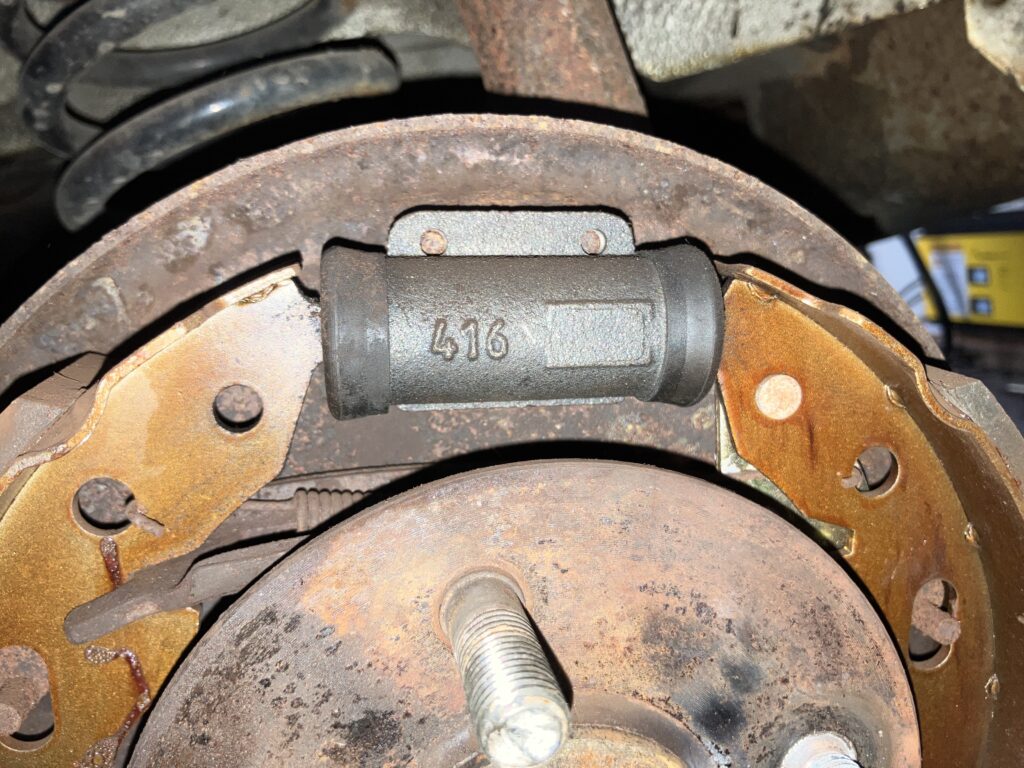
..and good.
Last week I said that one of the things that’s a pain about square taillight 2002s is that they have a molded one-piece carpet that goes underneath the console, so if you need to do something like replace the clutch slave, it’s a pain because the floor carpet piece isn’t separate like it is on a round taillight car. So instead, I looked at the bottom of the pedal bucket. If the clutch master leaks, you can often see the bucket’s stupid outer foam cover sopping wet. As is the case on many 2002s, this one is missing the foam cover (did I mention that it’s stupid?), but I’d apparently jammed a piece of foam inside the rectangular hole to plug it up, so I couldn’t look inside it from underneath, and as I didn’t see anything dripping from it, I thought it was best not to disturb it.
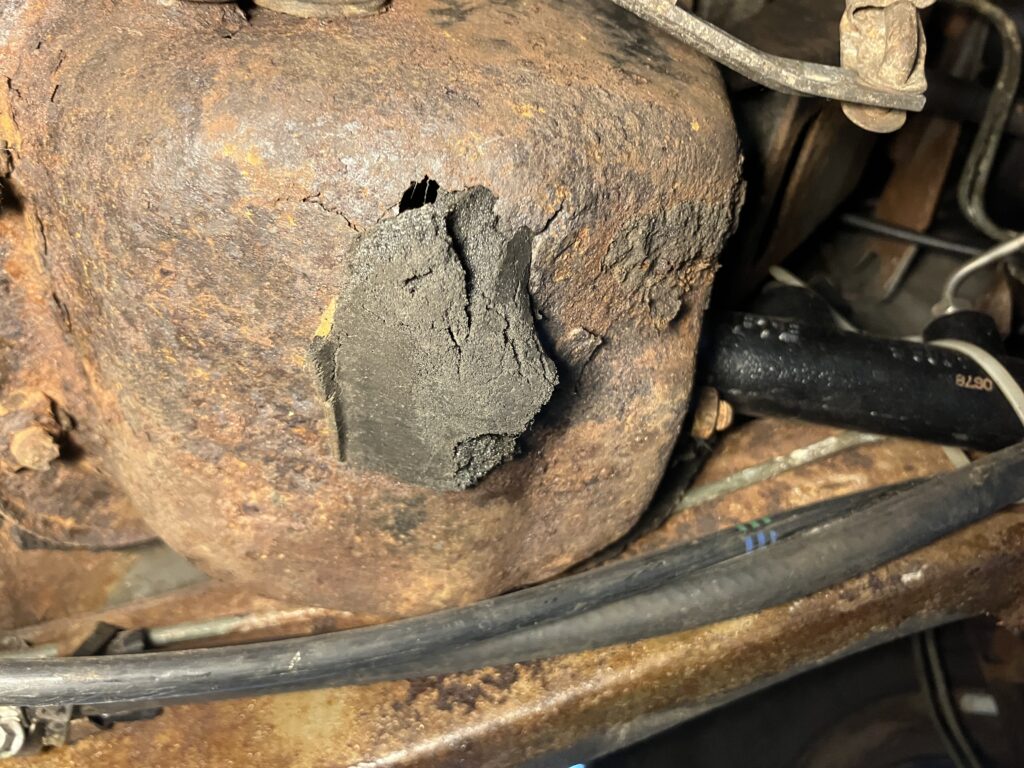
It looks like I gagged it.
From the photo above, you can see that the clutch slave looks recent. I vividly remember when it failed coming home from a cars and coffee in Rhode Island on Bertha’s first real post-resurrection drive. So, as with the wheel cylinders, I wouldn’t have expected it to be the cause of the leak, but as I said, parts quality, blah blah blah. So I took a flashlight, shoved aside the other foam piece that’s under the rug and on the top of the pedal bucket, looked inside, and was surprised to see some amount of dampness. It wasn’t the sodden stinky pool of a fully-failing clutch master cylinder, but it shouldn’t be there at all. Oh well, I thought; maybe the thing does need a clutch master cylinder.
I went upstairs to the laptop, found that the part is available for about a hundred bucks, and was about to click and buy when I thought “No, before you do this, check out the other thing it could be—brake fluid winding up inside the brake booster due to a bad rear seal on the brake master cylinder.” You’ll recall that I went through this same thing on my E9 last month, and pulled the hose off it, snaked a zip tie down into the booster like a dipstick, and it came up dry. On Bertha, the port is a little harder to access, as the hose goes into the bottom of the booster, not the top, but when I pulled it off, I didn’t even need to grab a zip tie—fluid was dripping out of the end of the hose.
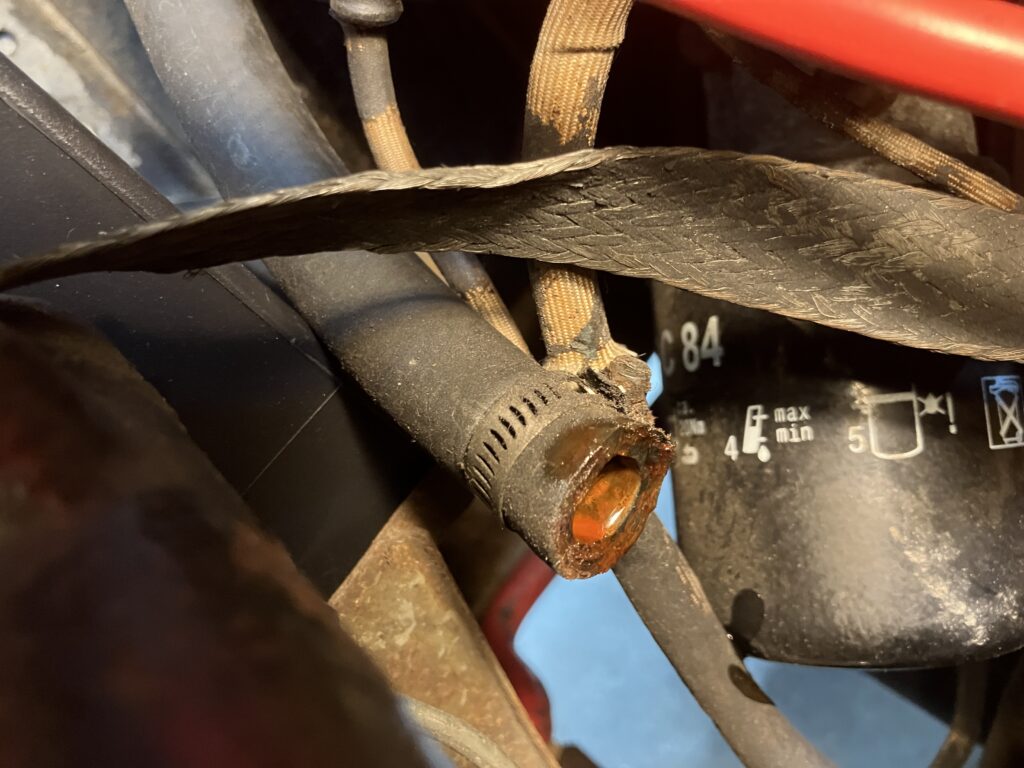
Ruh roh.
I touched a finger to it, sniffed it, and got that unforgettable cat-piss-like whiff of brake fluid. Those who have been reading me for decades know that I hate the smell and feel of brake fluid, and that opening up brake and clutch hydraulic systems is one of my least favorite things to do. So wanting to be certain, I bent a Q-tip and slid into the port on the booster.
It came up sopping. This was definitive, and meant that the brake master cylinder was bad and needed to be replaced—a job I was not looking forward to. Further, as Bertha has a braking system that came out of a 2002ti, it has the ti/tii 23mm brake master cylinder, not the standard 20mm one for a 2002.
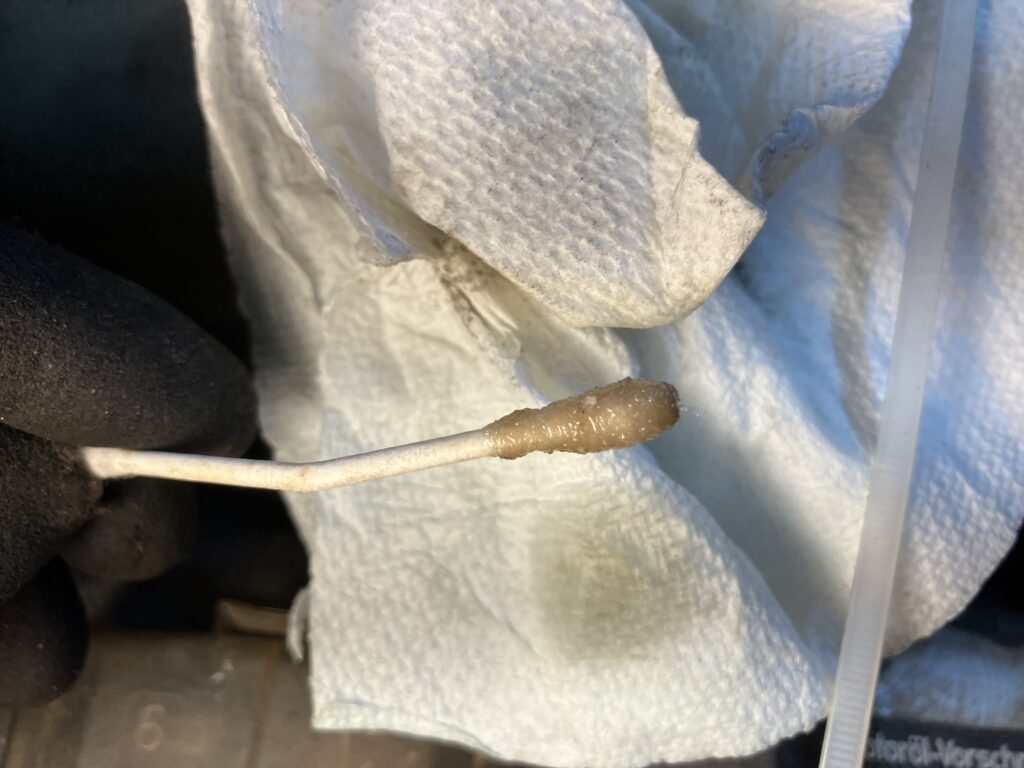
Ick.
The next day, I began attacking the problem. It’s winter, it’s cold in the garage, and I hate to turn on the heat unless I’m out there for a good duration, so I thought I’d do the 15-minutes-at-a-time thing. I went out and used the turkey baster (well, not the good turkey baster) to suck the brake fluid out of the reservoir. I was about to go back inside when I thought “Why don’t I give each of the brake lines a goose of Silikroil to loosen ’em up?” So I did, then came back inside and had another cup of coffee.
I was going to let the Silikroil sit for a few hours, but curiosity got the better of me, and I thought “Why don’t I just use the 11mm flare-nut wrench on all the fittings and see if they crack loose easily?” Four did, two didn’t. In a situation like this, where you’re in a world of hurt if a fitting doesn’t loosen up or snaps off, I head straight for the heat, but I found that my MAPP gas torch was empty. I was about to run to the hardware store when I thought “Let me just try again, this time with more torque.” I did, one of the two recalcitrant fittings cracked loose, and the other one, of course, began to round the corners off the nut. I thought “Idiot! Idiot!” But I had good clearance to get a Vise Grip on it, and off it came.
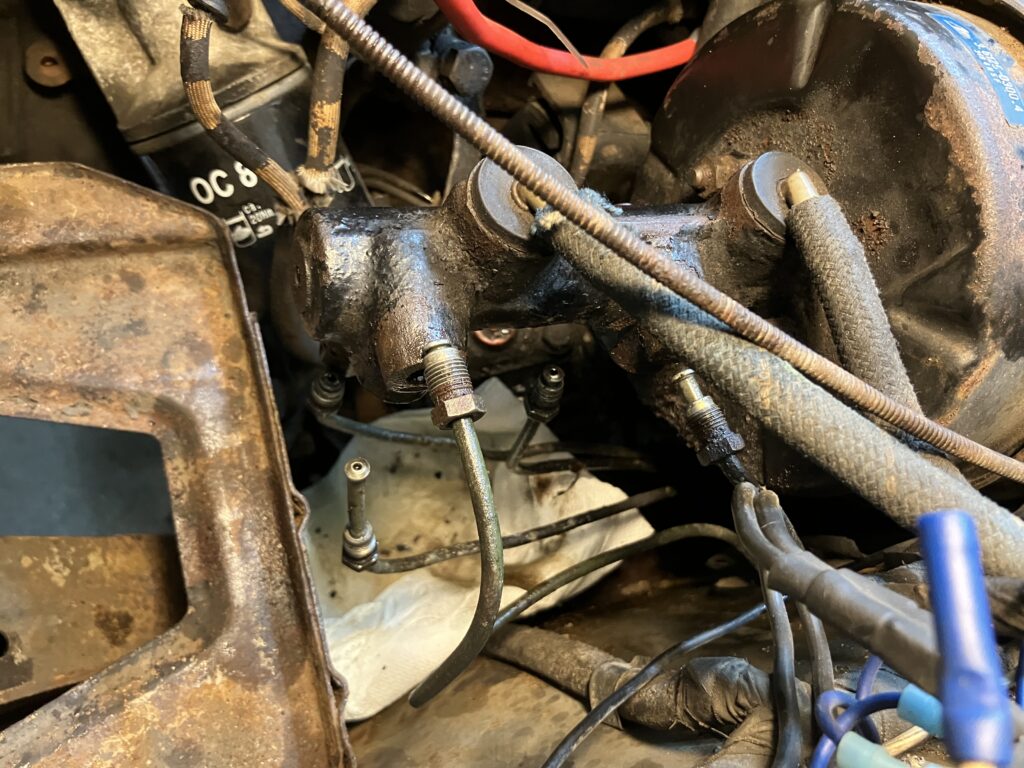
THAT’s a good master cylinder. Well, it’s a bad one, but you know what I mean.
At this point, pull the plastic nipples out of the rubber grommets, undo the two 13mm nuts holding the thing to the booster, and out it comes, so why not just have at it?
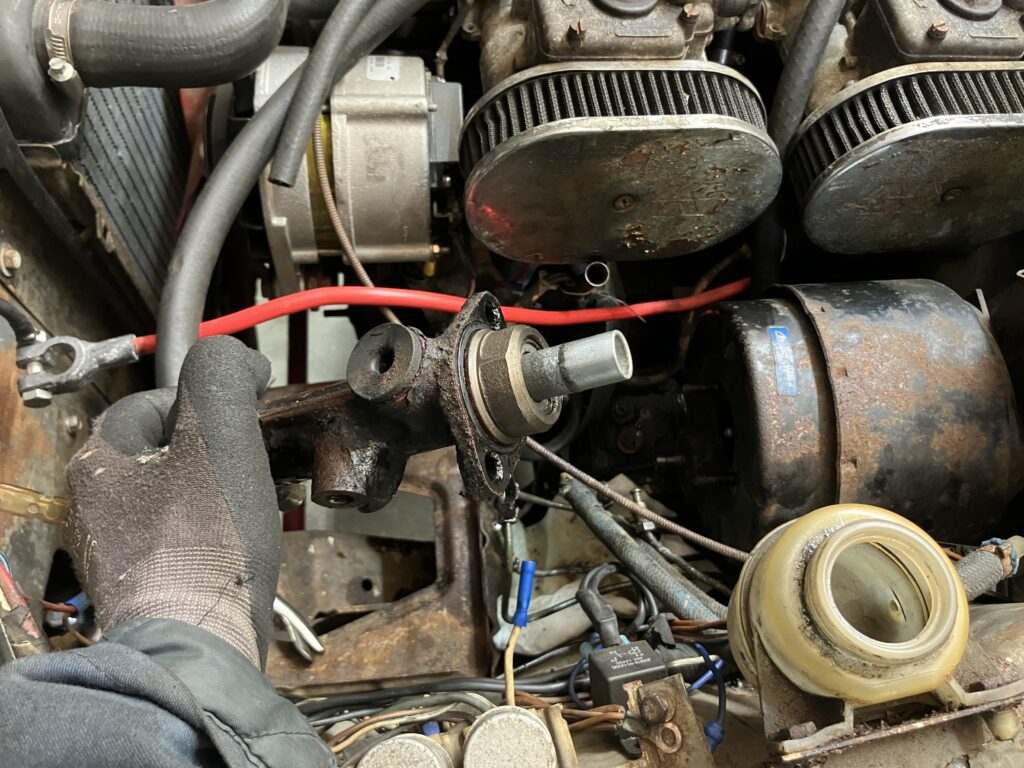
Yeah baby.
Obviously, the thing to do was to get a new one on order ASAP. I sat down at the laptop and learned that the original 23.81mm tii master cylinder appears to be unobtanium these days, with the closest match being the 22mm 2800CS unit that Ireland Engineering sells for $295. I rolled my eyes at the expense, but philosophized that I’d pulled this braking system out of a rotted 2002ti I bought and parted out on the streets of Brighton 40 years ago, so it had a good run.
And then I remembered something. In the summer of 2022, by utter coincidence, I was contacted by two women, both of whose husbands had passed away, and both of whom needed help dealing with their 2002s and their leftover parts. One of the cars was an original-owner Fjord blue ’72 2002tii, and I wrote a seven-part series about sorting it out and selling it for her on BaT. But the other car was a beautifully-restored Malaga ’76 2002 with a some go-fast modifications. For that one, I just floated it on my Facebook page, and connected the owner with an interested party. Months later, she gifted me all the parts that were in the basement. I’ve written multiple pieces about how these parts hoards are a mixed blessing. On the one hand, what 2002 owner wouldn’t say “yes” to new unused 2002 parts? But on the other hand, it’s rare that a parts stash is all wheat and no chaff, and no fair taking only new parts in boxes and leaving all the old stuff for a widow to deal with. My garage and basement still haven’t recovered from several of these events.
But a neuron fired and told me that the parts stash from the Malaga ’76 included a brand-new brake master cylinder. What’s more, I thought I recalled that it had “23” stamped in the side.
I found it. I was right.
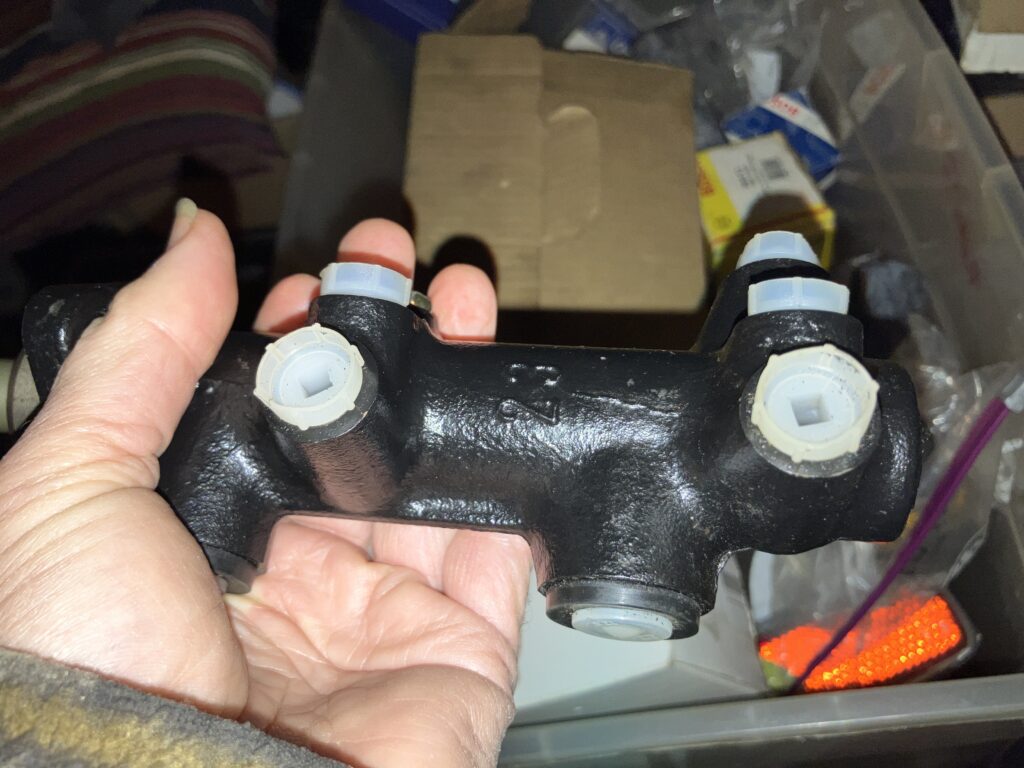
BOOYA!
Suddenly, “Oh crap this is going to cost me three hundred bucks” became “I got yer tii master cylinder right here FER FREE, pal! Mwahahahaha!” and “Do 15 minutes at a time” became “Holy hell, I could get this thing back together right freaking now.” I slid the thing onto the booster studs and began threading the nuts onto them, and then I realized that I hadn’t cleaned the brake fluid out of the booster. Damn.
But that was for the best, because when I slid it back off, I looked at the end of the new master cylinder, and realized that it was missing the rubber O-ring (part number 34314650345) that keeps the booster’s vacuum from leaking. It would’ve been a real drag had I installed it, threaded the fittings back on, filled and bled the system, only to find that that it didn’t work because it wouldn’t hold vacuum, and I needed to pull it back off all for the want of an O-ring.
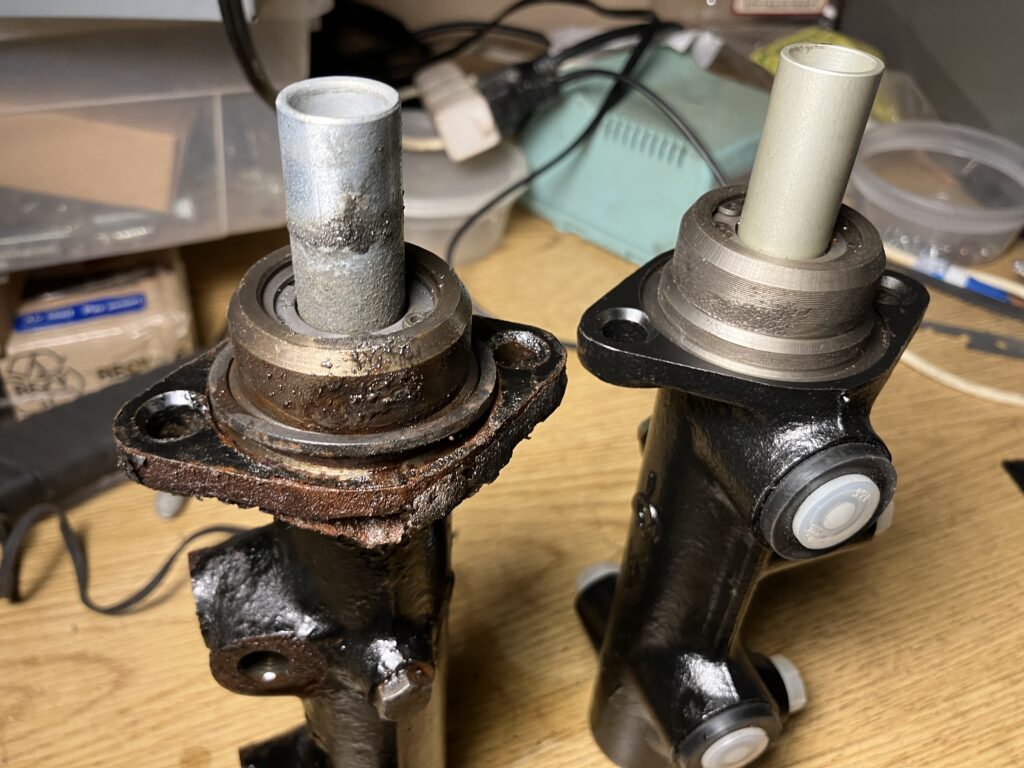
Note the O-ring on the old master cylinder (left), missing on the new one (right).
I came very close to simply swapping the O-ring off the old master cylinder onto the new one, but decided that, for the $10.51 that FCPEuro charged for the in-stock part, I’d be an idiot not to wait the few days for it to be shipped to me. Besides, there was nothing pressing me to rush the repair. It’s not like the car had a scheduled freeze-my-ass-off-and-listen-to-it-rust road trip or anything. Its main reason for being in the garage over the winter is to give me things to do. I didn’t even have an urgent need to get the car off the place of honor over the mid-rise lift. Just wait for the O-ring, Rob (sometimes I need to remind myself to slow down).
As much as I didn’t want to, I did need to clean the brake booster. I stuck in a paper towel, and it came out sopping wet. Yuck. There was so much brake fluid in it that initially I thought I’d need to remove it and wash it out with brake cleaner, but using paper towels to sop up the bulk, followed by a rag twisted around a coat hanger, was very effective. When they came out clean, I called it done.

It’s hard to tell because the camera wouldn’t focus on it, but that shine at the bottom is a big puddle of brake fluid.
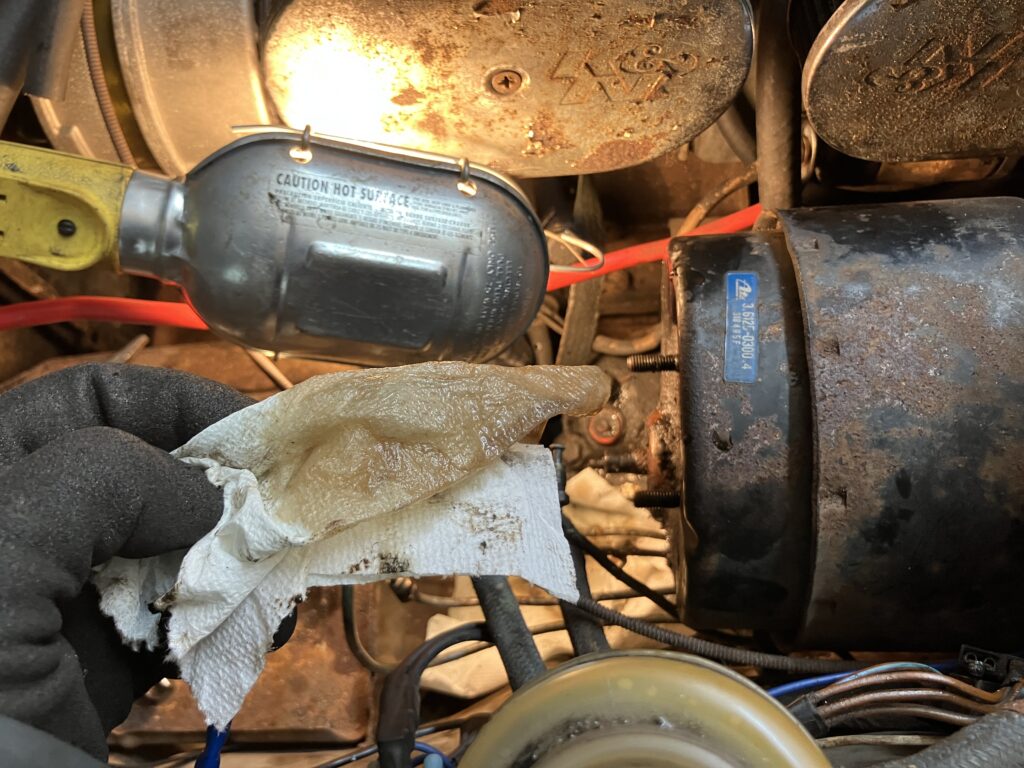
Honestly, I’d rather wipe up cat piss.
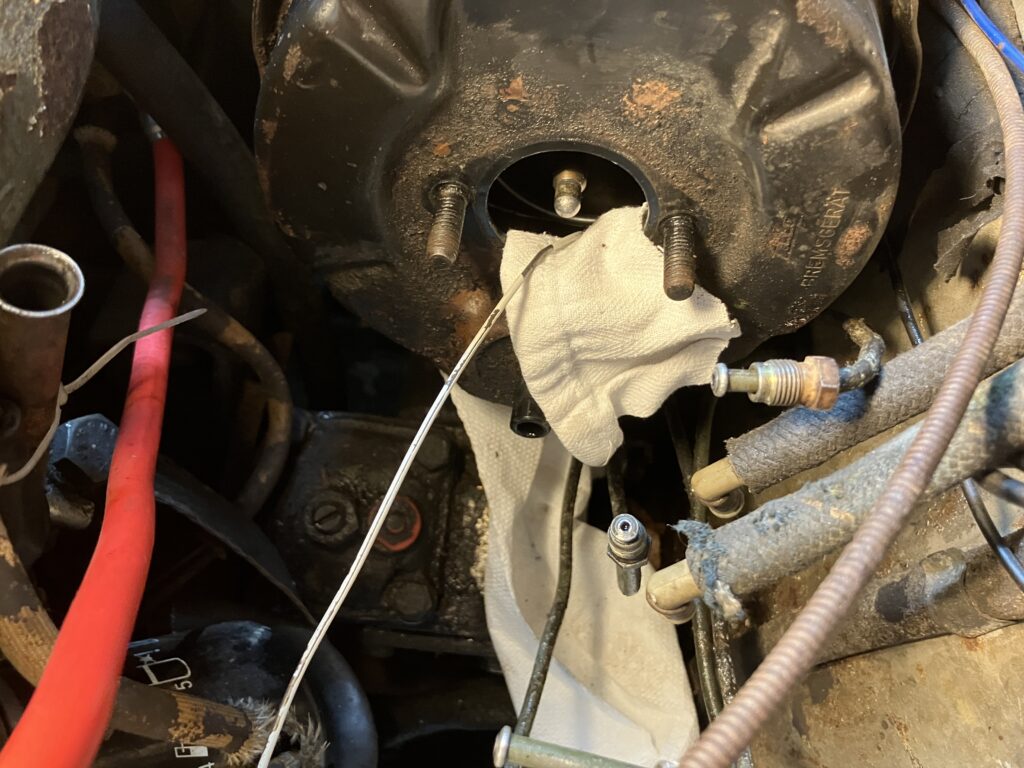
The tried-and-true coat-hanger-and-rag method.
The booster is now nice and clean, and as soon as the new O-ring arrives, I’ll throw it all back together.
And then I’ll be able to drive it and try out that cool new steering wheel.
—Rob Siegel