The post Self Propelled | Some Skills Transfer in Both Directions appeared first on BimmerLife.
]]>My wife, Carol, is fond of telling friends, “As a cook, Mike’s a pretty good mechanic.” It’s not that I can’t cook; recipes are like shop-manual procedures: Just follow ’em to success. But cooking is just not something I really like to do. I have, however, been known to bake—cakes, cookies, brownies etc, following those cookbook or mix-box instructions.
Early in our marriage, the first thing I baked for Carol was her birthday cake. We lived in a trailer—not a “mobile home,” a trailer, one with a five-degree list to starboard.
Thus the layers came out of the oven lopsided, and had to be carefully aligned to prevent the Leaning Tower syndrome. I finished icing the cake just before Carol arrived home from work.
“Mike, the frosting is beautiful,” she said. “Did Margie [our next-door neighbor] do it?”
“No, I did.”
“Where did you learn to ice a cake like that—your mom?” (She was a great cook, by the way.)
“Nope. You really don’t want to know.”
This conversation continued for a few more exchanges; then I finally revealed where I had learned my transferable skill: applying auto-body filler. As I explained to Carol, frosting is about the same consistency as filler, and sets up at about the same rate. “You’re right,” she mused. “I didn’t want to know.”
Going back even further, like most junior-high boys of my generation, I took wood shop, making the requisite foot stool and turning a gavel on the wood lathe. While not planning a woodworking career, I enjoyed the class. Those skills came in handy when I acquired a 1949 Fiat woody station wagon: structural wood, not trim. I was able to reconstruct the doors, whose mortised horizontal ribs had rotted ends where they joined the doors’ perimeter frame, plus other wood problems. Although I hadn’t learned cabinetry skills in my ninth-grade wood shop, I wasn’t afraid to tackle the wagon’s woodwork. And the time spent on the wood lathe taught me how to turn some attractive shift knobs for my cars.
After many years of teaching myself auto-body work, I enrolled in an evening auto-body class at our local vocational school. But having recently acquired an acetylene torch set, I registered for a welding class first, wanting to learn how to use that torch without hurting myself. I learned torch and arc welding, and later MIG welding, becoming reasonably competent; my welds weren’t always pretty, but they stuck. (Besides, that’s what a grinder’s for.) That skill stood me in good stead when repairing the ravages of 30 salty Ohio winters on my 2002—and I didn’t even burn out my grinder smoothing the welds.
When the Ocracoke Preservation Society asked members to make small paintings of Ocracoke-themed scenes for a fund-raising art auction, I wanted to participate, but my painting abilities run more to cars and houses. However, I unlimbered my torch and brazed sheet metal together to picture Ocracoke’s iconic 1822 lighthouse, framed by two L-shaped steel rods. Not only did it sell, it garnered one of the highest auction bids!
From another direction, I learned how electrical circuits function by sorting out problems—and installing new accessories—on my cars long before I ever had to do any household wiring. When we built a detached garage, I decided to wire it myself. I borrowed a household wiring book from the library, bought the requisite materials, and proceeded to wire six circuits, plus 220 volts for my compressor.
An actual electrician came out to run the drop from the house to the garage and check my work. He passed my wiring with flying colors. It’s still functioning properly after 48 years, so I must have learned something.
My primary responsibility as an Air Force civilian involved planning logistical support for Air Force units, especially when deploying from their home base to support a contingency. That involves determining what spare parts must accompany the deploying unit, allowing them to continue functioning for up to a month without resupply.
Choosing which parts to send is a detailed process, and begins with determining those parts that either need regular replacement (think oil filters on cars) and those parts that have a history of failure—based on maintenance records—for a particular aircraft. The completed deployment kit must be as compact as possible, but still contain—with a high probability of success—the parts necessary to “keep ’em flying” for that critical first month.
Those skills transferred neatly to my automotive fleet. I keep a small notebook in each car’s glovebox, noting any repairs made or replacement parts installed. Based on that information, over time I can predict when an individual part’s likelihood of failure starts to increase. If I have a long trip coming up, I can either make the repair/replacement in advance, or at least carry the part along, just in case.
It’s always the one you didn’t bring that you need.
The post Self Propelled | Some Skills Transfer in Both Directions appeared first on BimmerLife.
]]>The post Self Propelled | Add “Load-Test Battery” To My Pre-Trip Checklist appeared first on BimmerLife.
]]>By 1999, with Wolfgang’s refurbishment complete, his salt days were over, and he was replaced by a series of winter cars: a ragged but free E21, followed by serial Honda CRXs and finally an ’87 325e, which served faithfully for eleven years.
But just because my 02s were no longer year-round daily drivers didn’t mean they were languishing in my garage, longing for the open road. Prior to my acquiring a pristine ’91 E30 318iS, and when I wasn’t able to snag a press-pool car for a road-trip story, Ludwig was always our Oktoberfest transportation—almost.
Before a long trip, regardless of whether I’m driving one of my Bimmers or the family transport, I’m pretty good about checking all of the normal things: oil and coolant levels, tire pressure, windshield-washer fluid, and the wipers. I also check my maintenance-and-repairs book to see if I’m close to needing an oil change, or if a routine maintenance item is close to needing replacement based on previous mileage-to-failure notations.
At least I do that most of the time.
The afternoon before our early-morning departure for Oktoberfest 2009—at Lake Lanier, near Atlanta—Ludwig’s carburetor decided to go on strike. Resisting all efforts to do his duty and literally at the last minute, Wolfgang was called from the bench to fill in. Having covered only a few thousand miles—all short trips—since his cosmetic refurbishment a decade before, the entire drivetrain—engine, transmission, driveshaft, and differential—was untouched after 40 years and 215,000 miles. With just enough time to kick the tires and light the fires, I tossed in my tool box, extra oil, and the ever-present spares kit. Trying to outguess what just might fail in the next thousand or so miles, I added a few select spares. I shouldn’t have worried; the round trip was flawless, and I even won an autocross trophy.
Once back from Oktoberfest, I set out to discover what had caused the ’73’s carburetor to go on strike—only to discover that it had healed itself while we were away! It’s been working fine ever since.
But sometimes, just sometimes, careful preparation reaches up and smacks you in the face. This spring I’d been driving Ludwig a lot: a 1600-plus-mile round trip to MidAmerica 02 Fest in Eureka Springs, and even temporary stand-in use when my E30’s recently rebuilt steering rack developed terminal incontinence, and finding a replacement—from another rebuilder—sidelined Georg Fredrich for nearly a month.
In July, I was caravanning with fellow 02 owners Jim Denker and Will Tinker to the Deutsche Marque car show at the Gilmore Museum in Battle Creek. Our planned meeting point was a gas station just north of Dayton, in Piqua; from there we’d drive back roads through northwestern Ohio: much more pleasant—and scenic—than I-75 through Detroit. With fluids and tires all checked the night before, I tossed my duffle in the trunk, turned the key to start—and got nothing. Not even a click.
“Hah!” I thought, “I’ll just pull out my 100-amp booster charger and off I’ll go.” Those 100 amps didn’t do a thing. I had to push the car out of the garage and jump it with Carol’s Toyota.
Arriving in Piqua, I met Jim and Will, and like them, filled my gas tank, turned the ignition on: dead again. The three-year-old battery had neither charged nor healed itself on the 25-mile drive to Piqua. While Jim positioned his car for yet another jump (I was at least smart enough to bring jumper cables), Will got on his phone. “Mike, there’s a Wal-Mart a mile away.”
Off we went. While I went into the store to buy a new Group 26R battery, Will and Jim pulled my old one and wheeled it in, just in time for the exchange ring-up. Prepared for the worst, I had brought a battery-terminal brush and a little jar of Vaseline. Total pit stop time: under 30 minutes.
A month later, history repeated itself: Our Nissan Frontier was all loaded for our annual trek to North Carolina’s Outer Banks. I hopped in, hit the starter, and once again, got nothing. As with the BMW, the battery had been fine the night before. In déjà vu mode, we jumped it with Carol’s Toyota, and this time headed for the local Rural King, whence this three-year-old battery had come.
I was getting better with battery pit stops; I shaved ten minutes off my previous time.
The post Self Propelled | Add “Load-Test Battery” To My Pre-Trip Checklist appeared first on BimmerLife.
]]>The post Self Propelled | Diagnosing Problems with Brains and Electronics appeared first on BimmerLife.
]]>With OBD-2, code-reader sockets are identical in all makes and models sold in the U.S., and code numbers are the same from make to make. Any owner can buy a code reader to diagnose the car’s problem; they range from very simple to the level used by repair shops and dealerships. I started out with a simple one, then graduated to one that’s mid-level as I realized the increased level of diagnosis obtainable. For a shade-tree mechanic who’s relied on the Mark 1 eyeball and Mark 1 ear, and whose level of instrument sophistication was a multi-meter, code readers have been an education.
Since all of my BMWs except the ’91 E30 predate even OBD-1, my OBD education has been with my Nissan Frontier truck. During one of our annual trips to North Carolina’s Outer Banks, I realized the usefulness of even a basic code reader when the truck dropped to five cylinders during the drive home. Based on what I knew from working on carbureted cars with points and a distributor, when one cylinder suddenly quits working and you know there’s compression, the diagnosis is usually either a bad spark plug or plug wire. Plug wires rarely fail suddenly, and mine all looked good, so I diagnosed a spark-plug problem.
But new plugs didn’t help; it turned out to be a bad coil-on-plug. My familiarity was with a system having one coil per engine, not one coil per cylinder. I replaced the coil—and then a few months later, a second five-cylinder situation occurred. This time I was ready with a newly purchased code reader, which told me that another coil had failed. Thus forewarned about tetchy coils, I bought five more (I’m nothing if not forearmed).
The second failure started me including my code reader along with my usual tool kit that accompanies me on road trips. Thus I began to integrate electronics into my previously experiential diagnostic skills. Now convinced that a code reader was as important as my wrenches and screwdrivers—at least when working on our modern cars—I bought a more sophisticated reader when it went on sale. Whenever we’d take a trip in our “new”cars—Carol’s RAV4 and my Frontier—the code reader accompanied us.
On a Florida trip last year, it stood me in good stead—twice.
Cruising along northbound I-75 in the Frontier, as we neared Ocala, a cylinder started randomly missing. I didn’t need a code reader for that; based on three previous coil failures, I was 90 percent sure of my between-the-ears diagnosis, and had a list of which coils had been replaced. That left me to choose: Which of the remaining three is about to fail? While my brain did the initial diagnosis, electronics pinpointed the problem down to the misbehaving cylinder.
Unfortunately, I had forgotten to pack my spare coils. A Google search for “nearest auto parts store” revealed a nearby O’Reilly’s. They had the coil; with the misbehaving coil pinpointed, a few minutes’ work in the parking lot and the Frontier was back on six cylinders once again.
For a while.
Approaching Dalton, Georgia, still on I-75, suddenly the truck started to slow, regardless of what I did to the accelerator. Within a few miles we were down to 20 mph, motoring along on the shoulder; this was way more serious than a bad coil.
I deployed my code reader; it read Bad Catalytic Converter. An upstream converter serving one cylinder bank had failed, plugging the main downstream converter. This adventure provided me with two learning experiences: a clogged catalytic converter can stall an engine, and my code reader (again) diagnosed a problem that I could not have figured out on my own.
Conversely, that code reader was absolutely useless just a few weeks ago, but my brain was challenged with diagnosing a problem on a friend’s Renault 4CV. Indeed, I learned wrenching on my own 4CV, but it hadn’t been a daily driver since 1978, so those memories were a little rusty.
Don trailered his car to my house so that I could advise him on its in-progress restoration. He backed it off the trailer, but the brakes suddenly locked up; the car wouldn’t budge.
My reputation as a 4CV whisperer was on the line. Reaching back into the dusty brain compartment labeled “4CV troubleshooting,” I remembered that sometimes the parking brake wouldn’t release properly. But looking under the car, I could see slack in the parking-brake cable, so that wasn’t it. Maybe the brake shoes were stuck.
We jacked up the car, and off came the right rear wheel. I grabbed a 19-mm box-end wrench and backed off the brake-shoe adjusters, just a touch. The previously unmoving brake drum moved freely—and so did the car.
I didn’t tell Don that I just guessed that it was the right-side brake, and not the left that was misadjusted. My 4CV whisperer reputation remained intact.
The post Self Propelled | Diagnosing Problems with Brains and Electronics appeared first on BimmerLife.
]]>The post O’Fast 2025 | The Car Control Clinic Is Street Survival for Adults appeared first on BimmerLife.
]]>The car-control clinic teaches the limits of your car, of yourself, and of physics, Street Survival for the grown-up crowd.
Eighteen drivers registered for the O’Fast 2025 event. Chaired by Bill Wade and Jaynee and Tim Beechuk—plus volunteer instructors—the event featured three different sections: an actual classroom, with video and an instructor; a skid pad; and a handling-and-braking course, set up similar to an autocross course with cones and asphalt.
First came the classroom, with videos and instruction on vehicle dynamics and what affects them: tires, suspension, road surface, weather—and driver attitude. Then came the fun part. With the class divided into two halves for efficiency, one group experienced the skid pad while the other took to the handling-and-braking course.
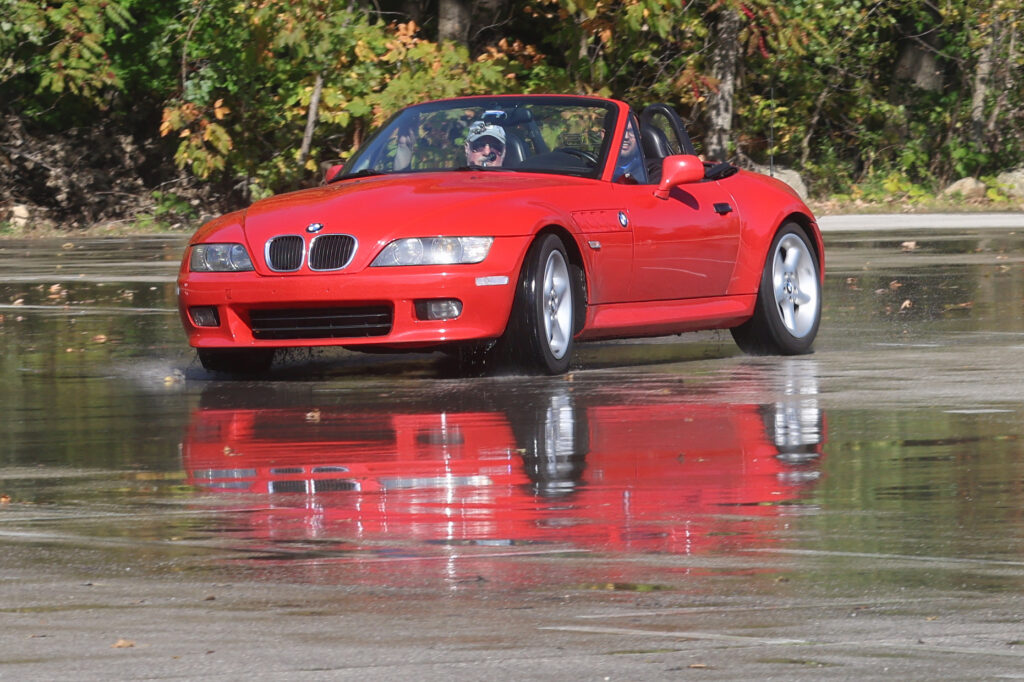
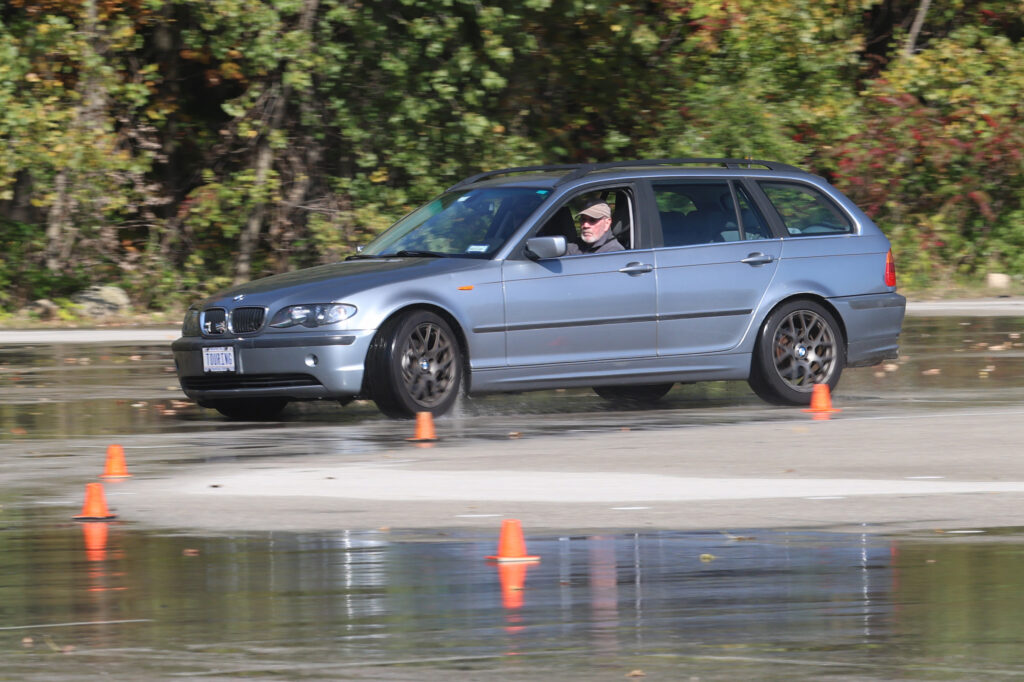
The skid pad is a circle described by cones, with a concentric outer circle perhaps twenty feet farther from the center than the inner one. The object is to drive the circle at increasing speeds, staying within that twenty-foot lane. Oh, and did I mention a spray truck that keeps the circle nice and wet? And if your car has traction control, it must be turned off.
Students quickly learned about traction limits—and how to recover from the resulting skid before it turned into a spin when those limits were reached. Speeds increased as did confidence—and grins.
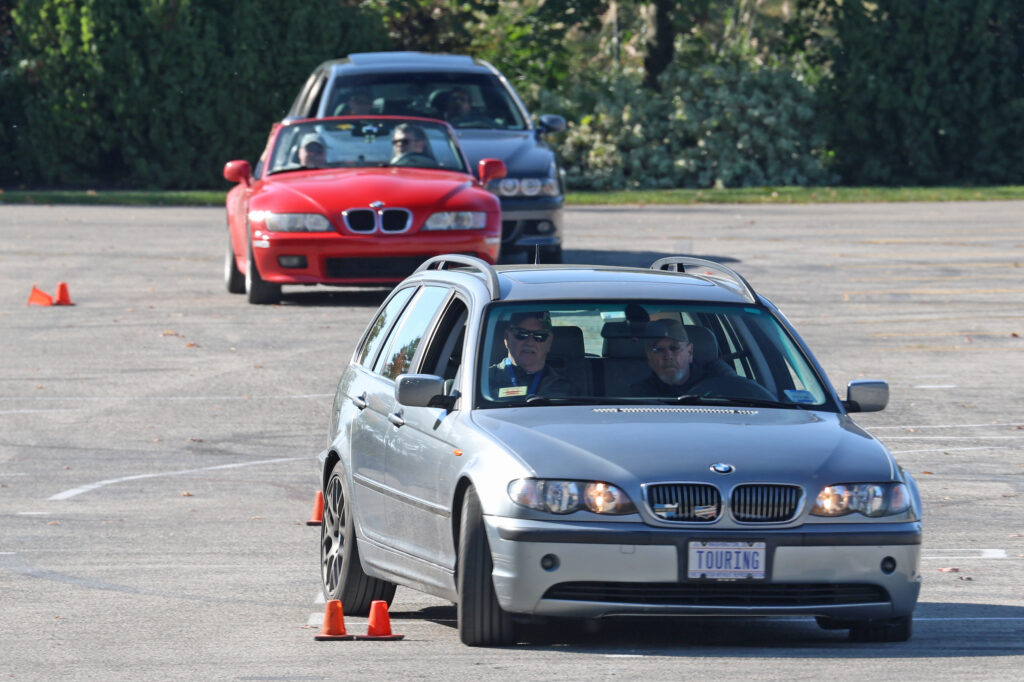
While one group was going in circles, the other was experiencing what amounts to a short low-speed autocross. With some tight turns and a multi-gate slalom, it was much like downhill skiing, but for cars. The object is to learn how your car reacts to sudden and repetitive sharp maneuvers; the lesson is designed to improve your ability to perform. For example, a quick right-to-left-back-to-right maneuver in order to avoid a car that’s suddenly backed out a driveway in front of you.
Hard braking is also a part of this session. In this exercise a student would accelerate to a typical street speed—35 to 40 mph—and on the instructor’s command drivers were to come to a quick stop as close as possible to—but before hitting—a stationary cone. Some students experienced the potentially unnerving rat-a-tat-tat of their cars’ ABS systems for the first time; they also unlearned what Driver’s Ed taught before the invention of ABS.
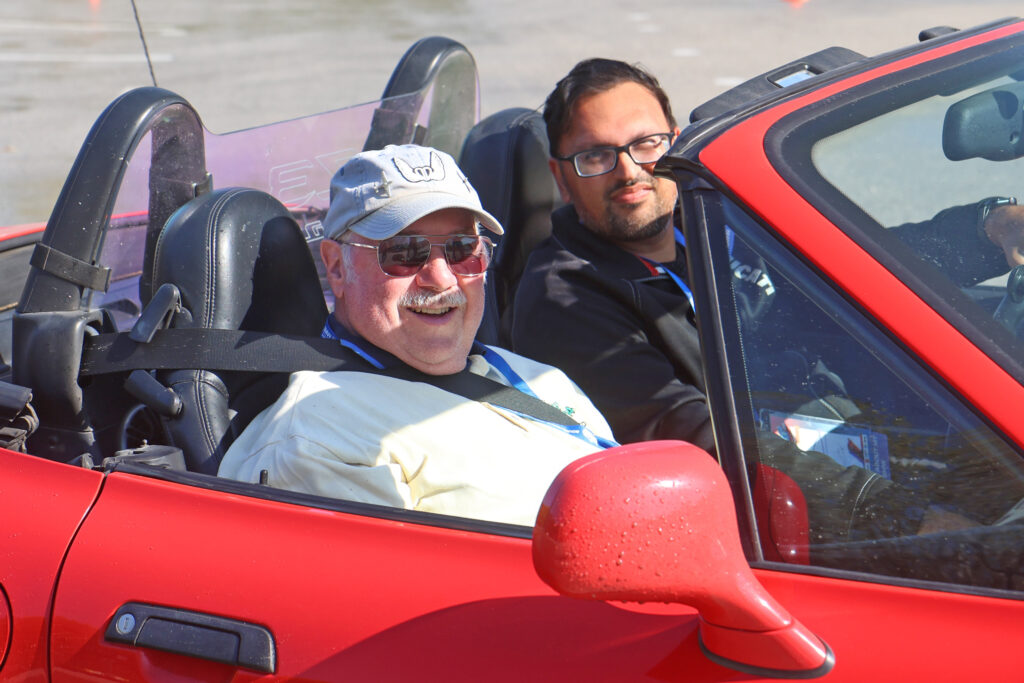
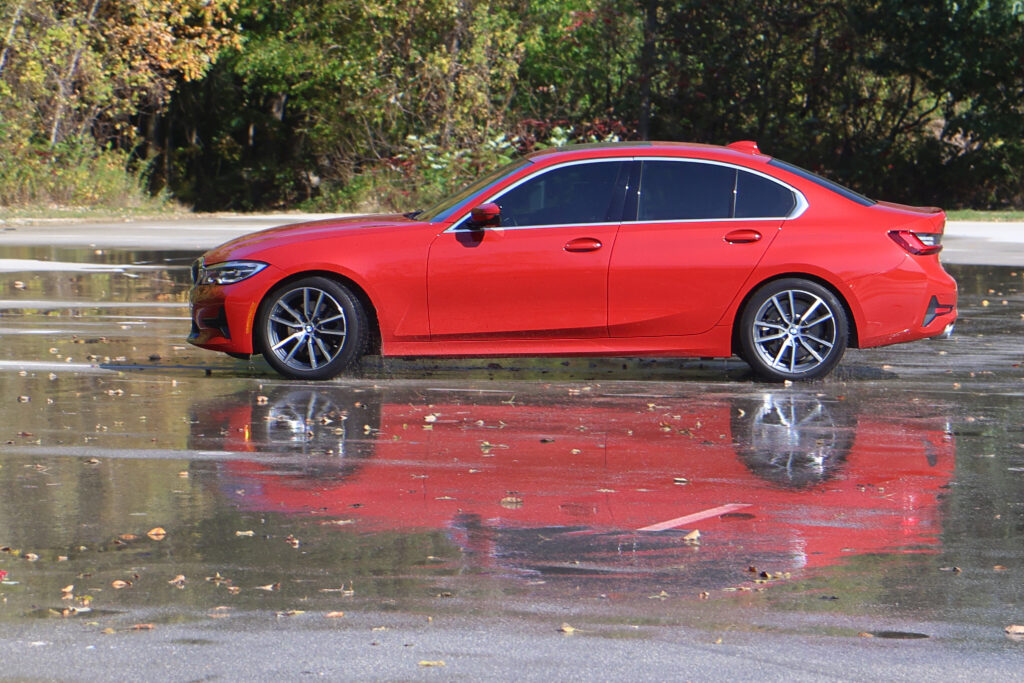
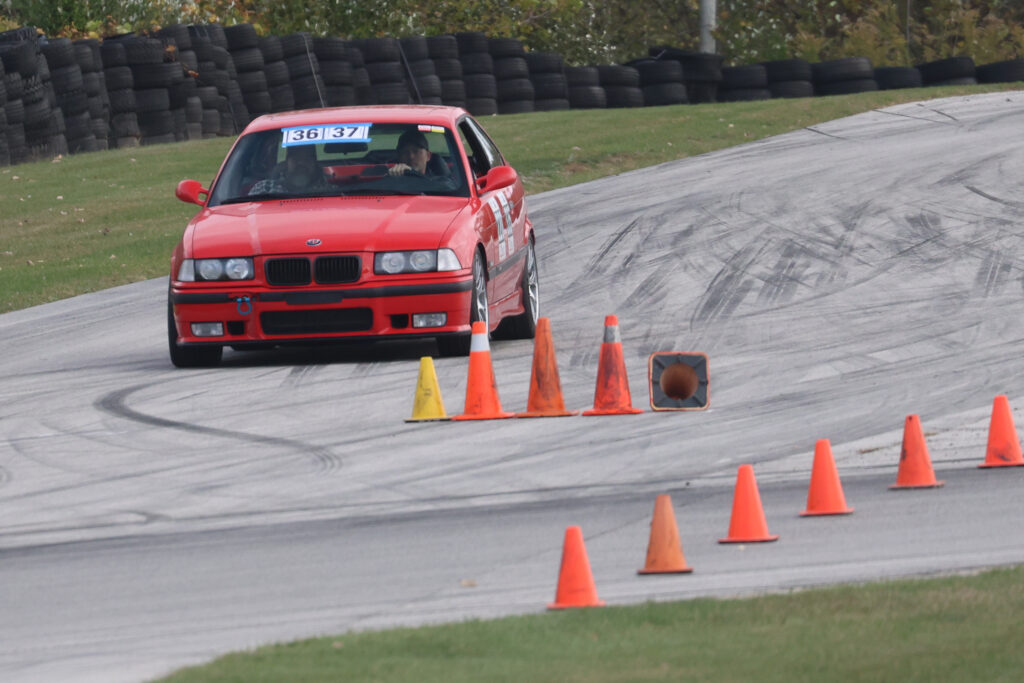
I had a chance to talk with two car-control-clinic participants, both from the Windy City Chapter. Wes Diggs normally drives a 7 Series, on the larger end of the BMW vehicle scale, and wanted a little more expertise in keeping it pointing straight ahead, especially during Chicago winters. He was driving a friend’s smaller BMW (a 3 Series, if I recall). “The clinic really helps me to define the handling boundaries of my car,” he told me, “in a nice, safe environment—not on Chicago streets.”
Not only was this Theresa Buck’s first car control clinic but her first O’Fest-style event—and her first BMW. She comes by Bimmerhood honestly; her grandparents had BMWs, and when, in her words, she “got her first Big Girl car,” it had to be a BMW. She’d been driving her new-to-her BMW since February, but she said that she hadn’t really driven it. “The Clinic was a chance to dip my toes into performance driving, since I’m driving a performance car,” she said. “I learned correct hand positioning on the steering wheel for maximum control, and how to make all changes—turns, braking, accelerating—smoothly. On the skid pad, I quickly learned the difference between oversteer and understeer, and what to do when visited by either. My day was well spent, and I’m a better driver for it.”
Buck added that she was looking forward to trying an autocross, and then perhaps a driving school. I think she’s hooked!
The post O’Fast 2025 | The Car Control Clinic Is Street Survival for Adults appeared first on BimmerLife.
]]>The post O’Fast 2025 | The Autocross Was a Blast appeared first on BimmerLife.
]]>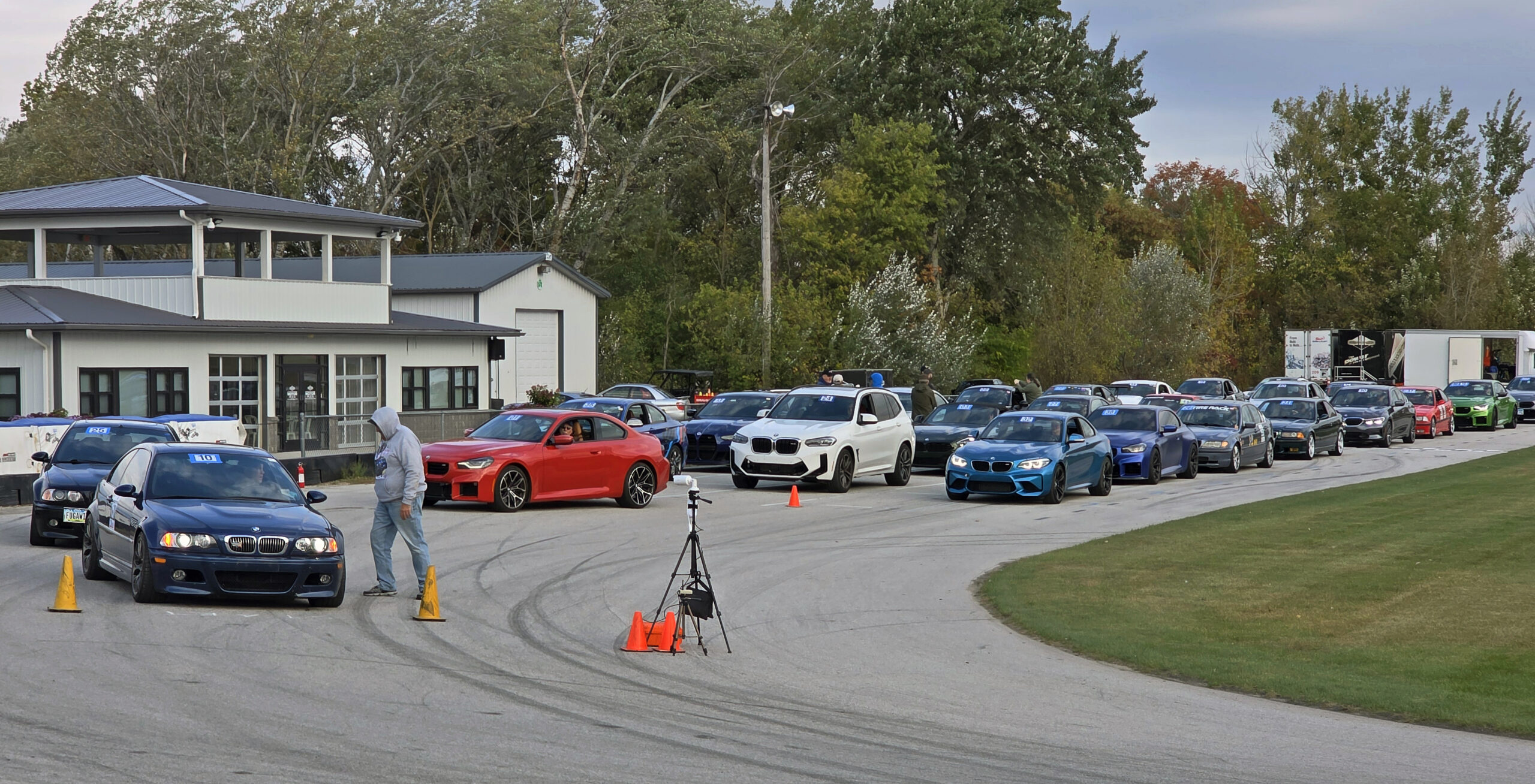
Photo: Jon vanWoerden
There were 36 entrants in the O’Fast autocross, most driving Munich products but also a couple of Stuttgart escapees—along with a big honkin’ Mustang. Sadly for me, there was not a single BMW 2002. If I didn’t leave mine at home, I would’ve been out there.
The course took advantage of Road America’s motorcycle/go-kart track. Since the pavement width catered to motorcycles or karts, this tight road course eliminated the need for the occasionally overwhelming traditional autocross venue: an empty expanse of asphalt peppered with seemingly random cones. That changed the normal autocross learning curve and worked to level the playing field, since there wasn’t a 400 cone course to learn in a football stadium parking lot. That let everyone get up to speed quickly and safely. As a result, there was not a single off-course incident during more than 350 autocross runs.
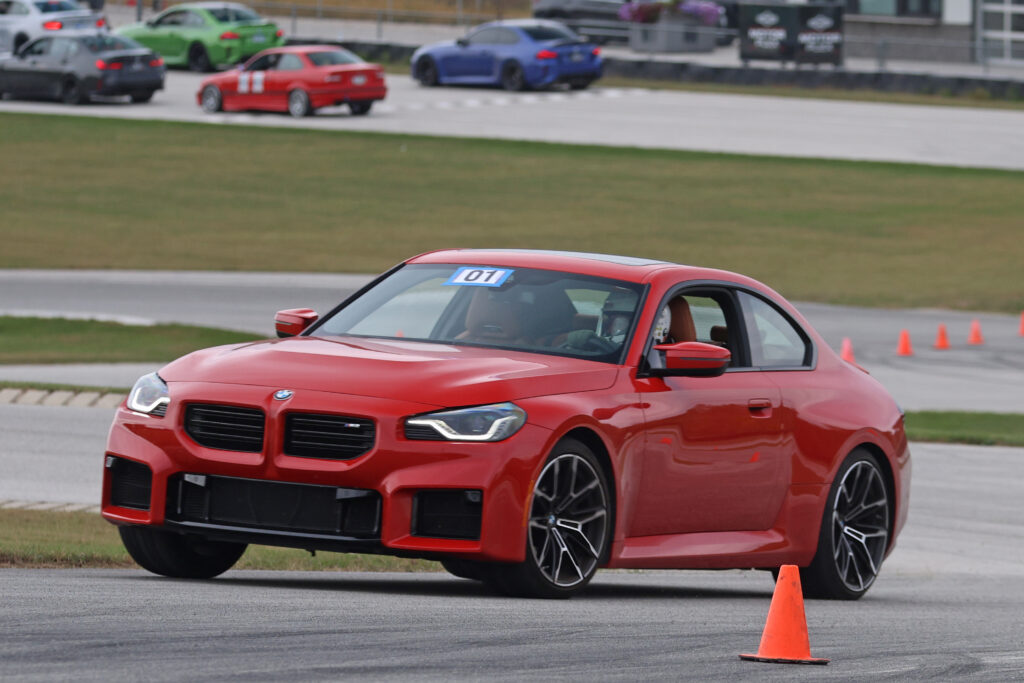
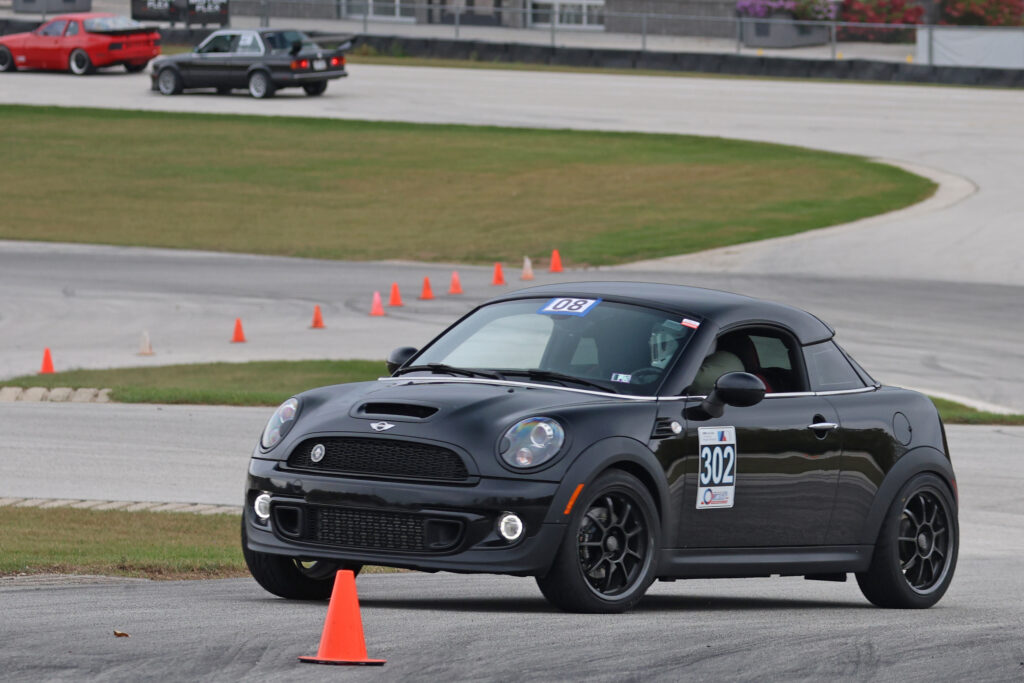
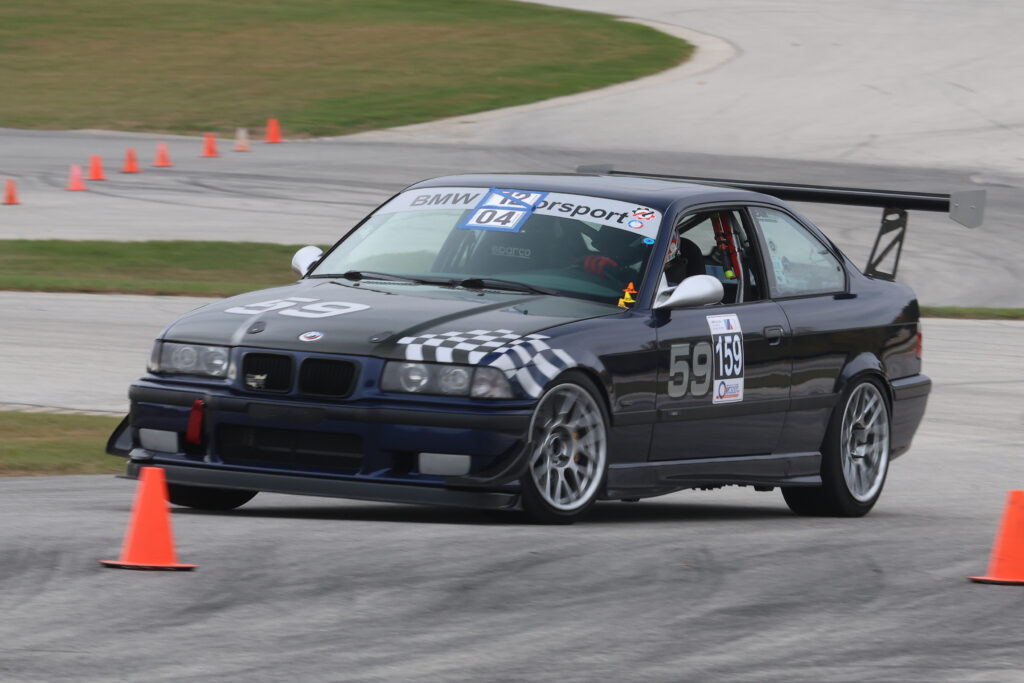
Steve Stephanian of the Los Angeles Chapter chaired the event. Stephanian and his crew laid out the course, while the Fox River Sports Car Club provided all the autocross essentials: cones, timing equipment, and volunteers. The finished design featured one sharp curve after another, with the only straight less than 200 yards long, ending at the finish line. This discouraged straightaway heroics to make up for lost time in the twisties.
Let’s take a run through all those curves. A rolling start—to preserve tire tread—led directly to an immediate sharp left, followed by a tight S curve, and then yet another S, this one shaped more like a horseshoe. A very short straight—measured in feet—ended with an unequal-length switchback and a second horseshoe. Midway through that second horseshoe, with the suspension partially unloaded, drivers reached the crest of the course’s ascending portion, and that unloaded suspension was now lightened even further in the transition to the downhill second half of the course.
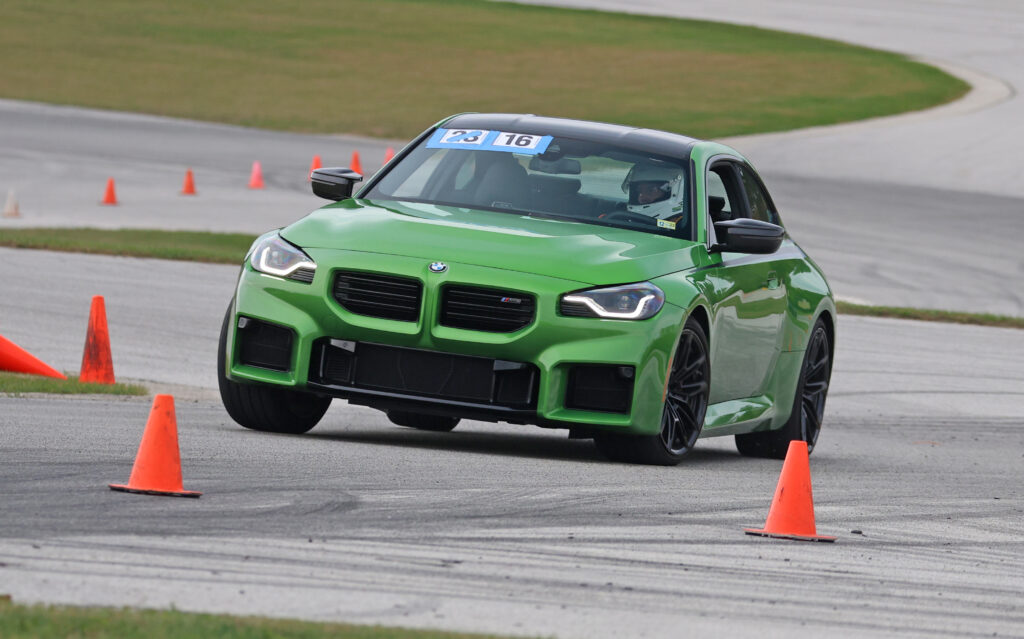
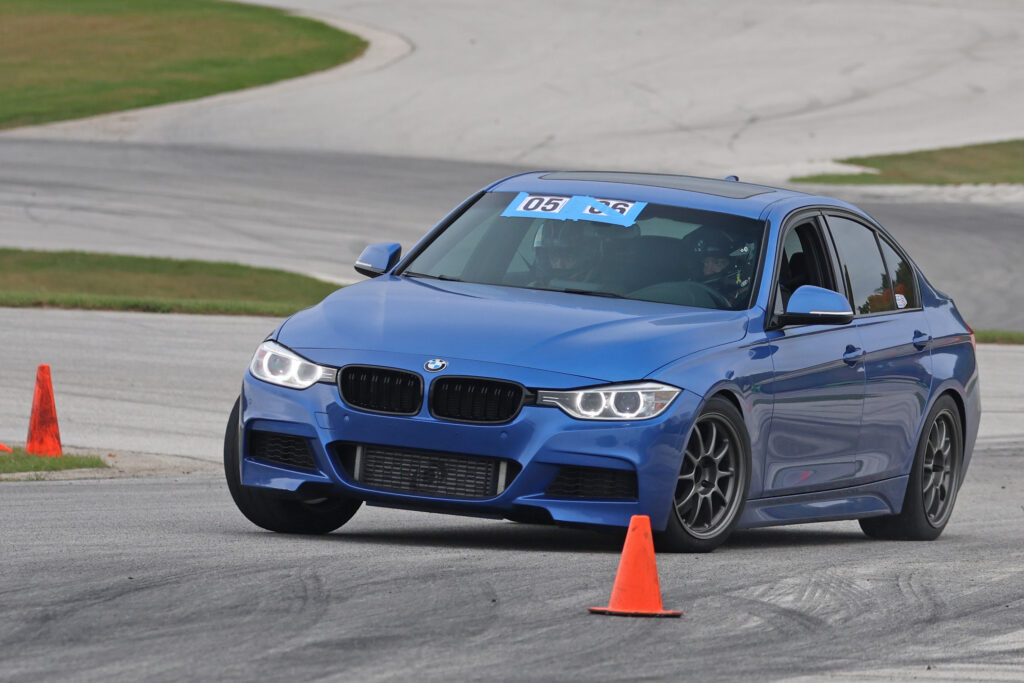
Next up was a left-to-right two-cone slalom; a cunningly placed cone might have lured a driver into thinking it was the horseshoe’s apex, but it wasn’t. After a panicked braking on the first (or even second) run to make it through those slalom gates without collecting cones (and penalties), the learning curve kicked in for most drivers, and they chose an earlier apex. Unfortunately—but of course deliberately designed—that right-hand exit was exactly the wrong way to approach the final wiggle: a sharp right-then-left. Now, at last, came a straight—with gravity providing more speed than really necessary, while a nice wide—but slightly offset gate—tempted the hot-shoes.
Drivers concentrating on the road twenty feet in front of the hood were then oblivious to the sharp right-hand finish gate; much rubber was sacrificed near this gate in a (usually) successful effort to avoid those ever-lurking cones.
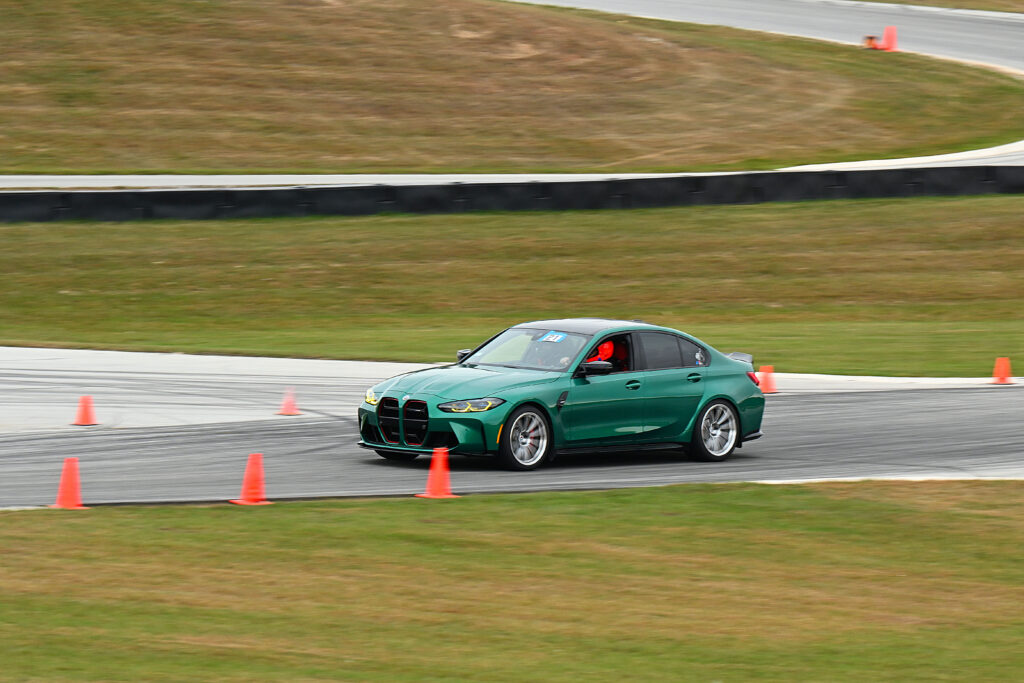

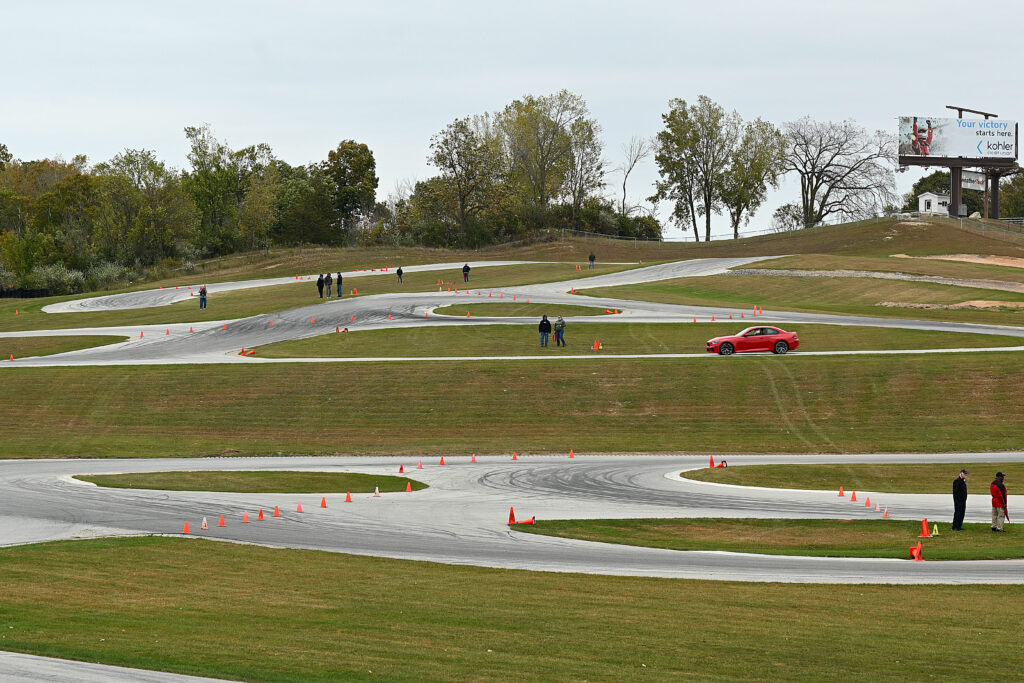
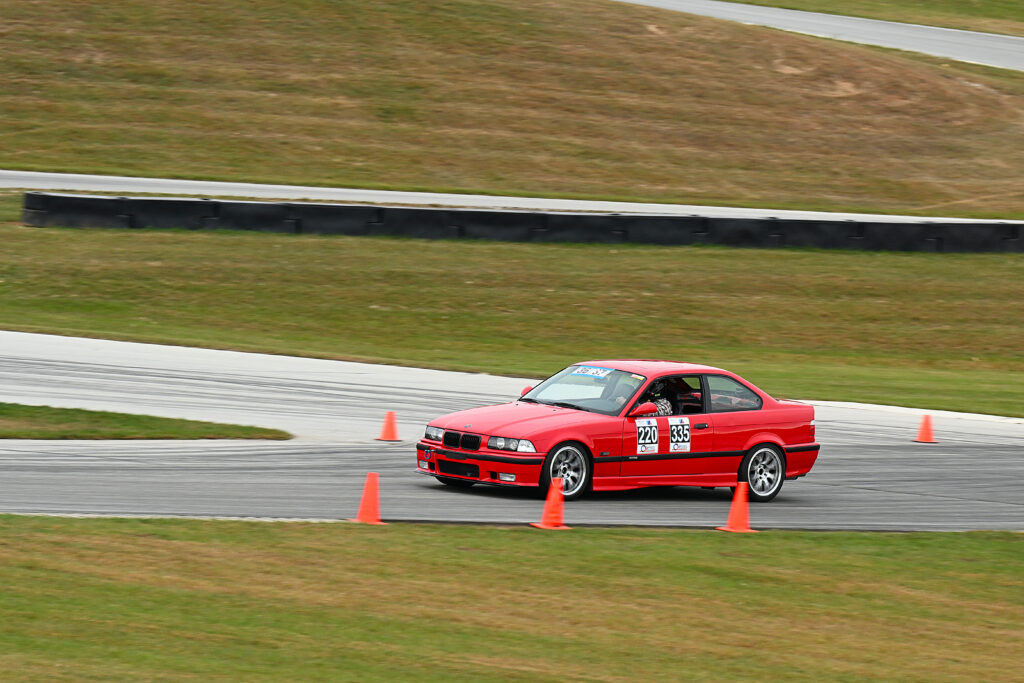
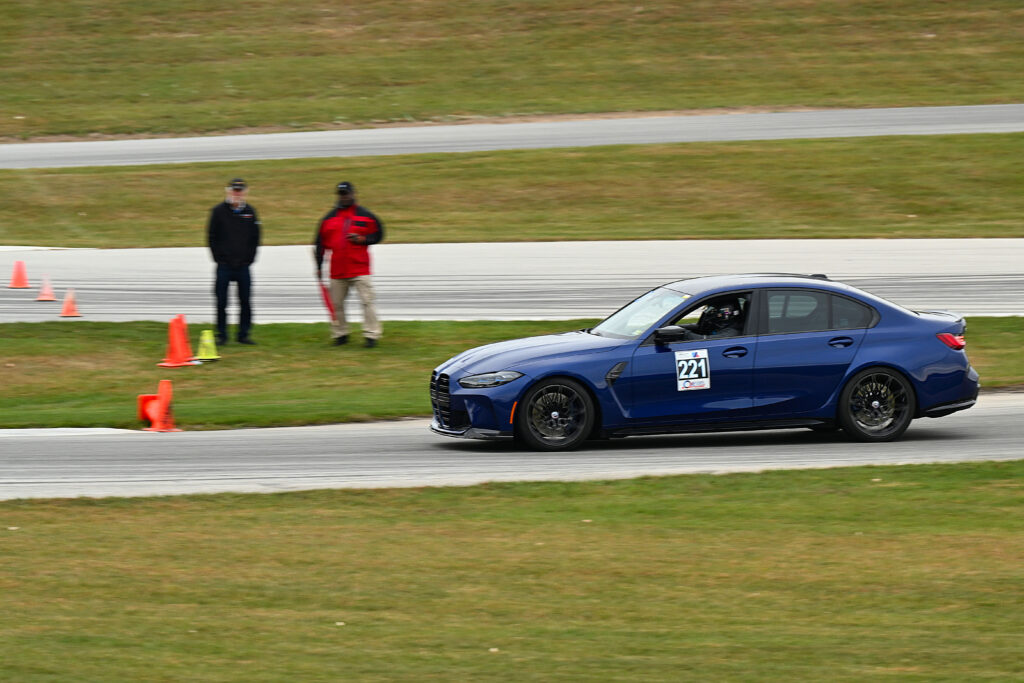
All of this maneuvering took less than a minute. A good time was in the mid-50-second range.
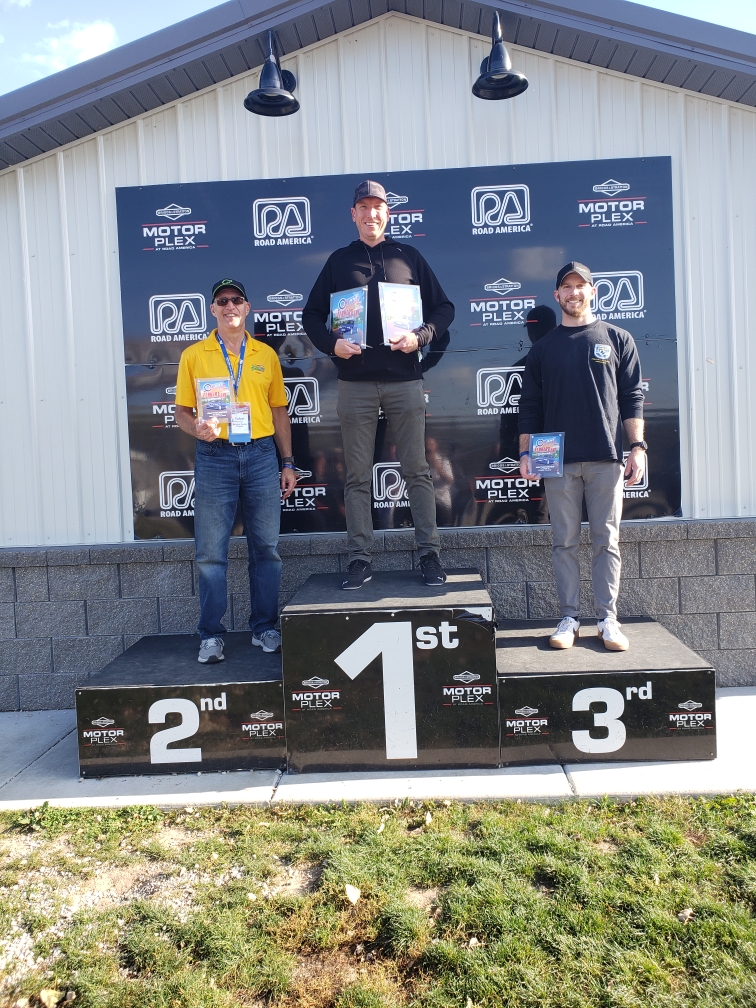
Eric Kersten of the Badger Bimmers chapter on top of the Class B podium, also holding the FTD trophy
With efficient staging and running, each of the 36 drivers had eleven opportunities to make that perfect run. After the (rubber) dust had settled, Eric Kersten not only won his Class B in his 2024 M2, he had the fastest time of day (FTD) with a best run of 51.638 seconds, leading second-place finisher Rafael Garces—also in Class B—in a year-newer M2 by less than a second.
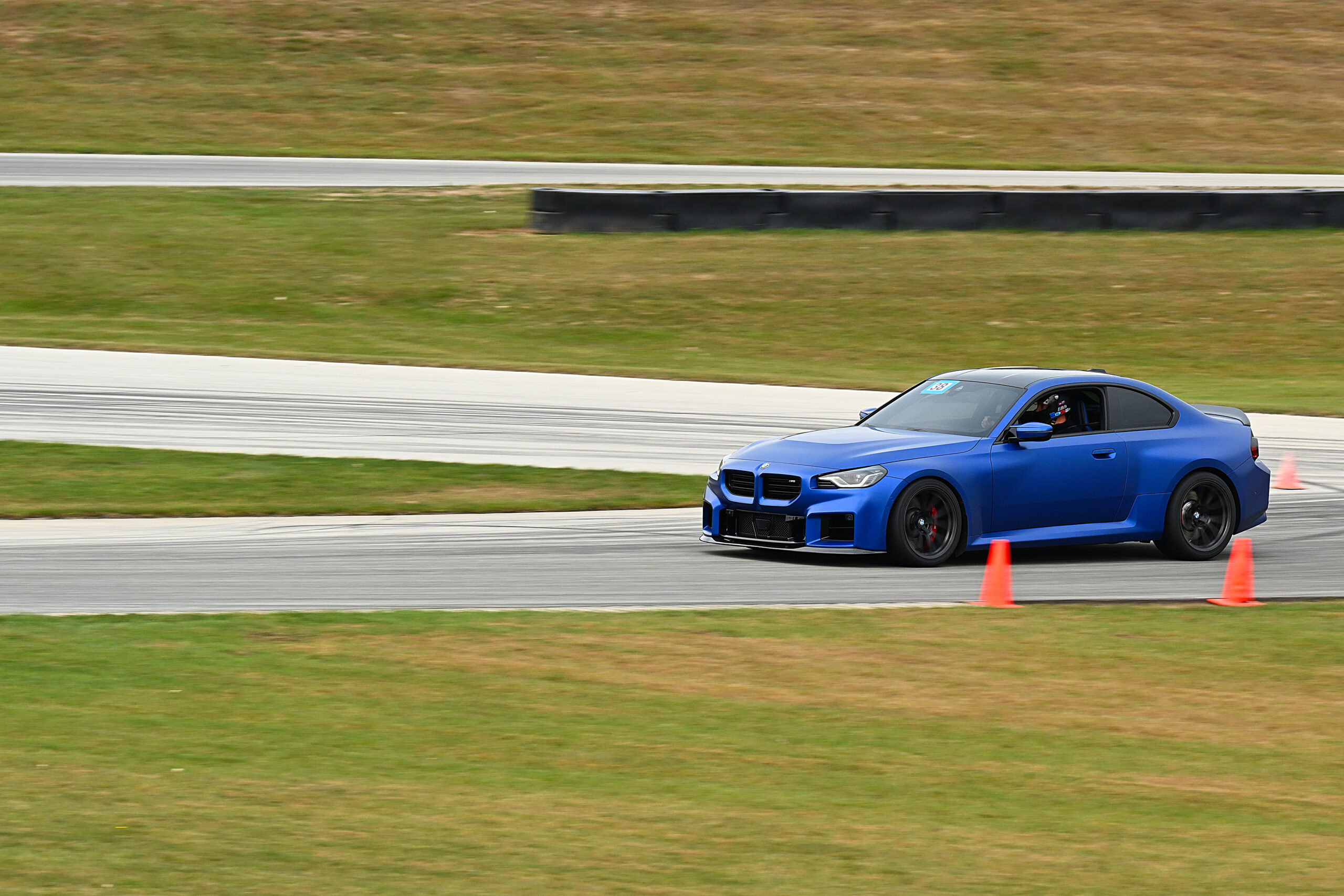
Kersten in his frozen blue M2 Photo: Richard Daugherty
Perennial hot-shoe Michael Washington led Class A, and was third overall driving his ’95 M3. Class A’s second-place finisher, Scott Smid, also drove a ’95 M3. Dimitar Stavrakov had the best time in Class C in his 2003 M3, followed by Matthew Scott, driving the same year and model BMW. The fastest driver in Class D was Chris Riester, who drove his 2003 330i Sport, followed by another perennial O’fest autocrosser, Mel Dillon, in his 2014 235i.
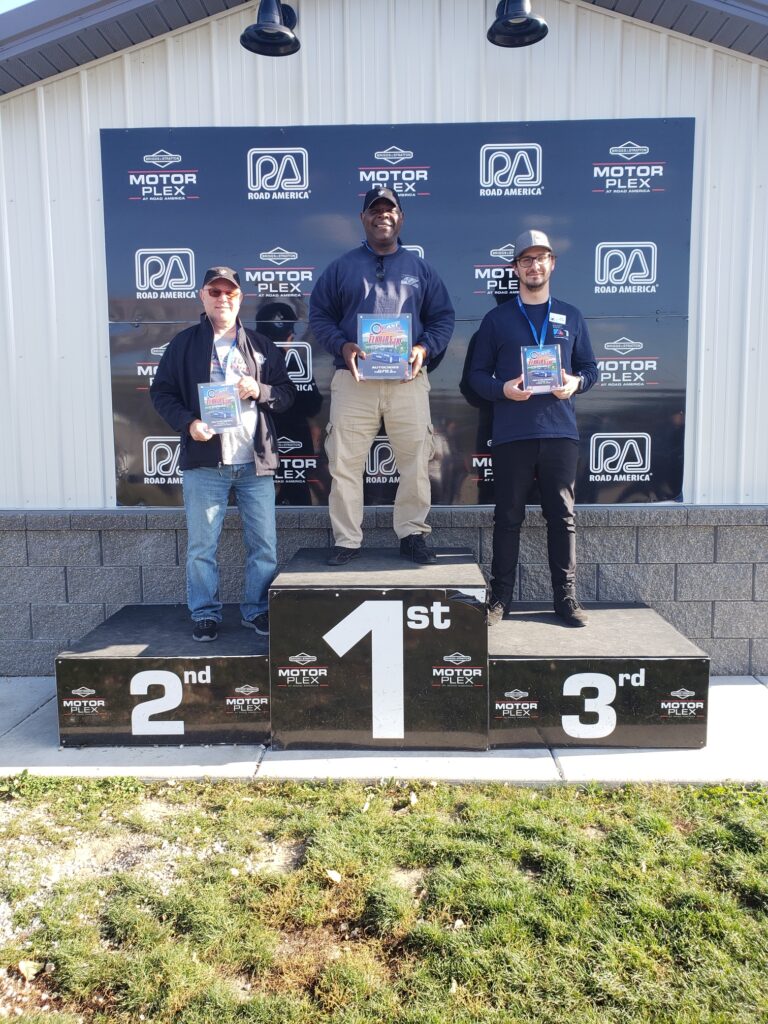
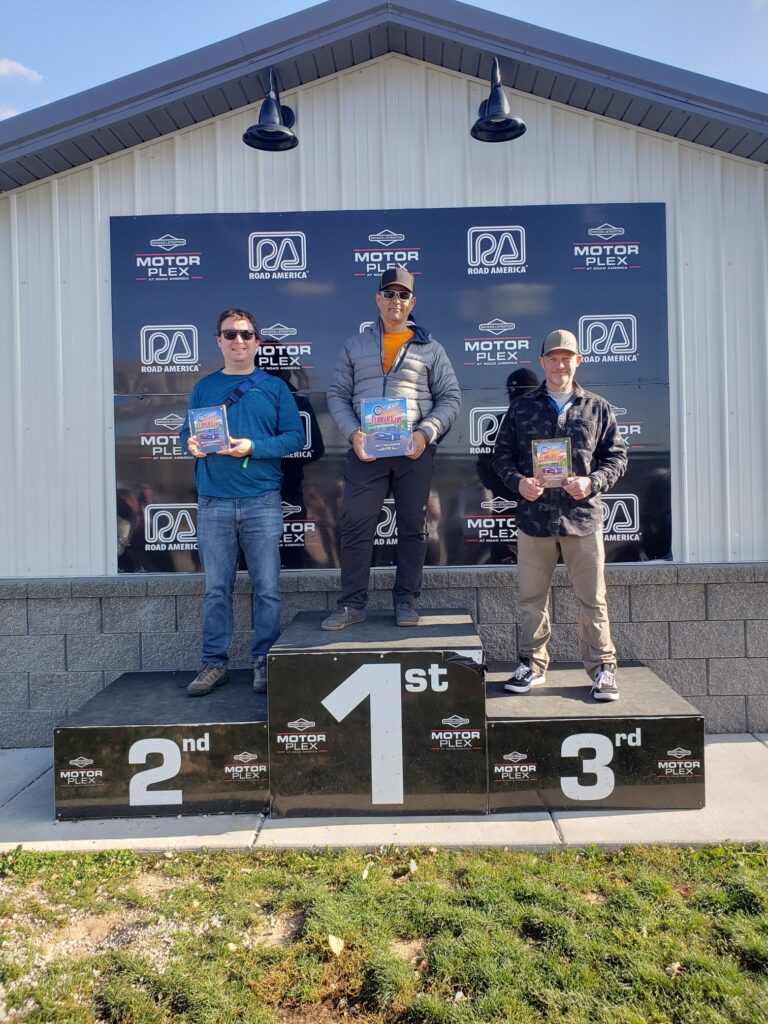
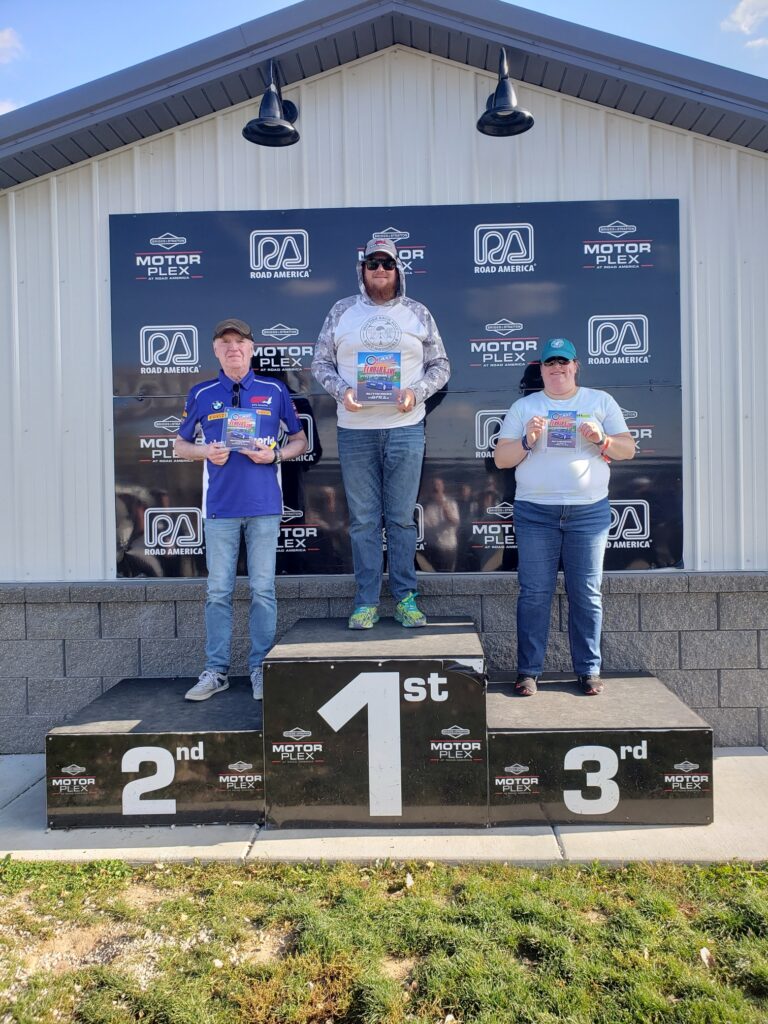
A 2014 328i was Dimitre Dimitrov’s weapon of choice, taking first in Class E, while Victor Garces was less than two seconds back in his 2024 2 Series Gran Coupé. Richard Daugherty wheeled his ’23 X3—not generally thought of as an autocross vehicle—around the course quickly enough to win Class F ahead of Richard Daugherty’s xDrive 330i.
Finally, in Class X—for non-BMW rides—Brian Tippens drove his Hyundai Ioniq to a class win, beating the two Porsches and the Mustang, much to the surprise of everyone except perhaps the owner. Even more surprising, he was fourth overall (!) for the day, just 2.1 seconds off the winning FTD. Apparently, all that electric-motor torque—and Tippens’s driving skill, of course—overcame the weight from the Hyundai’s batteries.
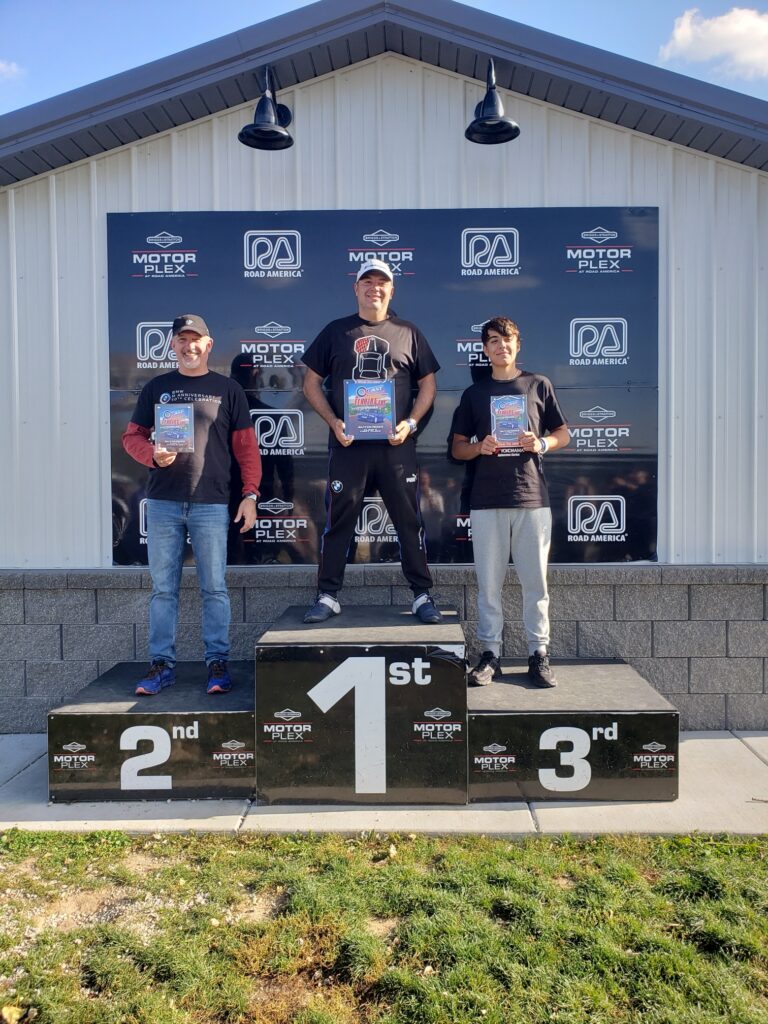
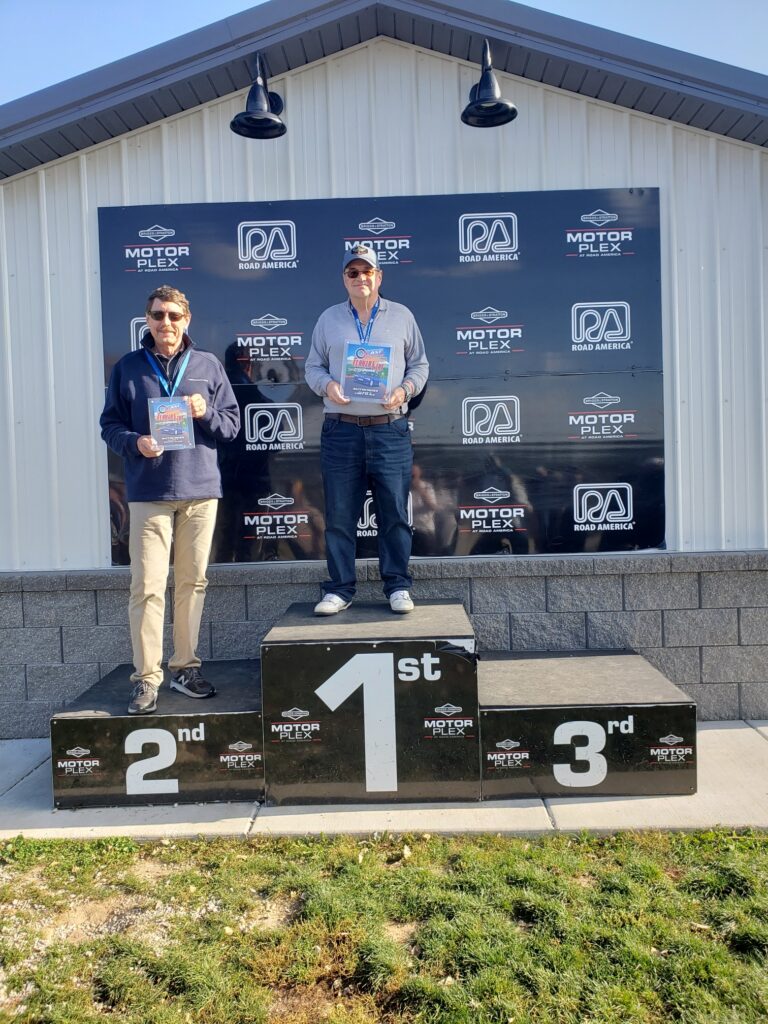
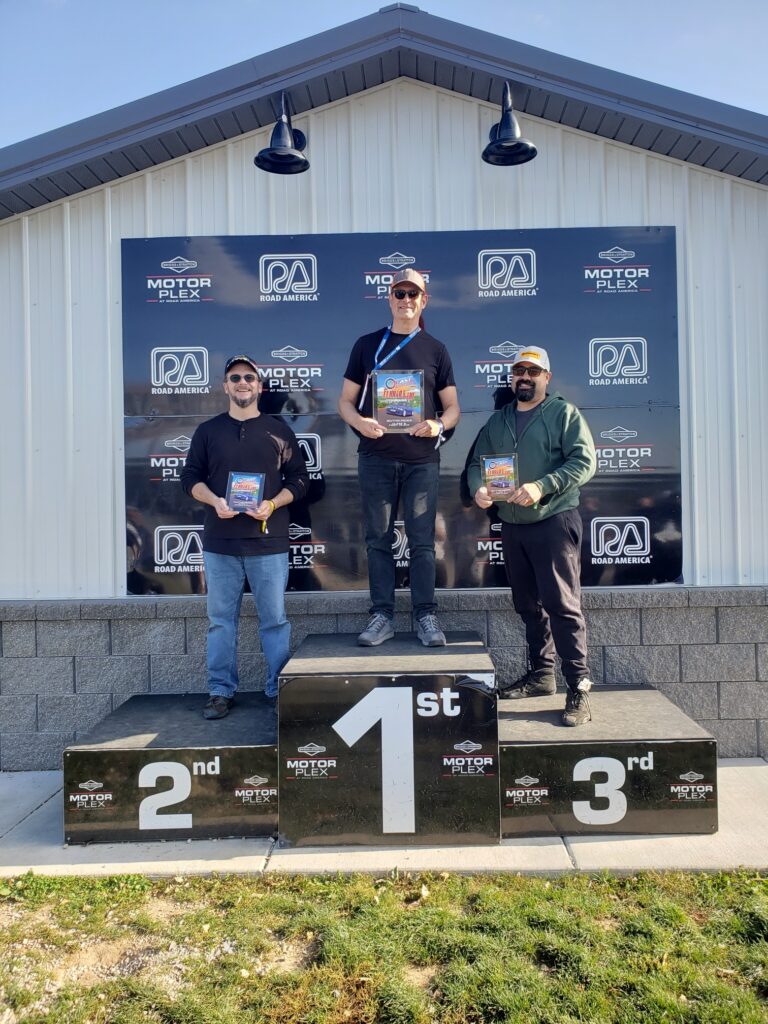
As always, the autocross did what it does best and gave entrants of all skill levels the opportunity to find the limits of their car in a safe, controlled setting. The only problem is that once you start autocrossing, it can be become addictive. Not a problem, of course, just make sure to increase that tire budget.
Top Photo: Jon vanWoerden
The post O’Fast 2025 | The Autocross Was a Blast appeared first on BimmerLife.
]]>