The post Four Quick Things You Learn After Driving the M8 Competition Gran Coupe appeared first on BimmerLife.
]]>I recently spent a week with a 2025 Gran Coupe, ironically right around the same time BMW stopped building them. I wish it was sticking around.
There’s No Better Way To Cover Miles
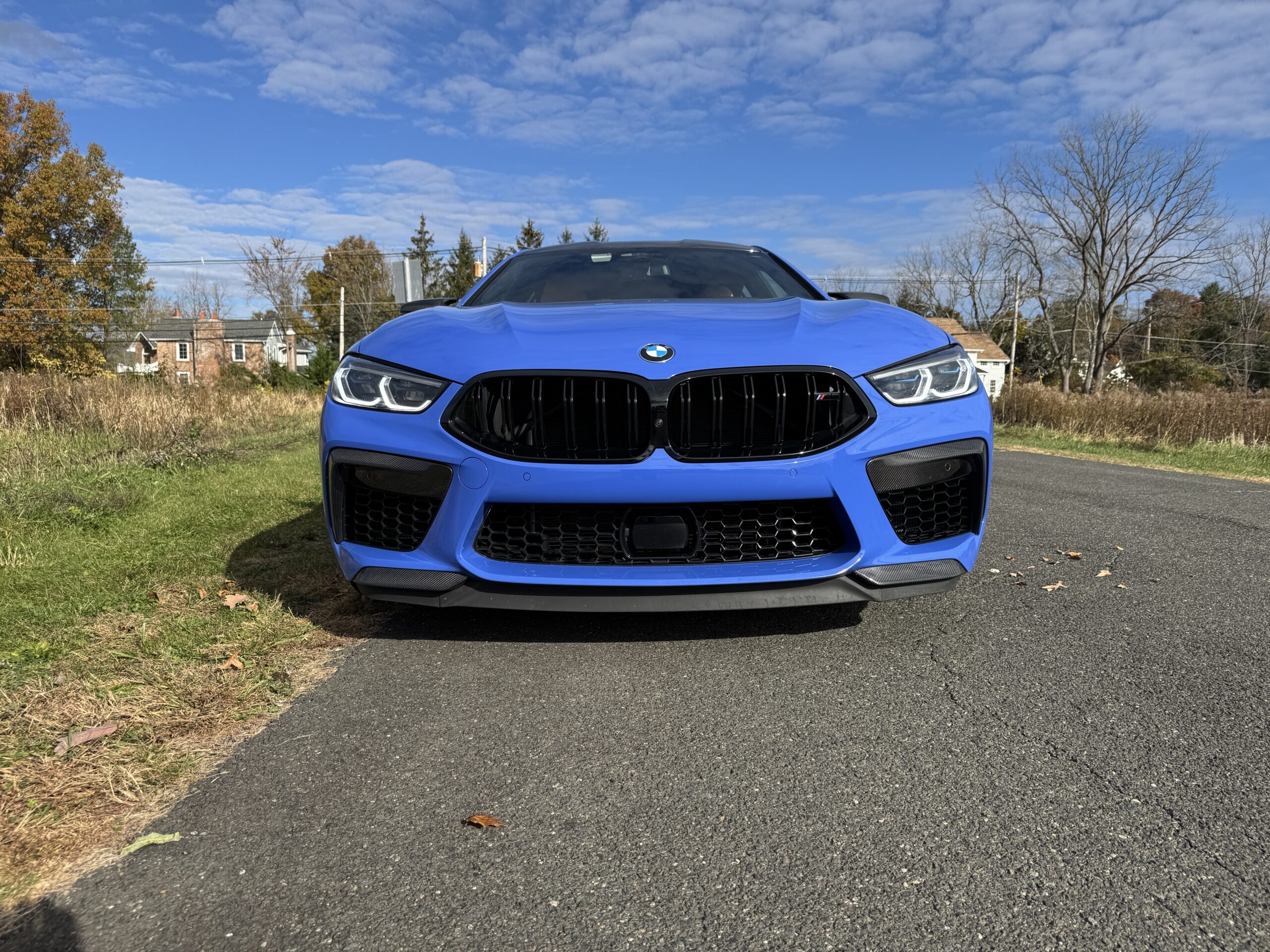
Photo: Travis Okulski
The M8 GC is a simply phenomenal grand tourer. I’ve driven a few of these now on longer trips, and there aren’t many cars that have the ability to sit comfortably and quietly at 80 mph for hours, but then take a quick back road detour and become engaging and fun, a serious sports car.
Before this most recent time with a GC, I drove one from Los Angeles to Monterey in 2024 for Monterey Car Week. Most of that time was spent on the 101, a six-hour straight-shot up the coast (normally I’d take a detour onto 33 or spend most of the drive on the Pacific Coast Highway, but I had to be in Monterey at a certain time and the PCH was close from rock slides).
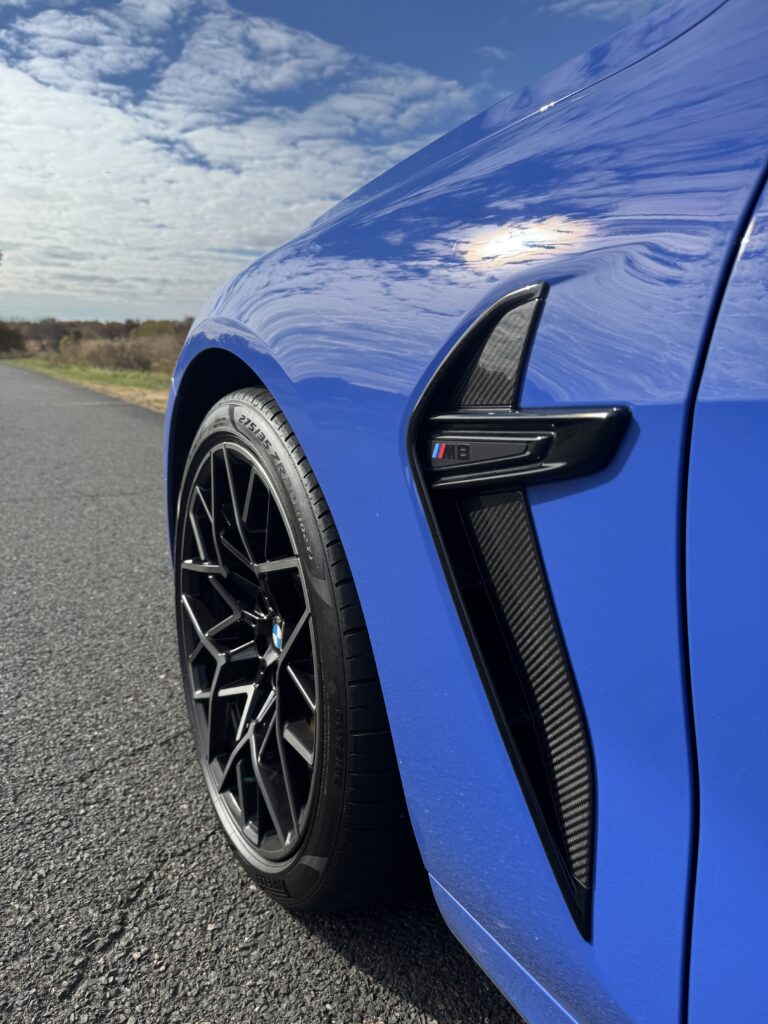
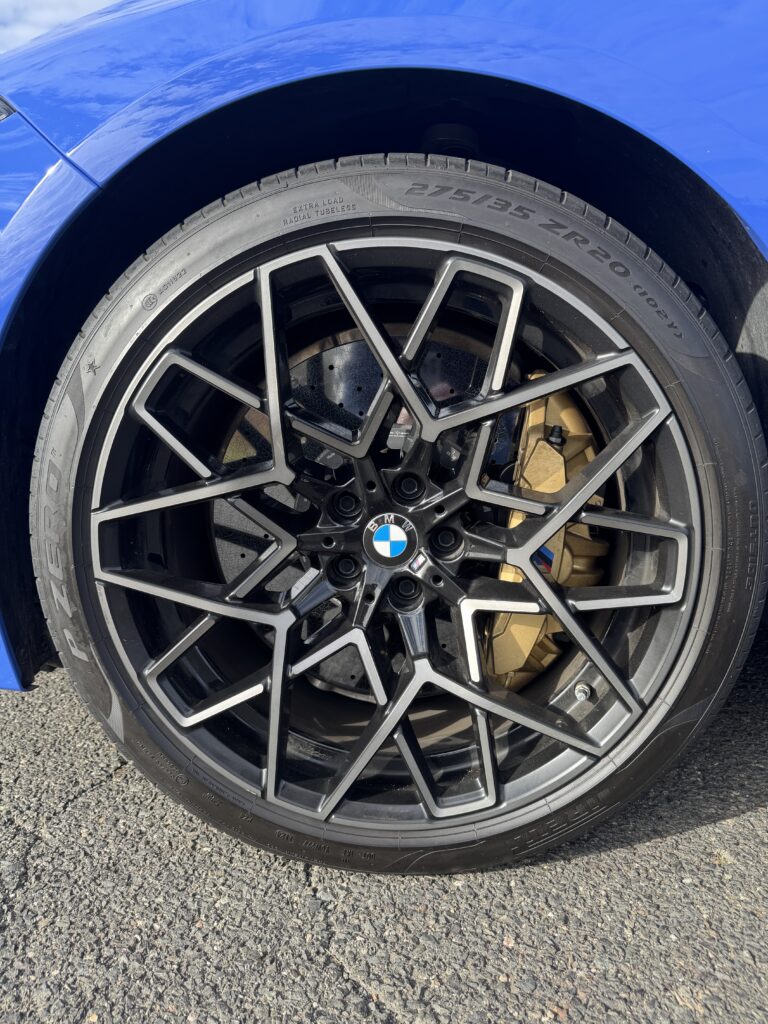
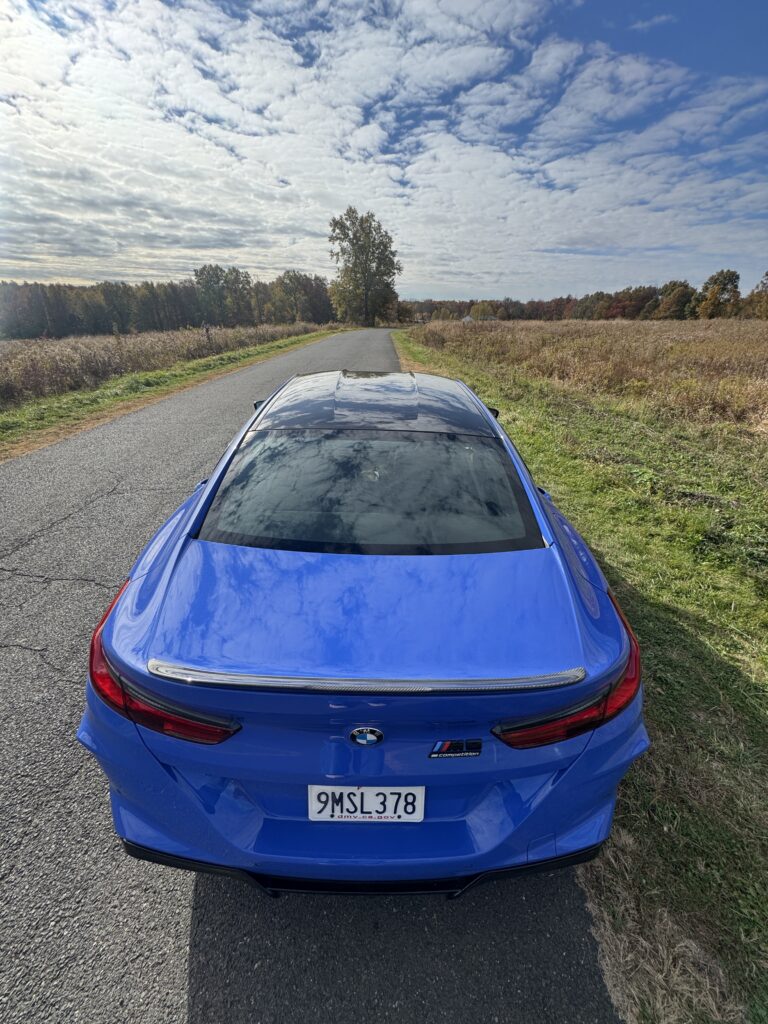
The M8 made record time, the only weak link was me, since I had to stop for food. It didn’t drink too much fuel, it wasn’t overly harsh or loud, it just did its job, and perfectly. And it really doesn’t hurt that the M8 has 617 hp from its 4.4-liter twin-turbo V-8, enough to cover any gap in traffic.
That Engine
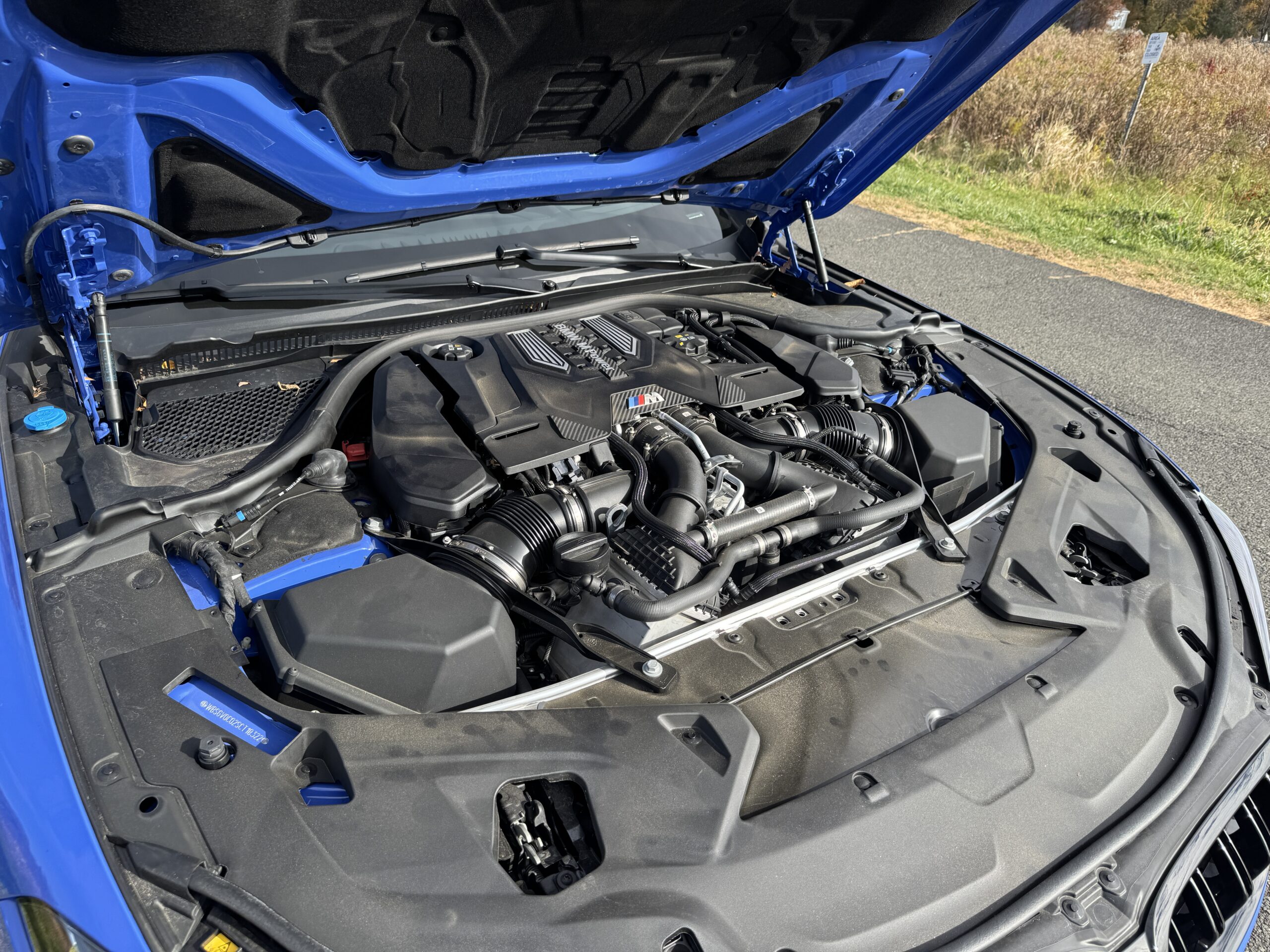
Photo: Travis Okulski
Speaking of the engine, that thing is a masterpiece. Sure, it’s in multiple products—from the X5 M to the current M5, now hybridized, of course—but that doesn’t make it any less special here. I’m not sure I can emphasize enough just how fast this thing is. It really doesn’t need more power, 617 hp and 553 lb-ft of torque is a ton, and the way the M8 pulls without really a hint of turbolag is hugely impressive.
It sounds great on startup, an excellent burble, yet it’s refined and quiet around town. At speed, I know some of the noise is synthetic, but I don’t care that much, it sounds great.
But really, this is one of the all-time great turbocharged engines. The immediacy of the response, the tractable power, the outrageous acceleration, all of it adds up to be the secret sauce of this special car.
It’s Delightfully Uncomplicated, Somehow
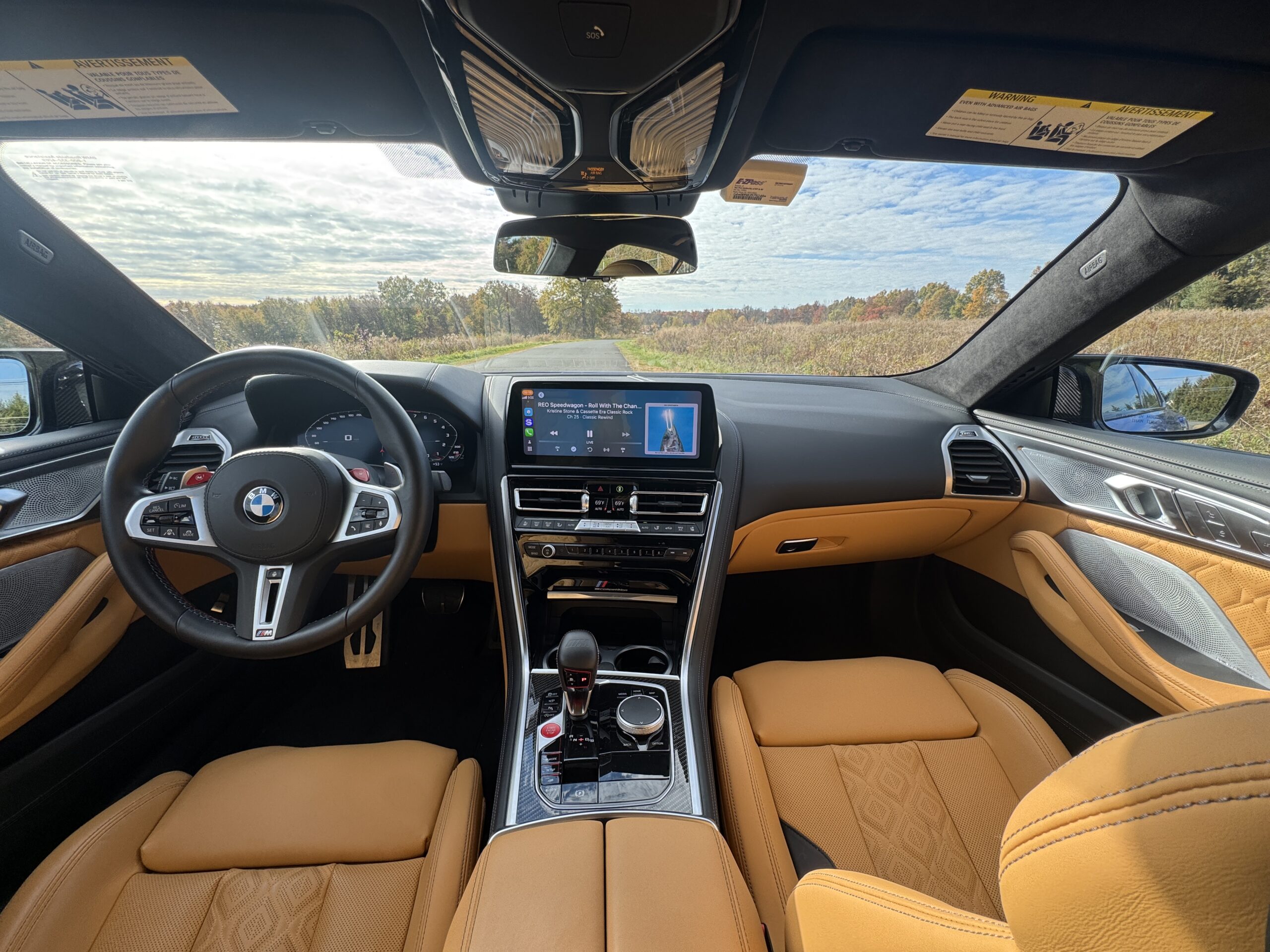
Photo: Travis Okulski
Now, I’m not going to claim this is a simple car. The M8 has multi-mode four-wheel drive, about 85 settings for shift speed, chassis, traction, and more, and a number of drive modes and safety settings, yet compared to the new M5, it seems like it’s from a different era.
I know the trope is that the last BMW is always better than the new BMW, and when that last BMW was new, it was worse than the car that came before it, but that’s not what I’m claiming here. The M8 and the F90 M5 were basically the same car with different bodies. The G90 M5 is totally different, a fully hybridized car where tech takes center stage. In that context, the M8 feels old school.
It’s lighter and has an interior with buttons and dials. You don’t have to work the climate control or shift speeds through iDrive. It actually might be nearly as complex in terms of setup and modes, but the ways to access them are simpler in the M8, and I appreciate that.
It’s Sad To See It Go
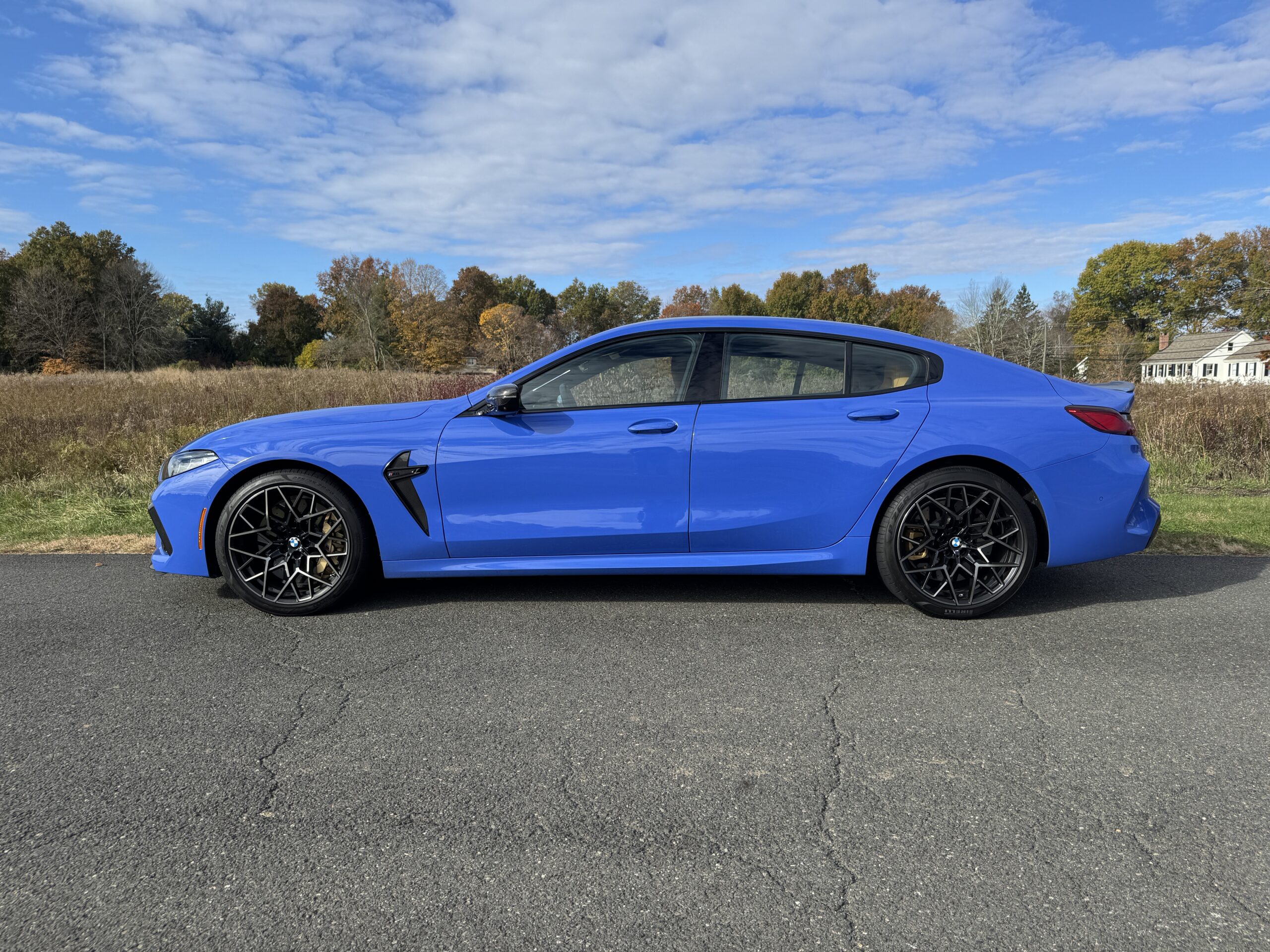
Photo: Travis Okulski
It’s definitely sad to see the M8 leave. BMW’s bigger coupes have been a calling card of the company for nearly its entire history. From the CS to the 6 and 8 Series, then the more modern versions in the early Aughts, these cars have been part of the brand’s fabric like the 3 Series.
Now, there won’t be one anymore. And yes, I understand that I’m lamenting the loss of a coupe after driving the four-door version, but it still rings true. It’ll also be sad to lose the Gran Coupe, which took the 5 Series and made it sleeker, lower, and more elegant. I’ve always loved the way these cars look, the extra length of the four-door really accentuating the cut roofline and near liftback proportions.
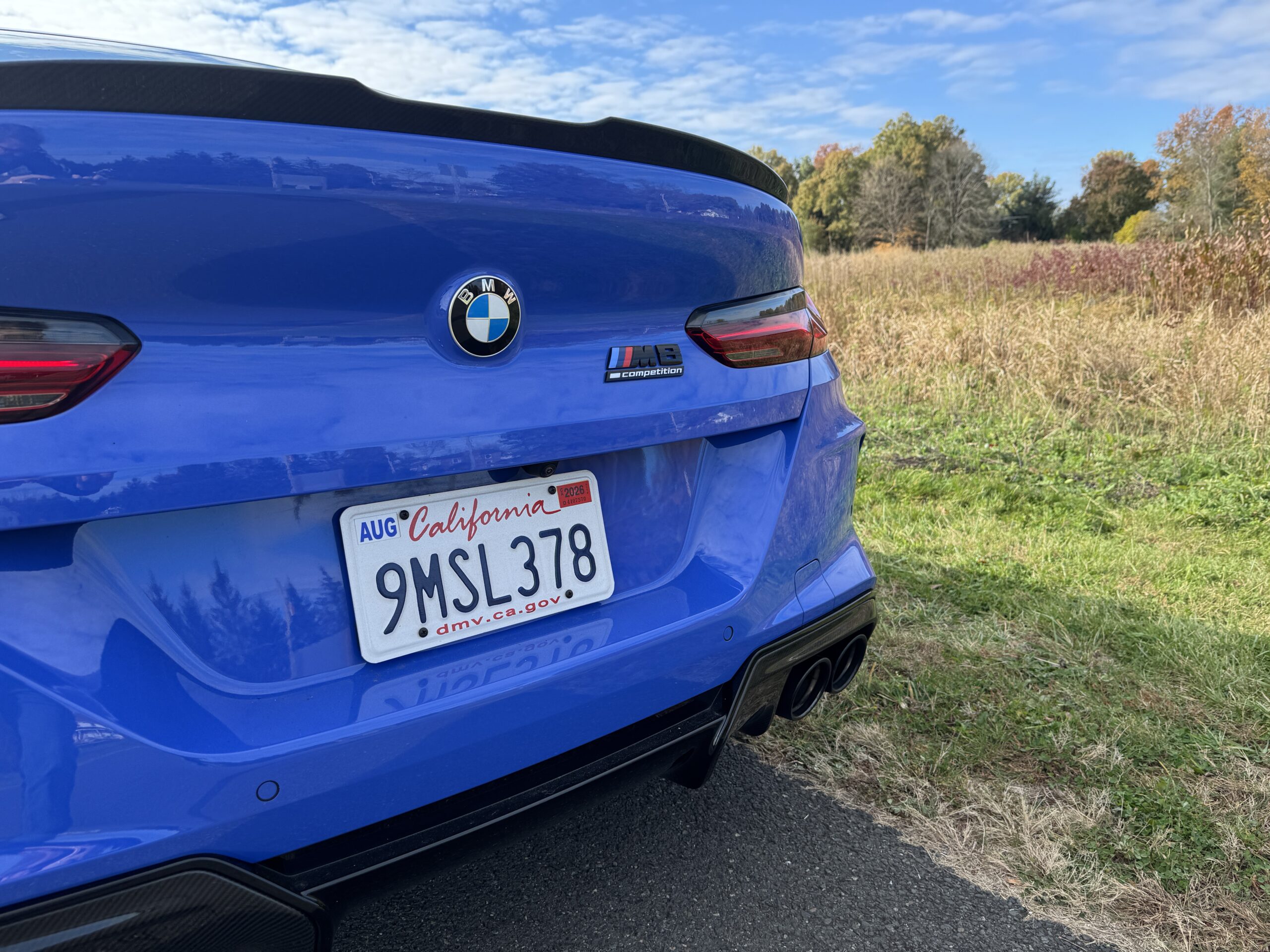
Photo: Travis Okulski
Here’s to hoping BMW brings back a new full-size coupe soon, even if it adopts the complicated underpinnings of the M5.
The post Four Quick Things You Learn After Driving the M8 Competition Gran Coupe appeared first on BimmerLife.
]]>The post 2027 BMW iX3 50: First Drive appeared first on BimmerLife.
]]>Rarely, something more significant comes along. For BMW, the new iX3 is its most significant car in a very long time. This is the first realization of the long-teased, long-hyped Neue Klasse platform. Well, the neue Neue Klasse, anyway, a name not applied to a new BMW platform since the early Sixties. BMW has literally been telling the world for years that this car is a massive step forward for the brand. After wheeling one around the stunning scenery in Málaga, Spain, I’m inclined to agree.
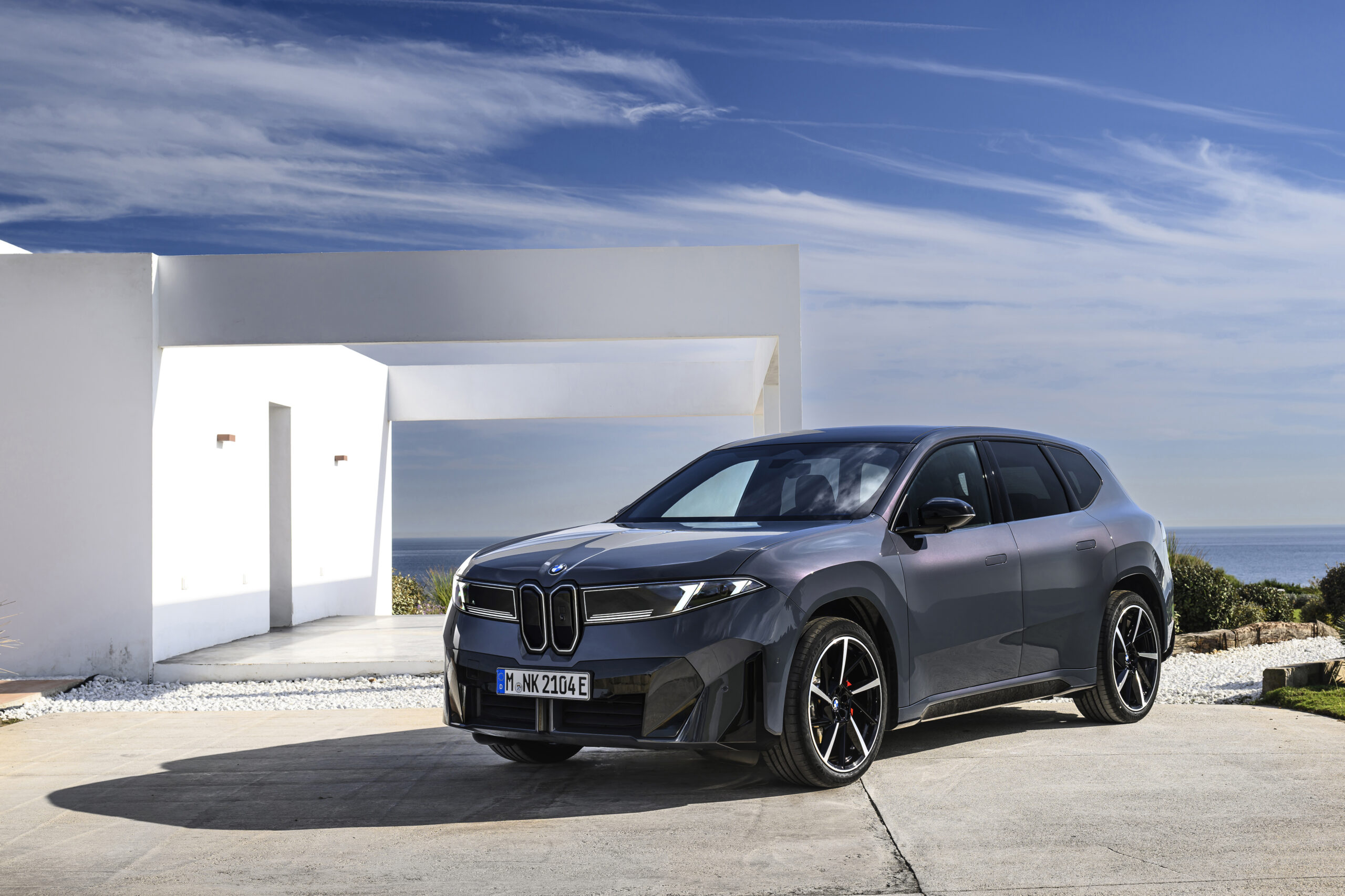
Photo: BMW
Pack Attack
While most of BMW’s previous EV efforts have rolled atop some variation of the company’s Cluster Architecture platforms, which do double-duty for internal combustion and electrification, the iX3 is the first of this new generation of EV-centric BMWs.
That means a massive change to the fundamental chassis design, wholly built around a 108.7-kilowatt-hour battery pack. That net capacity is similar to what was seen on the iX and i7, but it uses a new cylindrical cell design and chemistry to deliver far more capacity in a smaller size.
The iX3 uses a cell-to-pack architecture, a change from the former modular designs used in BMW’s EVs. All EV batteries are made up of hundreds or thousands of individual cells, often grouped together into replaceable modules. Those modules are then brought together to form the battery pack itself.
This battery design does away with the modules, effectively gluing all 188 cells together to form one big battery. The absence of those removable modules does eliminate repairability, but in exchange, you get lighter weight, greater energy density, and lower cost. It’s a trade-off that many EV manufacturers opt for in pursuit of EVs with higher ranges and lower prices.
That new pack pairs with revised designs for the other key EV components, like motors and inverters. The iX3 has two motors, a synchronous electrically excited unit at the back and a simpler, asynchronous motor up front. Since neither relies on permanent magnets, reliance on rare-earth metals is reduced. The iX3 can also coast—or sail—without regen, though a one-pedal mode is available. Combined power output is 463 horsepower and 476 pound-feet of torque sent to all four wheels.
Current runs through new, far more efficient silicon-carbide inverters, helping this thing do somewhere around 400 miles on a charge. That’s a significant boost from the (admittedly larger) iX’s 364 miles, from a larger, 113.4-kWh battery. The iX3’s new architecture also delivers a higher maximum charging rate of 400 kW, current that comes in through BMW’s first use of a NACS port, the plug popularized by Tesla and used by that company’s Supercharger network. Find yourself a charger with enough juice, and you can pick up an 80 percent charge in 21 minutes.
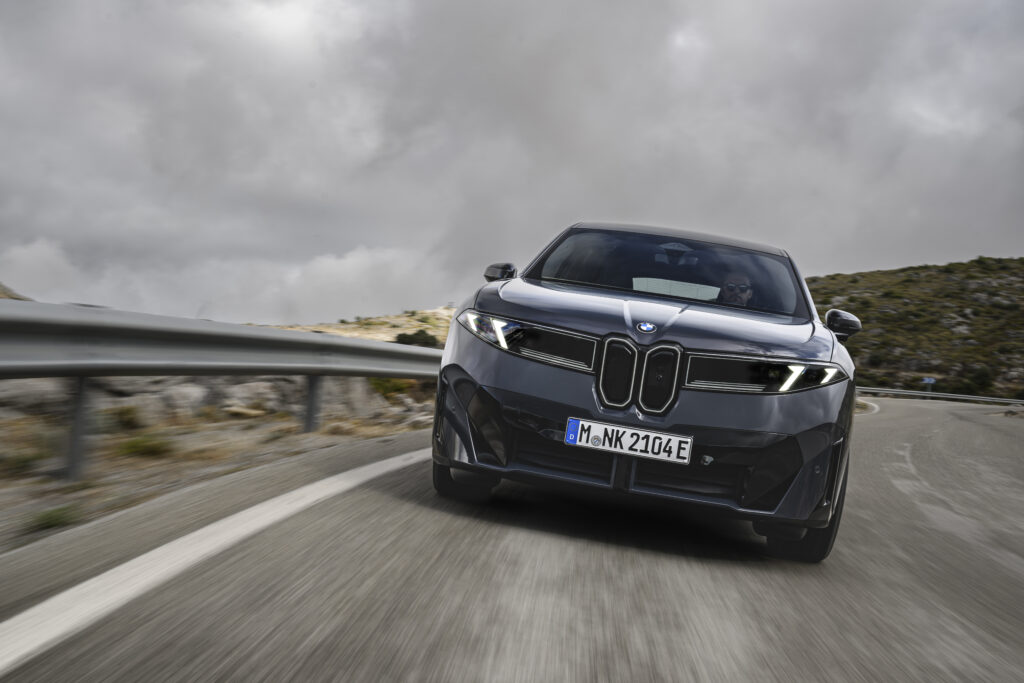


I covered nearly 100 miles behind the wheel of an iX3. They were not easy miles. I climbed up and over mountains as I crisscrossed my way through the stunning Sierra Crestellina National Park in southern Spain, doing so with the A/C on and with plenty of time in Sport mode. I did all that on 30 percent of a full charge, for an average consumption just short of three miles per kWh and a theoretical maximum range of about 325 miles. That means you can get big miles even driving like a hoon, and I’d expect BMW’s 400-mile estimate in more moderate driving to be perfectly achievable.
And driving like a hoon is something you’ll actually want to do. While the base X3 can be underwhelming dynamically, the iX3 is surprisingly rewarding. The car I drove had the M Sport package, but that only comes with up-sized 21-inch wheels; otherwise, the tune is exactly the same as any other iX3. All flavors of BMW’s new compact SUV roll on the same suspension setup, which is neither adaptive nor adjustable.
It simply is what it is, and what it is is very good. The engineers who tuned the iX3 told me how they were able to optimize the SUV’s suspension setup to take advantage of generous damping and suspension travel. The result is a surprisingly different experience. Over uneven roads, you can really feel the iX3’s suspension moving a lot, and by extension, the body can move a fair bit, but it never feels out of control. The damping is plush but predictable, leaving the car absorbing bigger bumps without fuss, then settling quickly so you can dive into the next corner.
There’s a fair bit of roll too, but steer eagerly and you can work through quick sequences of corners without feeling like you’re constantly waiting for the suspension to settle. And, thanks to a refined steering setup, you can really feel the car react.
Steering Feel
In Personal mode, the iX3’s steering is ridiculously light and near-absent of feedback. It makes parallel parking with one finger a breeze. Drop over to Sport mode and things firm up predictably, but more importantly, you also get a big boost in feedback. In that mode, I could really feel the asphalt imperfections and, more importantly, when the front tires were giving up their grip.
The fronts always gave up first when I was entering corners too hard, a balance that maybe isn’t the most engaging, but does make for the kind of safe, predictable behavior that you want from a practical crossover SUV.
On corner exit, getting back to power, the behavior of the iX3 changed dramatically depending on the mode. In Personal mode, if I stomped on the accelerator too hard, the car just continued to understeer. However, when I got too aggressive on the throttle in Sport mode, it was actually the rear that kicked out first.
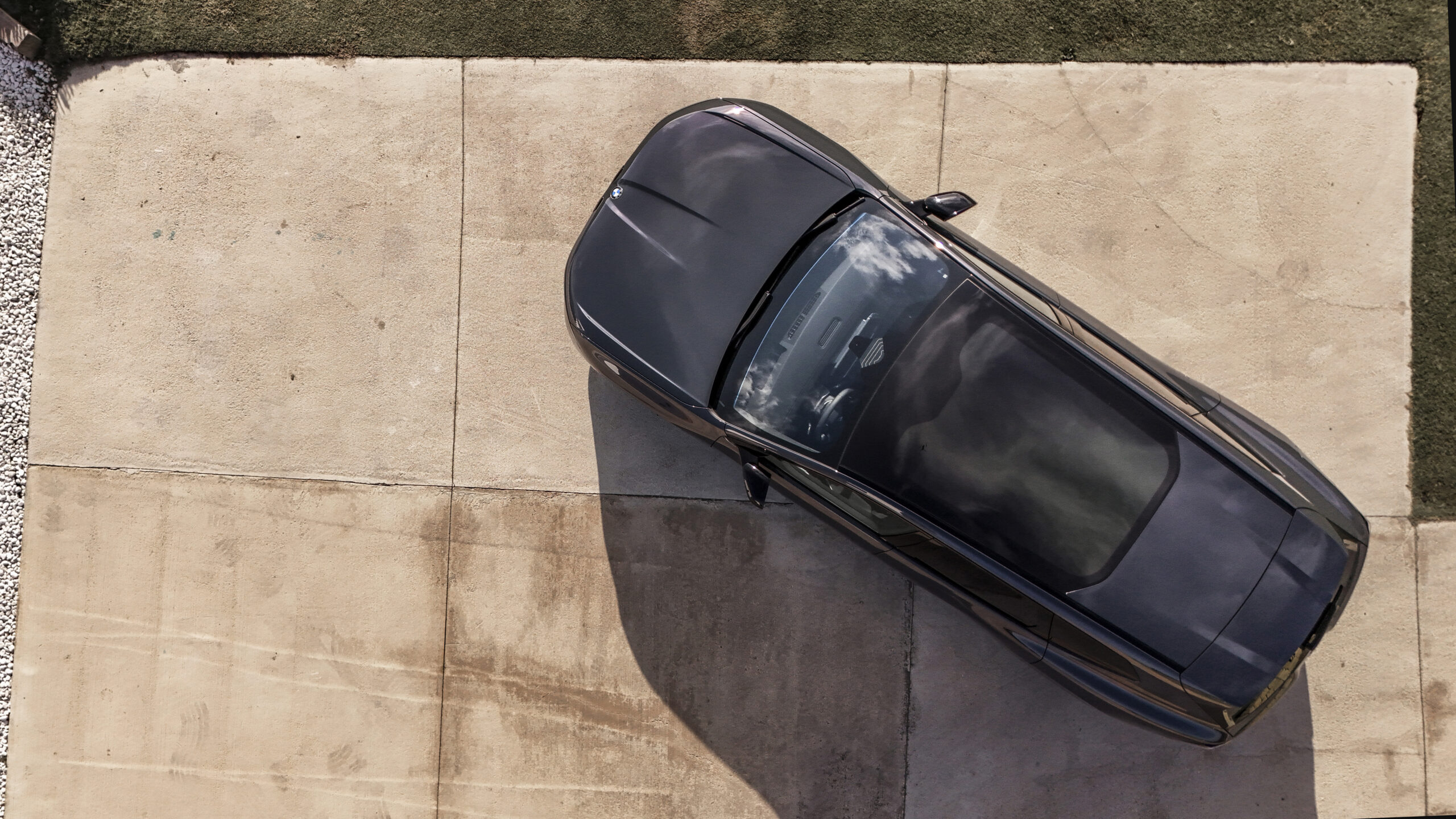
Photo: BMW
This isn’t thanks to a fancy, variable locking center differential like in the M5 or anything like that, because the iX3 has no center differential at all. The dual-motor configuration means that the SUV can dynamically change the power-output curve of each motor independently, varying its front/rear power bias with infinite precision. It really makes for a machine that feels substantially different as you dial from mode to mode, even if the suspension tune stays exactly the same.
BMW’s enhanced control over those motors extends to other areas of the drive, most impressively in the regenerative braking. This is the first BMW EV that can come to a complete stop relying only on the braking force of those electric motors. That may sound like a minor point, but in practice it creates an experience unlike any EV I’ve ever driven, and I’ve been lucky to drive damn-near every EV that’s ever hit the roads in the U.S.
The Joy of Stopping
On an earlier drive of the iX3 prototype, on a closed course, Dr. Falk Schubert, the ADAS engineer for the iX3, asked me to close my eyes. He then brought the car to a complete stop and asked me to tell him when I knew it had stopped moving. Amazingly, I couldn’t tell. The car’s final deceleration was so smooth it was absolutely imperceptible.
Again, that sounds like a minor thing, but in practice, driving in traffic or zipping from stop sign to stop sign, it makes a substantial difference, especially for your passengers. Going back to any other car after driving the iX3 feels harsh and crude, much like going back to internal combustion feels harsh and crude after living with an EV for a while.
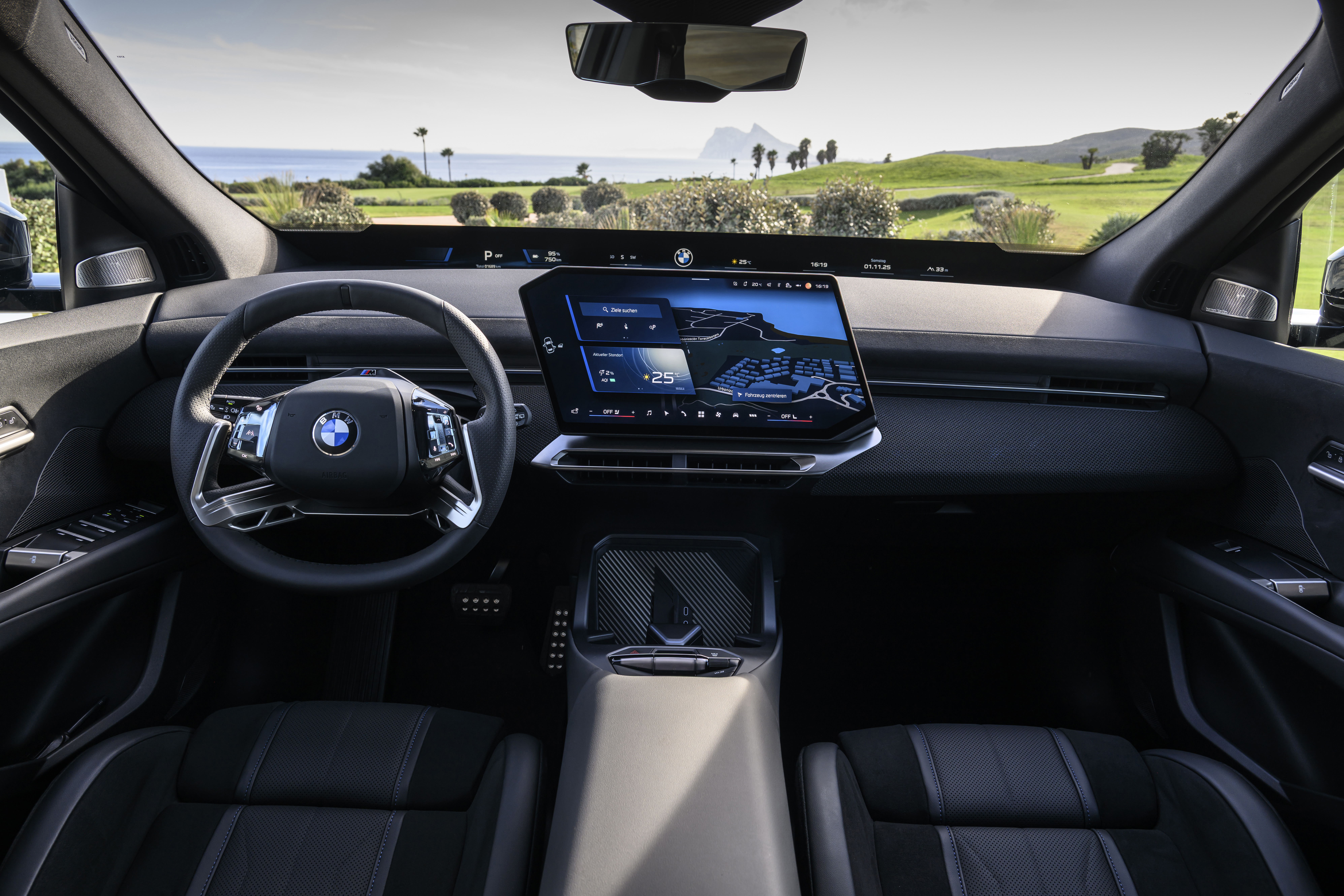
Photo: BMW
The in-cabin software experience is a similar step forward. BMW tragically does away with the rotary iDrive controller in the iX3, but in exchange, you get a much smarter, much snappier voice assistant. The revised BMW Operating System X interface on the angled, 17.9-inch touchscreen is improved, but will be familiar to anyone who’s left any fingerprints in a BMW lately.
The Panoramic Vision system, though, is like nothing else on the road. Think of it as a head-up display that spans the entire width of the windshield. The left-most portion acts as a gauge cluster, while the rest of it is fully customizable, showing anything you like from navigation prompts to weather forecasts.
It looks a bit overwhelming, but I quickly found myself getting used to and appreciating having all that information available at a quick glance. It’s a big step forward in automotive user interfaces.


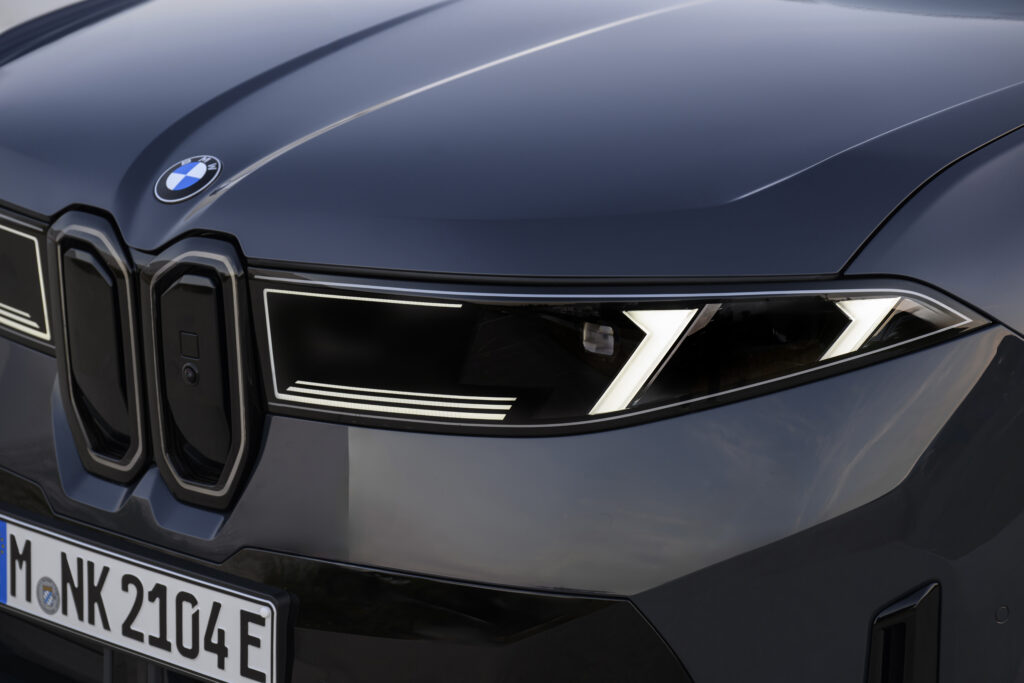
That’s a good way to summarize the iX3, a new SUV that makes everything else in its segment feel like a step backward. From the finely tuned suspension to the radical new user interface and the substantial range, it’s all genuinely impressive. It’s every bit as significant as BMW promised it would be, and truly a big step forward for the brand’s EV future.
The post 2027 BMW iX3 50: First Drive appeared first on BimmerLife.
]]>The post What You Learn After Driving the 2026 M2 CS appeared first on BimmerLife.
]]>For 2026, BMW is giving the M2 the CS treatment, creating a harder-core, more driver-focused M2. Like the current M3 and M4 CS, that means more power, less weight, styling tweaks, and no manual gearbox option. Unlike those cars, the M2 stays rear-wheel drive. What does that mean for the experience? I spent a day with the CS in South Carolina at the Michelin Proving Grounds and on the surrounding roads to find out.
It’s Fast
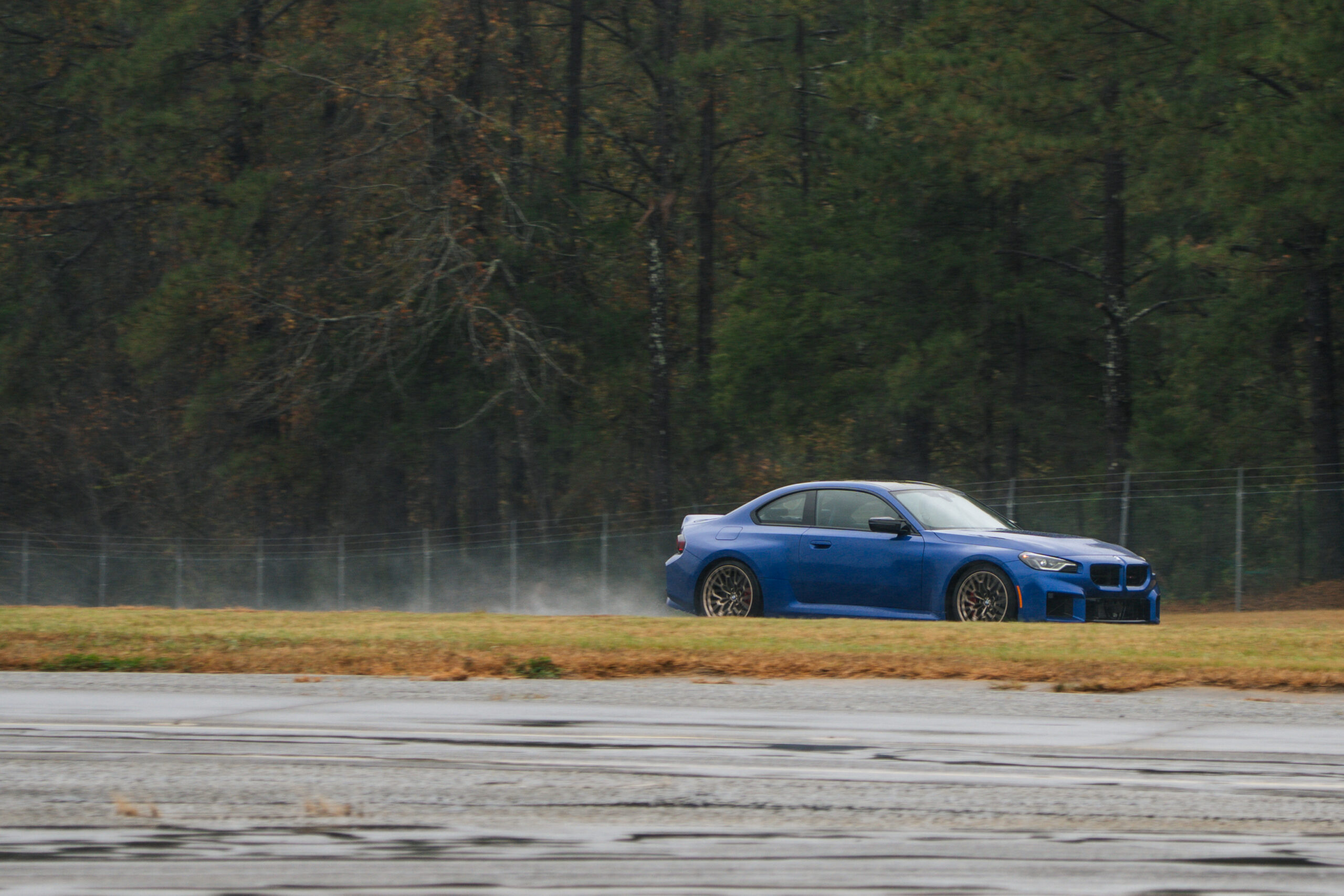
Photo: BMW
You’re probably rolling your eyes right now. This auto-only CS weighs 100 pounds less than the base car with a manual gearbox, and has an extra 50 hp, giving it a total of 523. Of course it’s fast.
Off the line, it doesn’t really feel quicker than the base M2. That’s probably because our test was conducted on damp roads and the M2 CS doesn’t gain all-wheel drive. However, in gear acceleration, once the car is done clawing for grip, is noticeably more urgent. This thing pulls. Anyone familiar with the S58 3.0-liter twin-turbocharged inline-six will understand, but mid-range power is excellent.
There were a number of times on the short road route where I put my foot down and realized about a second later that if I didn’t take my foot off the gas, I’d be in jail. Paired with the now ubiquitous ZF 8-speed auto, it’s a great combination. On track, that broad powerband is ultra-impressive. The first hit of torque will break the rear loose when grip is low, but get through that and the S58 powers to redline without any true discernible loss of power. It’s pretty fantastic.
It Probably Wouldn’t Be Better With a Manual
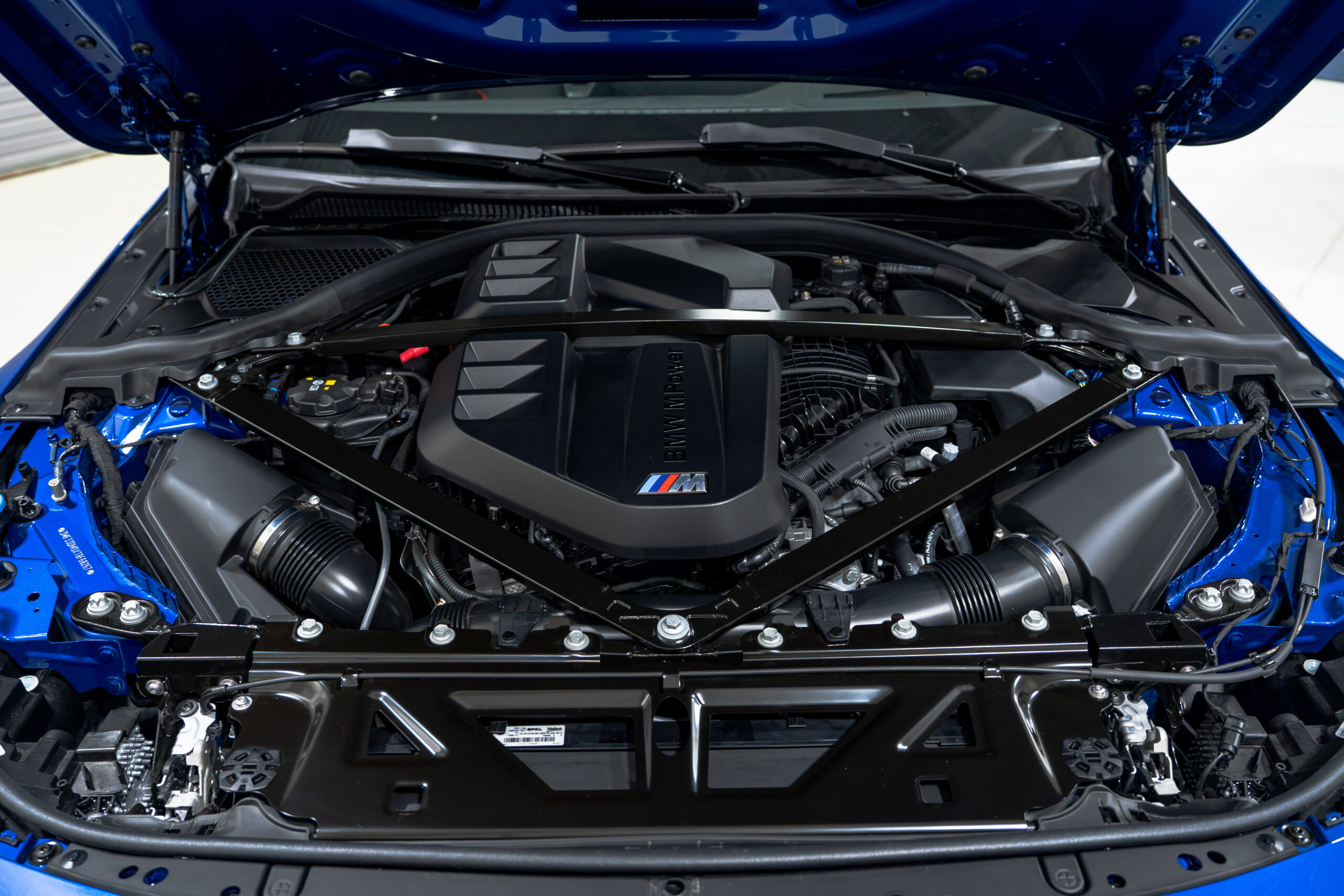
Photo: BMW
I know, heresy, but let me explain. Since the F8X-gen M3s, I’ve preferred M cars equipped with a DCT or automatic. It’s more the way modern engines work, than anything, delivering a huge smack of torque across the entire rev range. Maybe it’s just me, but I find it harder to be smooth with a manual considering how these engines deliver power. They feel more natural with an automatic, like they were built for them.
And now that the ZF 8-speed has gotten so good in manual mode, so responsive, it feels engaging. You just need to be conscious of the shift speed settings, and choosing the right one. On the damp roads, putting it in its most aggressive map resulted in jarring shifts that upset the balance. And even if it wasn’t damp, they were just unpleasant on the road. The second quickest setting felt just fine and didn’t sacrifice speed. It was the same when the track was wet. The slightly less aggressive shifts in the second quickest mode kept everything in line in the rain.
When the track started drying, though, I popped it in the quickest setting. That setting needs full commitment, you need to be flat out to get the best, for it to feel natural. It bangs shifts so hard that it’ll get annoying on the road at an average pace, but it’s perfect for the track. So, for most settings, put Drivelogic in the second setting, on a dry track, put it in three.
Handles Great, Limited Feel

Photo: BMW
The complaint with modern BMWs is that the steering is quick and accurate, but lacks feel. It’s much the same in the CS. I found myself hoping for more weight and communication of what the front tires were feeling, not artificial weight depending on what mode I was in.
That said, thing thing has grip, the front end specifically. It sits lower than the standard car and has more camber. It’s pointy, and I mean that in the best way possible. It refuses to wash out unless you’re being a true idiot. Once Michelin’s larger handling track started to dry for our lead-follow sessions, the CS was easily quicker than the lead M3 Competitions. The more aggressive front end lets me turn in harder and get back to power sooner on tighter corners than the instructor in the M3. That didn’t impact it in high speed corners, where it was stable and predictable. There were times where you can feel it start to dance at higher speeds, the rear moving away before the front, but it wasn’t sudden or uncontrollable. Just a signal from the rear end that grip was wearing thin.
Outstanding Traction Control
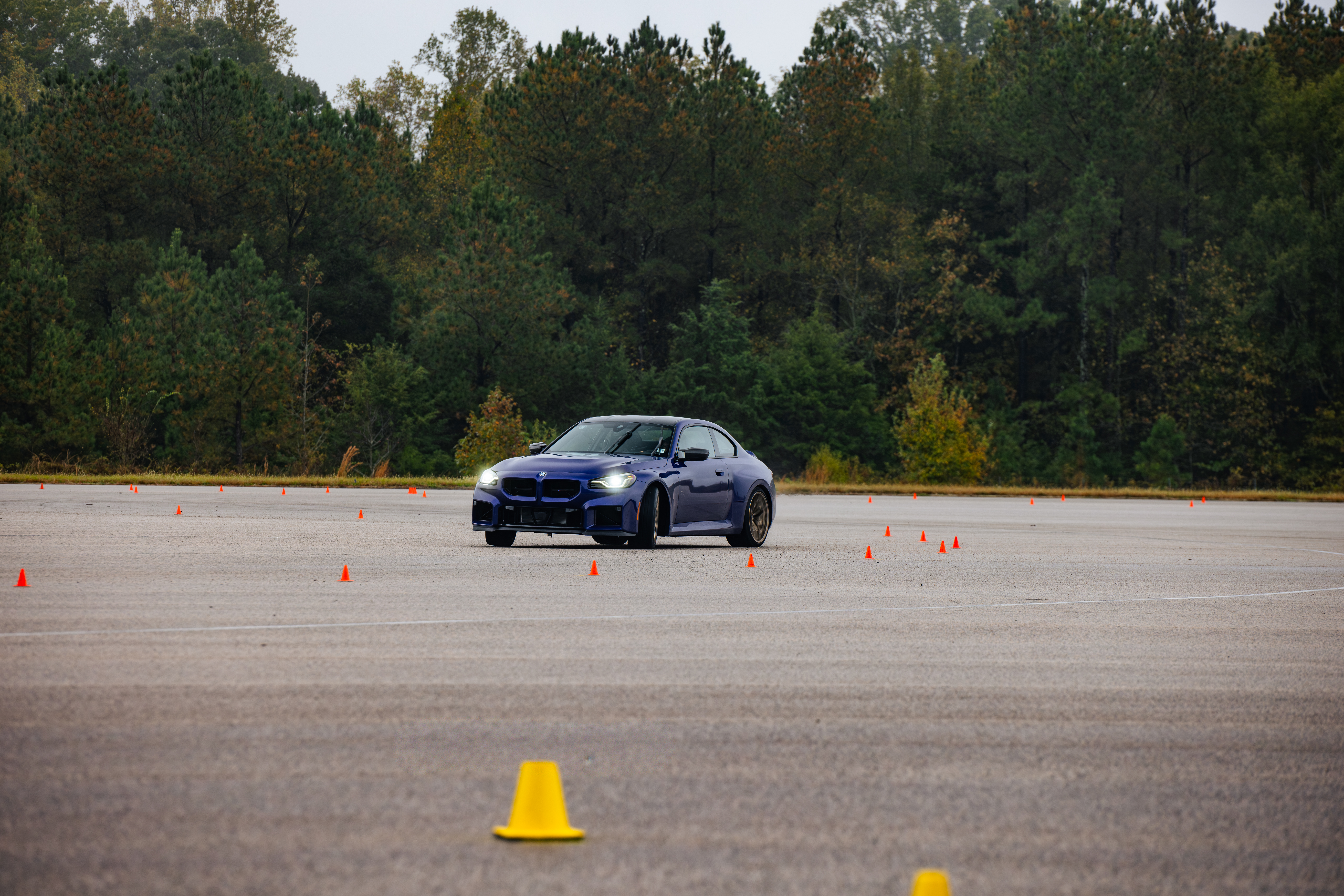
Photo: BMW
On track, I left the car in M Dynamic Mode (MDM), which gives you a safety net but lets the car move around. It keeps traction and stability control activated, just in a more permissive setting. It could slide on corner exit with a tiny bit of slip, but it surely wouldn’t let you get into trouble. Kind of the perfect setting for a damp or drying track.
But on the autocross course, which was also damp and drying, we were told to play with the 10-setting traction control. This is a much more granular control, but basically ESC is turned off and then the rear wheels are given 10 different levels of allowable slip, with 10 being the least permissive and 0 meaning it’s all up to you.
I dropped down through the levels on the course, seeing just how dumb the car would allow me to be. Turns out, I could be pretty dumb starting in level four. It’s an intuitive system that I turned down on each run until I turned it all the way off. I was expecting the car to bite me at that moment and become uncontrollable. It didn’t.
I think that’s partly because running down through the modes earned my trust in the chassis and steering, and just how much power was needed to slide it around. Turns out this is a delightful car without any aids on, easy to slide and look like a hero in without much effort or skill. I had a blast.
Too Many Modes
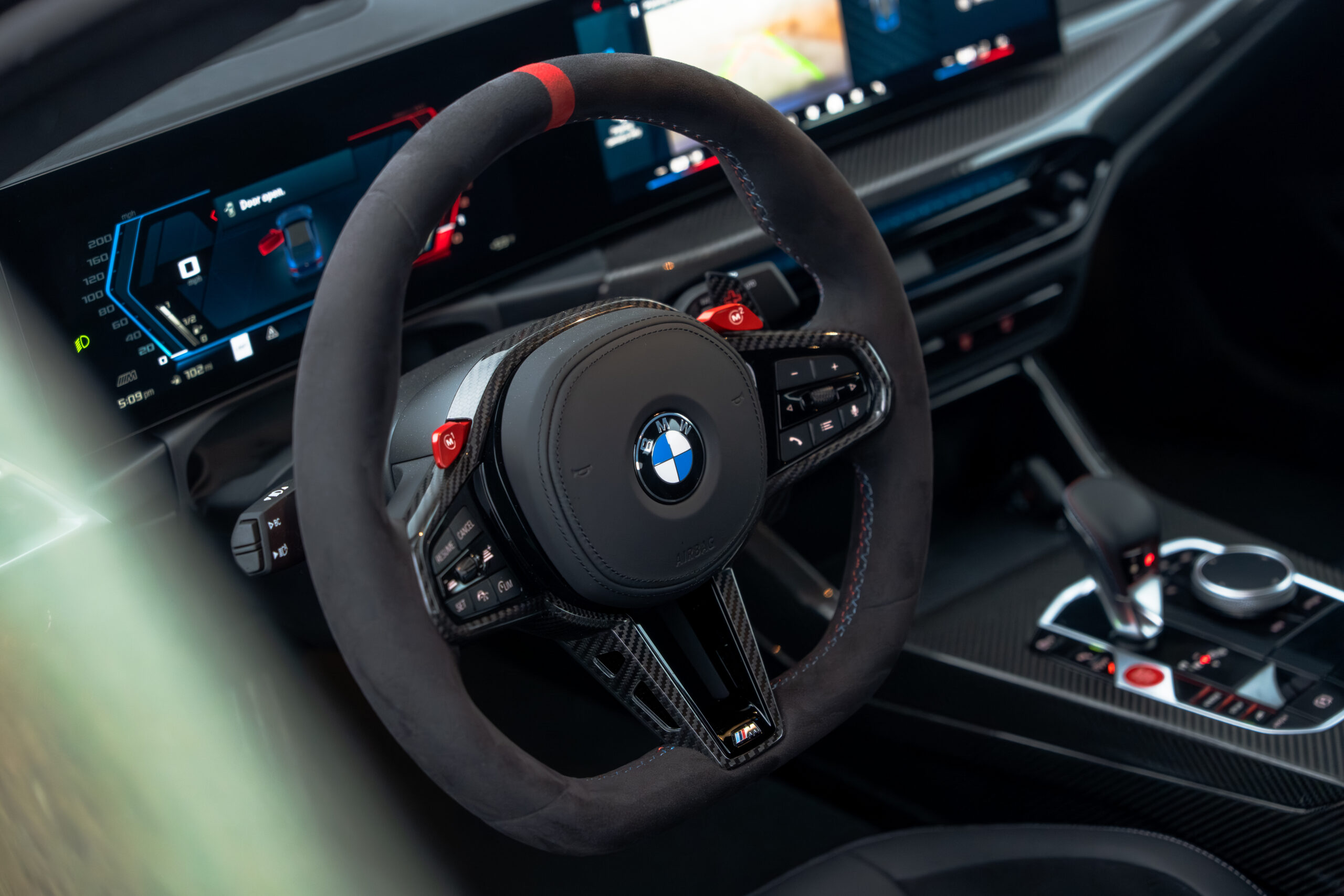
Photo: BMW
BMW does have a mode problem these days. This car has so many different settings and modes that it’s nearly impossible to get through all of them in a day of driving. There are modes for everything from the traction control to the steering feel, setups for street or track, shift speed and sound. It’s too much.
While I appreciate the idea of giving the driver granular control over every aspect of the car, sometimes it’s better to just pre-determine a setup and make that the default.
It Looks Great
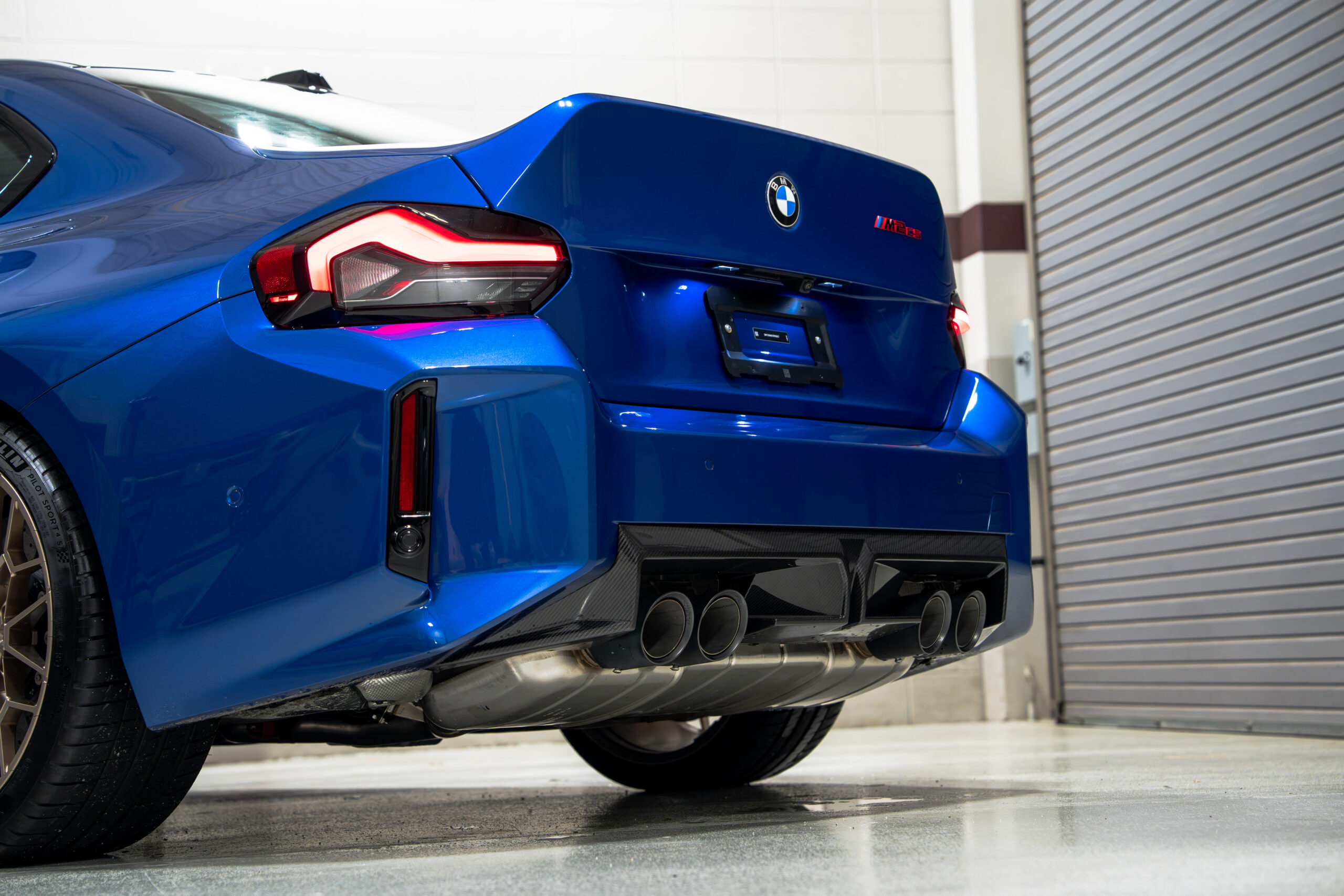
Photo: BMW
When the M2 debuted, it received immediate backlash. Nothing new for BMW designs, of course. Even if the car looks great, the one that came before it get lauded for how elegant it was and the new car derided for being hideous.
This G87-generation M2 went all in on angles. It’s supposed to be inspired by box flares, and it shows. The CS continues that theme and features updates to the grilles along with a new splitter, one that isn’t made of carbon fiber because they don’t want it scraping along the ground. It also gets a bespoke set of forged gold wheels, a different design than the accessory wheels you can get on the base M2.
The most obvious change is the carbon fiber trunk with the ducktail spoiler, which is tall enough that you can see it in the rearview mirror. It looks interesting, a true differentiator to the base M2.
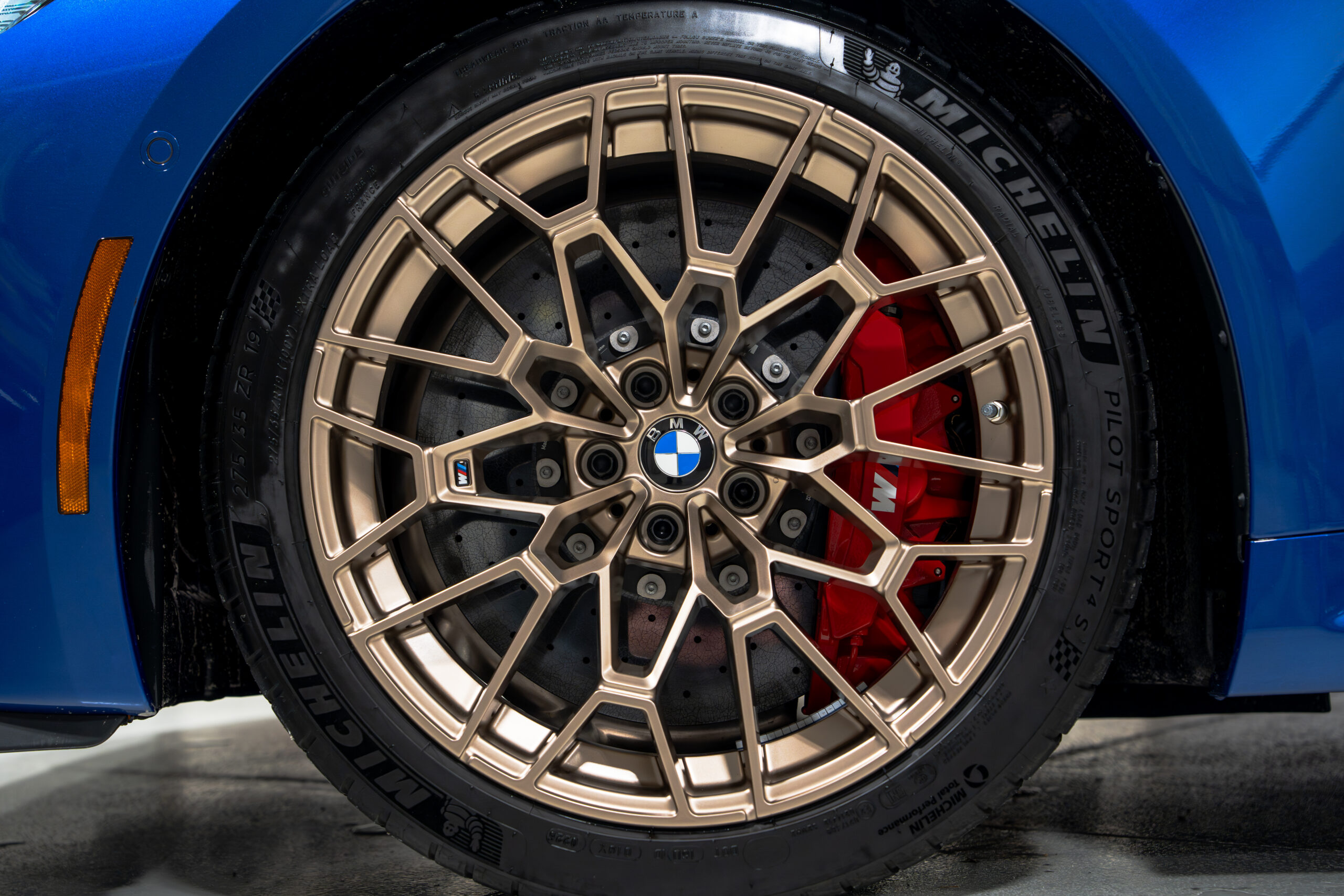
Photo: BMW
It’s also the main new carbon panel on the car, as the hood on this CS remains stock. It also doesn’t get the yellow running lights of the other CS cars. BMW says these choices were made because of cost. They wanted it to be under $100,000, and that’s what had to be done to maintain that.
Now, is this the M2 to buy? The additional power is nice, but the handling is the real highlight. It feels more nimble and lithe than the base car, more connected, and the conditions meant I sampled it with the Pilot Sport 4S tires, not the Cup 2 or Cup 2 R. On a more aggressive tire, I bet it’s even more impressive.
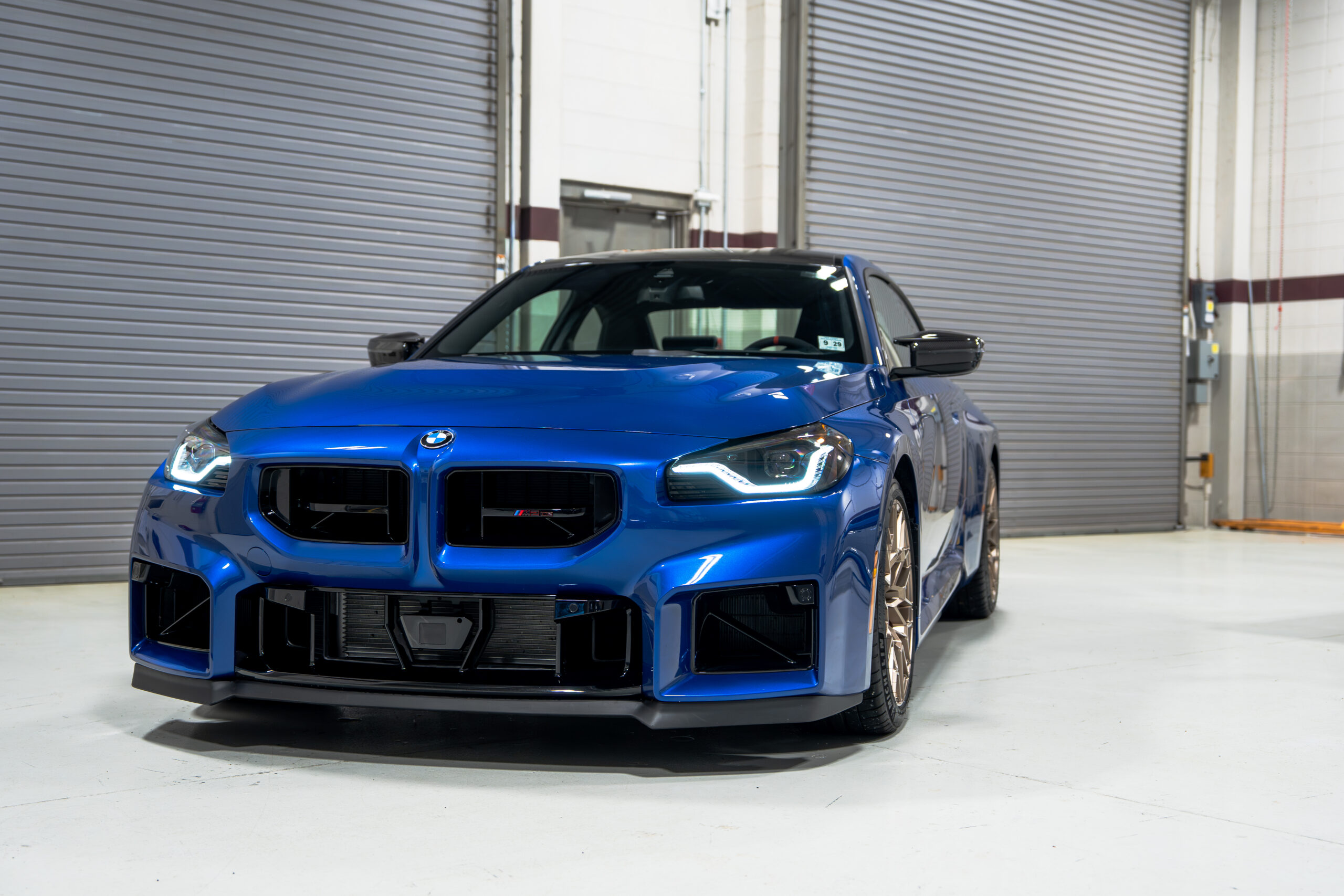
Photo: BMW
If you’re in the market for an M2 and have the budget to stretch to the CS, I’d do it. It retains everything I like about the base car and sharpens it, and it looks even better. Seems like a win.
Look for many more thoughts on the M2 CS in the next issue of Roundel.
The post What You Learn After Driving the 2026 M2 CS appeared first on BimmerLife.
]]>The post 2026 BMW iX M70: An Outrageously Quick EV Crossover appeared first on BimmerLife.
]]>BMW released the iX in 2022, around the same time as the i4. Unlike the i3 and i8, the i4 and iX represented a more traditional shift. The iX still makes heavy use of carbon fiber like those cars and has an advanced EV powertrain, but it traded in novelty for usability. It represented a shift in ethos. The i3 was the ultimate city car, the i8 a vision of an electrified supercar future. Both were brilliant, if a bit too far away from what traditional buyers were looking for at the time. The i4 looks like a 4-series Gran Coupe, the iX appears to be an X5 that’s been tailored for on-road comfort. Even if the styling is an acquired taste on both.
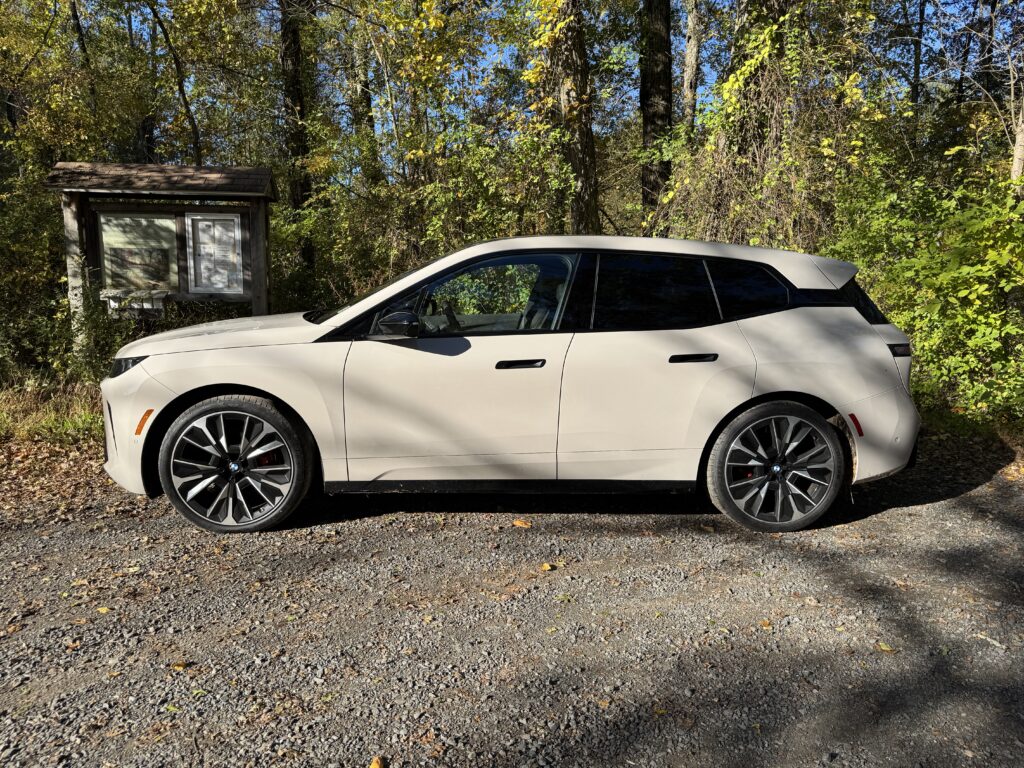
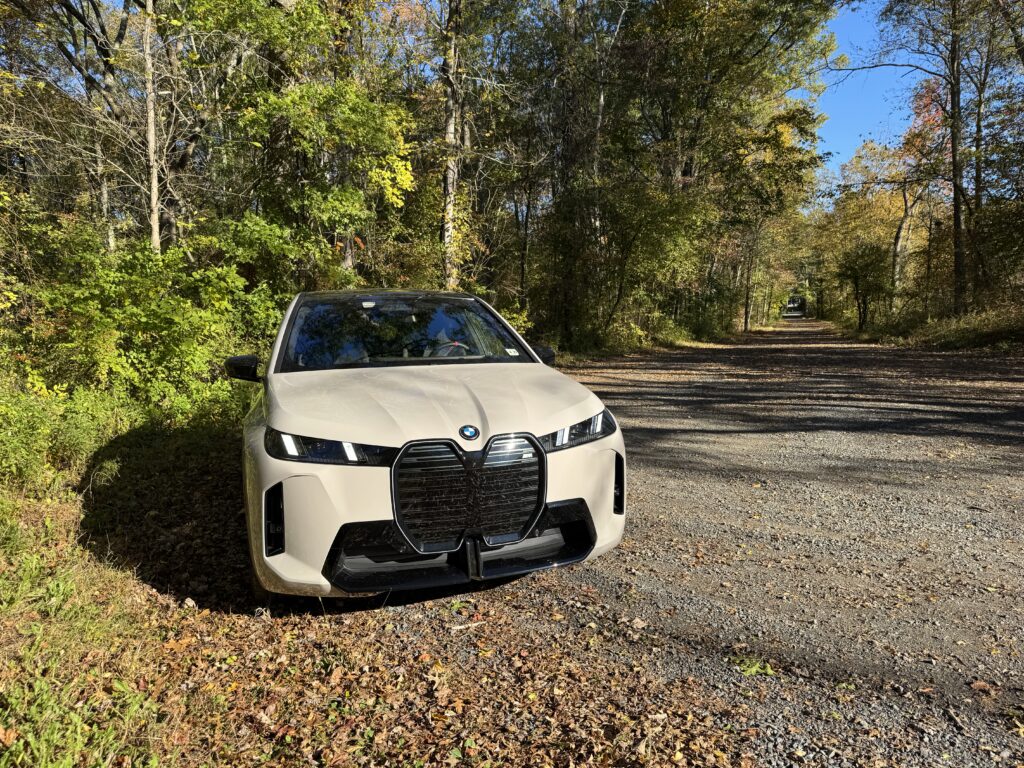
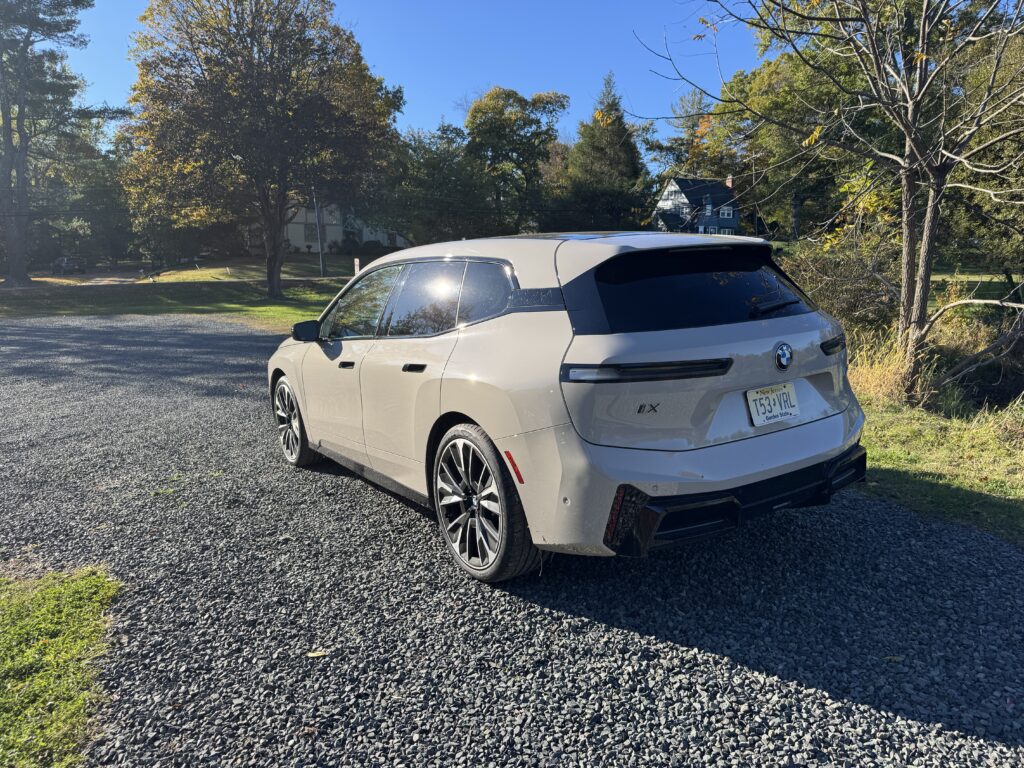
This is another example of BMW pushing design into an uncharted realm. It was created for a first impression; you’ll either fall in love or recoil in horror. Like when I first saw the G80 M3, I wonder who signed off on the iX design and thought this was a good idea. This 2026, which is the LCI version of the model, has seemingly doubled down on the look, with what appear to be even larger kidney grilles and no substantial changes to the polarizing look.
Here’s the thing, though, and I can’t believe I’m saying this. Years after the G80 M3’s debut, I now like the design. Maybe I’ve gotten used to seeing iXs around over the last few years, but I don’t think this one looks bad at all. I like the narrow lights and am thankful they didn’t go the same route as the 7-series and X7, with marker lights and lower, separate headlights. I’ve even gotten used to the large kidneys. And even if you still hate the way it looks, at least it’s interesting.
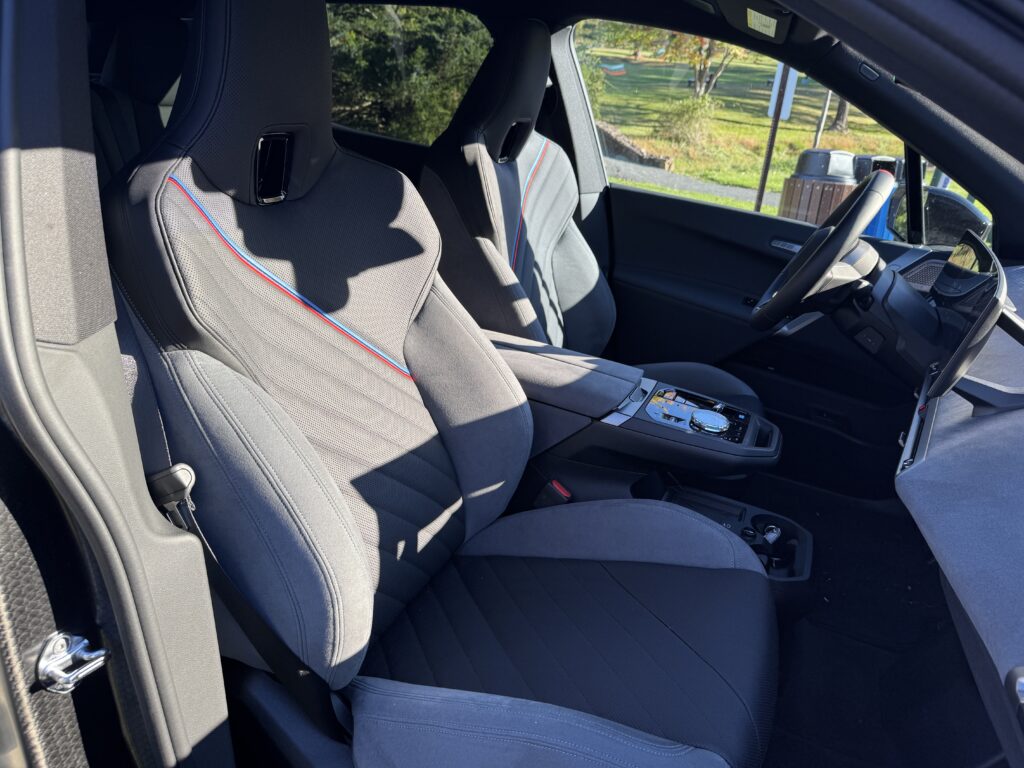
The interior is much less polarizing. There’s still iDrive and a digital dash. The seats in this M70 model are finished in Sensatec and have M stripes on them, I guess in an attempt to associate some motorsport heritage with an electric crossover. Still, they’re comfortable. And thanks to the iX being an EV, that allows BMW to latitude on the packaging. There’s no center tunnel so the front footwells feel open. The center console almost appears to float, rather than being attached to the floor. It may be nearly identical in size to an X5, but the interior feels far roomier and spacious.
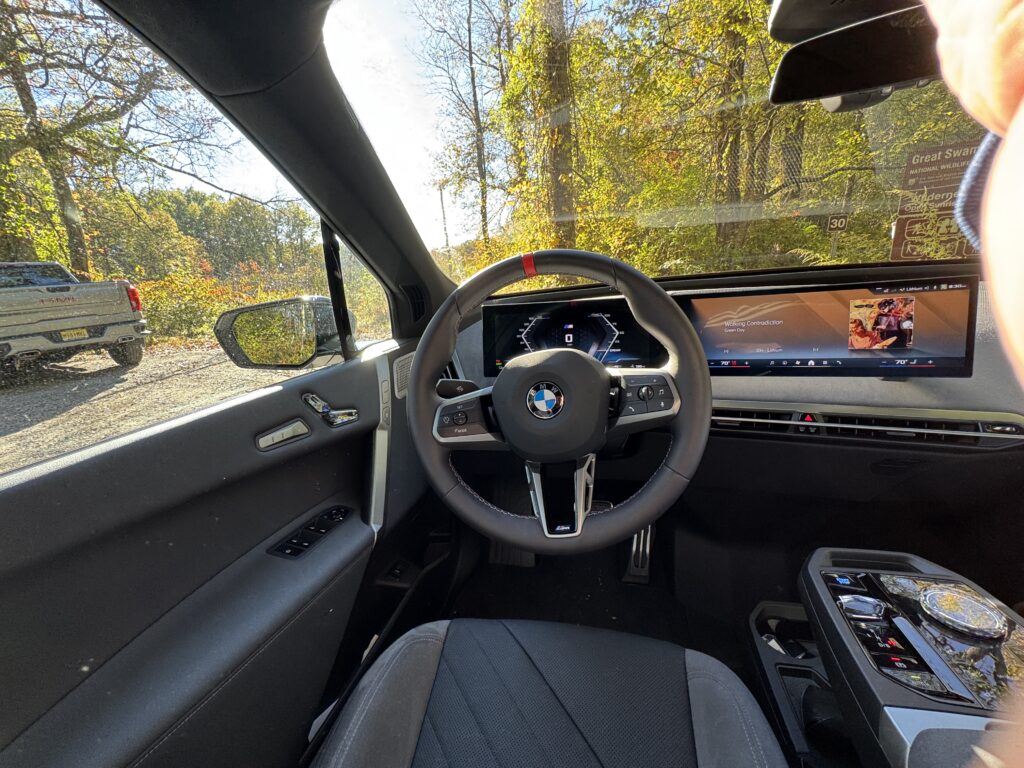
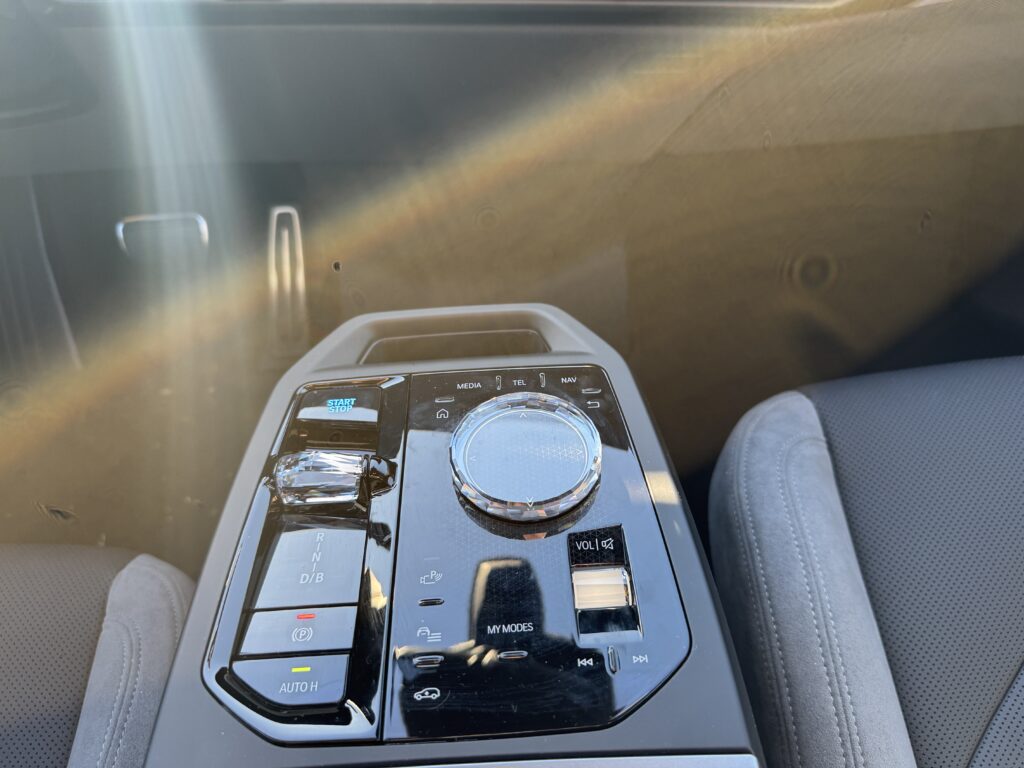
It runs the latest version of iDrive 8, which allows touch operation or the traditional console-mounted wheel. For a system that was lambasted when it debuted in the E65 7-series, it has become the gold standard of in-car infotainment. It’s intuitive and easy-to-use, though there are now so many menus and options within the system that it’d be nice to see core functions, like climate control, moved back to physical buttons.
The real thing with EVs is that many of them are nearly the same to drive. They all tend to have instant torque, regenerative braking, and a real feeling of distance between the driver and driving experience. This iX, the M70, is broadly similar in that sense. It has 650 hp and 811 lb-ft of torque, outrageous numbers for a crossover like this. It is far quicker than it has any right to be, hitting 60 in less than four seconds. I also found it to be quite efficient, delivering excellent range over a week of driving. In fact, I used it for everything and it didn’t even deplete the battery to a place where I felt it needed to be charged.
The experience here is distinctly more EV than BMW; it’s aloof. The X5 is eminently more engaging to drive, while the iX makes its experience around tech and outrageous acceleration. Are EV crossover buyers looking for an engaging experience? In reality, probably not, even if it has a BMW badge on the nose. The ride quality is excellent, though, and the battery pack provides a low center of gravity, which means a car of this non-traditional shape can corner quite well. I also liked that the regenerative braking had multiple settings. There were settings that kept the amount consistent no matter the speed, and an adaptive level which took other factors into account, like surrounding traffic. I spent the majority of my time in that setting, and while 90 percent of the time it was perfect, the other 10 percent was frustration when it either seemed to slow for no reason or didn’t slow when I needed it to.
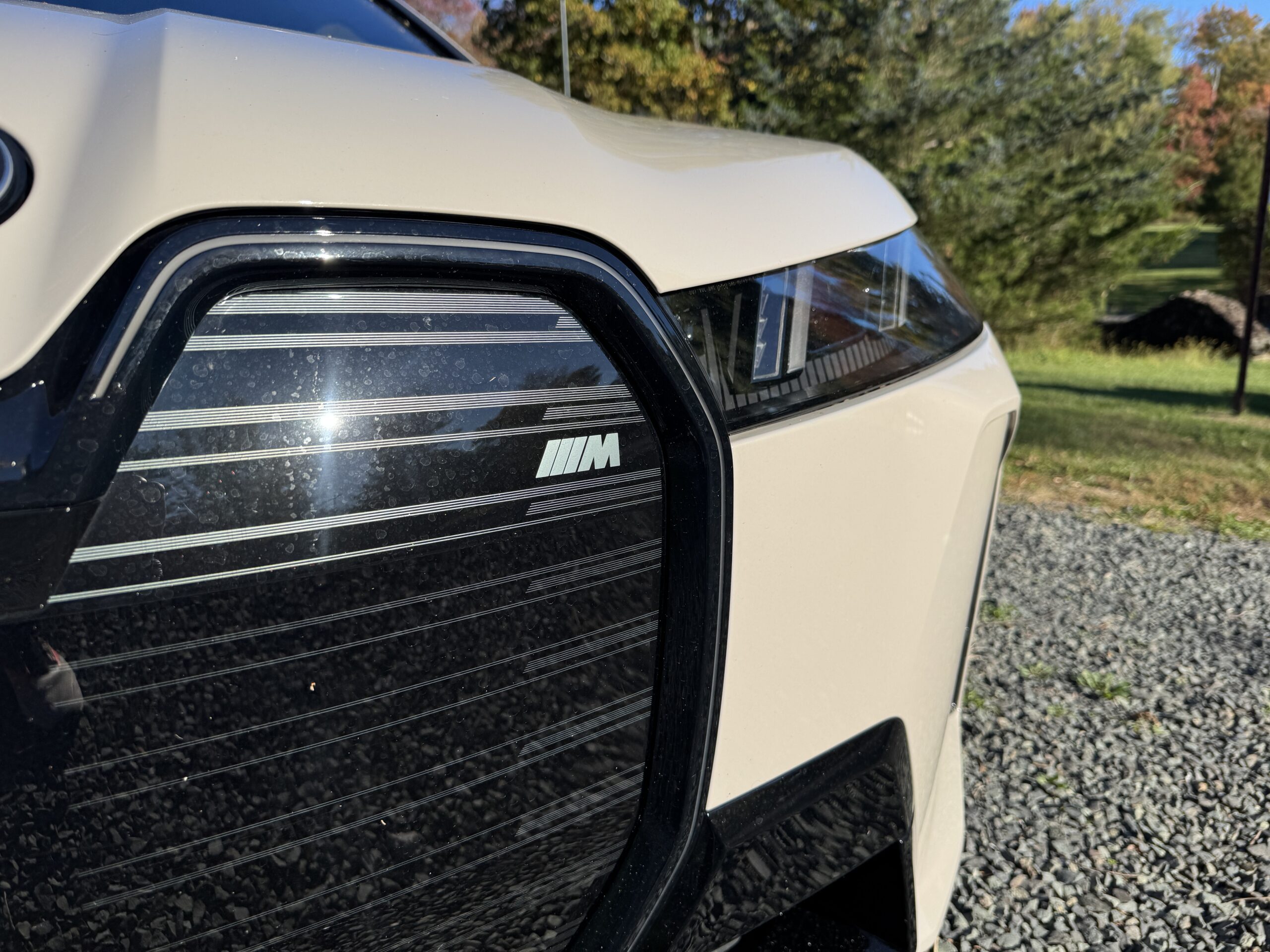
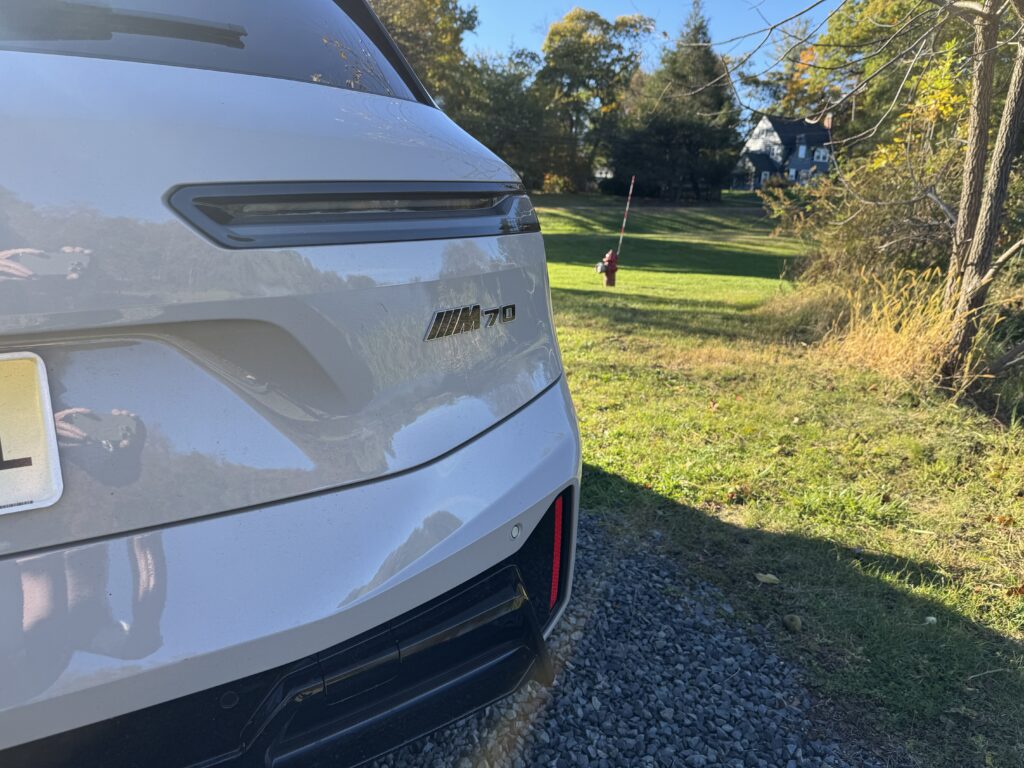
A rogue M badge appears. Photo: Travis Okulski
Now, the real thing here is need and the rapidly evolving EV market in the US. I think the iX makes a real case for itself as a family car. It’s smooth, spacious, intuitive, and a great place to spend time. The M70, with its $112,675 base price and $118,225 as-tested price tag, makes less sense. I don’t see the need for an M badged–even if it isn’t a true M–trim of this car.
In an EV crossover, you want range and efficiency. You want fast charging. The M70’s range is estimated at 283 to 303 miles per charge. The base model, the xDrive45, starts at $76,325 and can go an estimated 279 to 312 miles. It even hits 60 in 4.9 seconds. So for an extra $36,000, you knock 1.3 seconds off the acceleration times. The xDrive60 can go up to 363 miles on a charge and hits 60 in 4.4 seconds, all for $89,675. That seems to be the sweet spot.
For the BMW faithful, the iX might be a bit too big of a departure, yet the company has taken turns like this before. There was doubt when the i3 and i8 arrived, when the E65 7-series arrived, when the X5 arrived, even when the Isetta arrived. Those models are now a big part of the company’s history, as the iX will someday. For now, though, if you’re buying one and you don’t need to get to 60 in less than four seconds, save some money and go for the xDrive 60.
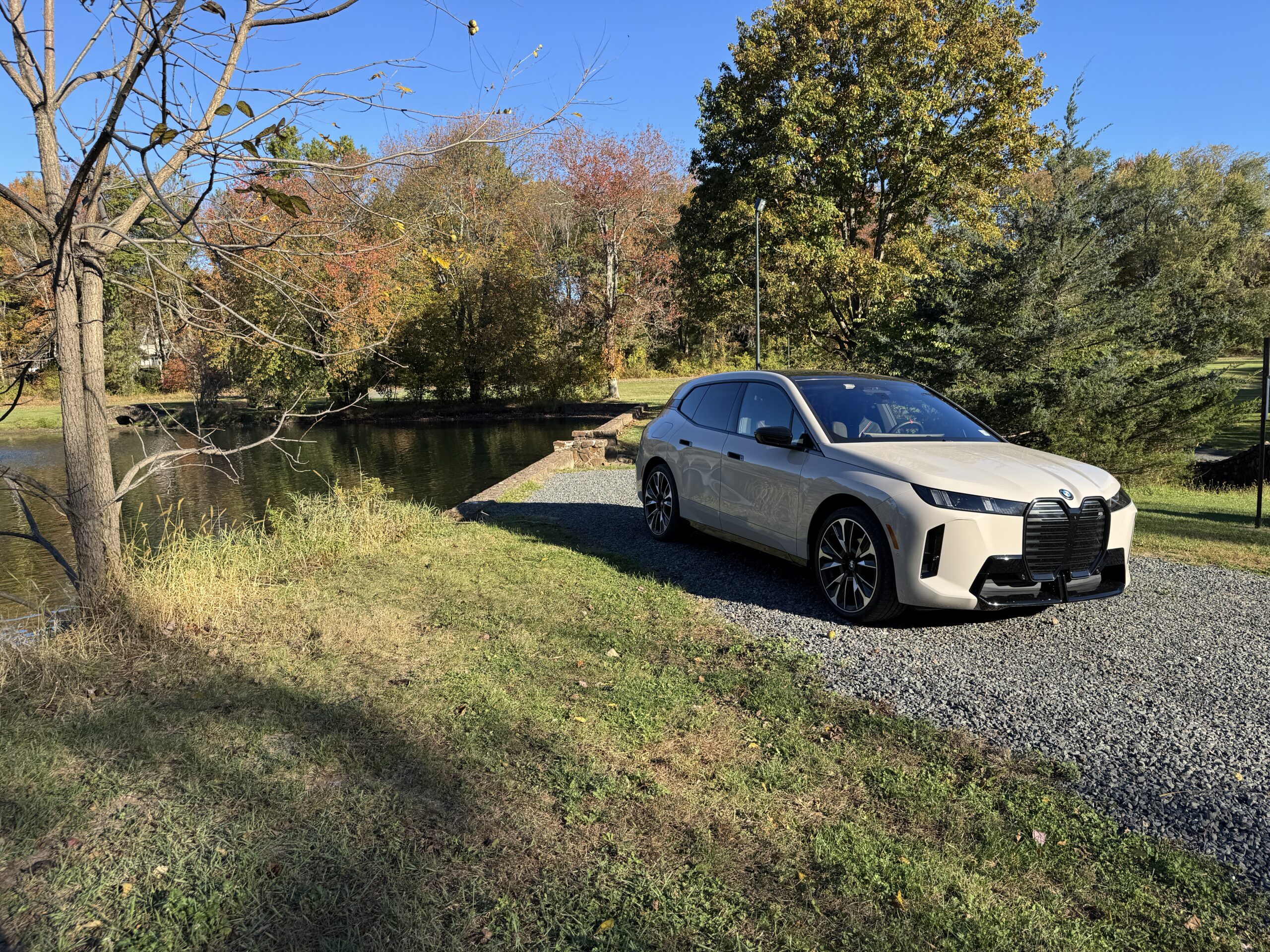
Photo: Travis Okulski
The post 2026 BMW iX M70: An Outrageously Quick EV Crossover appeared first on BimmerLife.
]]>The post Weekend With A Wagon appeared first on BimmerLife.
]]>There are some firsts when it comes to the new M5, most notably that a Touring wagon model is available for the first time, which is the model I spent a few days with. The other big first is that this is the first M5 that’s a true hybrid, combining an electric motor integrated into the transmission with a brawny 4.4-liter turbocharged V8 up in front. The result is a total of 717hp and 738 lb.-ft. of torque, with the V8 making 577 of that horsepower.
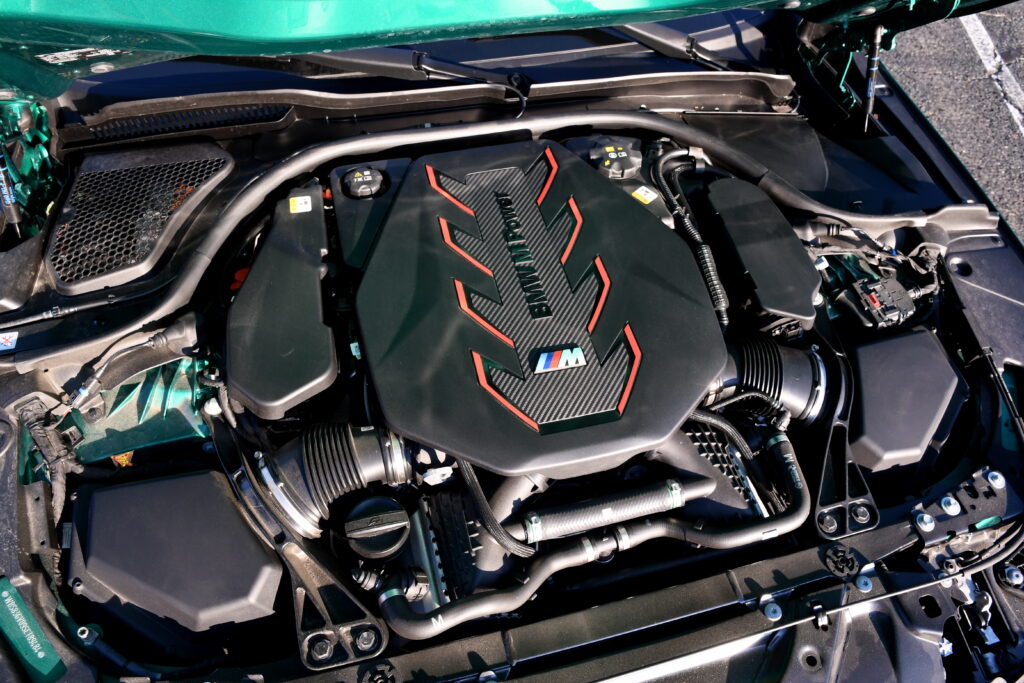
The V8 combined with an electric motor puts out a lofty 717hp.
All that power can launch the M5 Touring to 60mph in a very impressive 3.5 seconds, which is just a tenth slower than the M5 Sedan due to the extra 140-ish pounds it carries. That’s getting into supercar territory. Remember the old E28 M5 ad that declared you could “be one of the fastest families in America” if you owned one? That adage still holds true for the new M5. A direct rival, the Mercedes-AMG E53 Hybrid Wagon, puts out 577hp and takes a half-second longer to get to 60.
The electric range in the new M5 Touring is around 25 miles, which is far enough to drive around town and from stop light to stop light for a reasonable distance. I found it enjoyable to put the car into full electric mode for that type of driving and was surprised at how quick the M5 was from a standstill using only the electric motor (which makes 194hp and 207 lb.-ft. of torque at its maximum). It’s quicker than you would expect.
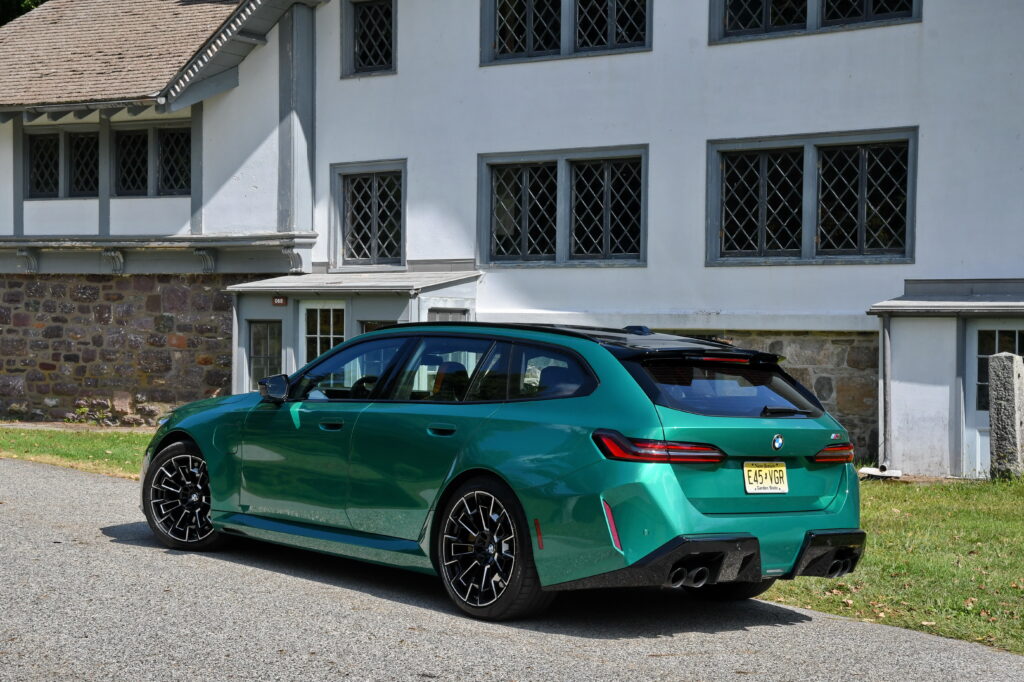
The Touring is the same length as the Sedan and only weighs around 150 lbs. more.
You’ll have to decide for yourself if you like the design of the new M5 models. I think M5 design started going downhill after the E34 generation, but others that saw the new car while I had it loved it. I was surprised at how much attention it got, especially from younger people. I guess there’s something cool about a big green wagon that is this fast. The M5 Wagon does have appealing lines from the side and the rear, but I think the front has too much black plastic, and if you own this car you’ll constantly be cleaning debris out of its big radiator intakes. Drive the new M5 down a country road in autumn, and you may collect enough leaves to create your own pile to jump in when you stop.

Get used to cleaning debris out of the radiator intakes if you own this car.
I’ve gotten used to using the screen in the newer BMW models for everything, and although some features would still be easier to have buttons or controls for, the system is pretty easy to live with after you get used to it and remember where things are. My biggest annoyance from a technology perspective was that you now have to push a button on the dash to unlock the fuel filler door. I’m not sure why BMW felt the need to do that.
Indeed, technology is a central theme in this car, which you’ll realize when you open the setup menu. M cars have been this way for a while, but the new M5 has more settings than ever before. The driver can choose settings for Drivetrain, Energy Recovery, Drivelogic, Chassis, Steering, Brake, M xDrive, and M Sound, and that’s just the setup menu. There’s also Hybrid setup options that include Hybrid, Dynamic Plus, Dynamic, Electric and eControl, as well as settings for traction control and M Mode.
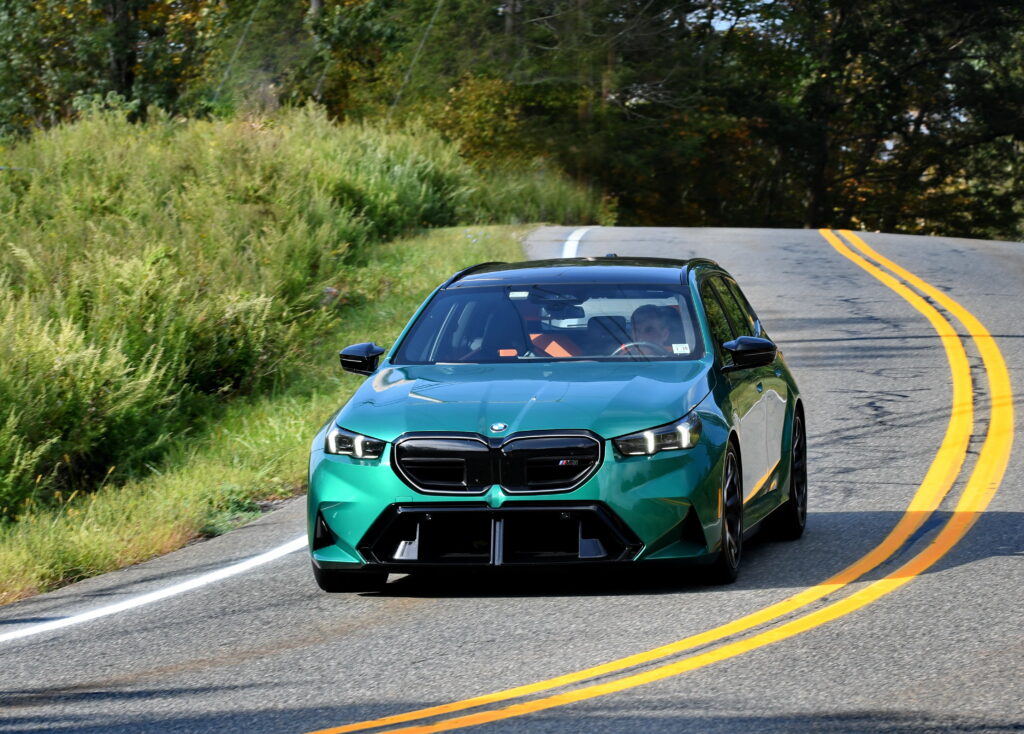
The M5 Touring is still fun to drive on a twisty stretch of road.
It sounds overwhelming and it would use way too many words to explain them all here, but once you get used to where you like most of the settings, you can program the M1 and M2 preset tabs on the steering wheel to your liking. I tend to have a setup for performance and back road driving in the M1 preset and daily driving setup in M2. You’ll also find that some of them (like the Brake setting) don’t seem to have much difference between them.
Despite the prodigious size and weight of the new M5, it’s genuinely fun to drive and still feels like an M5 on the road. It wouldn’t be able to feel that way without all the technology on board to manage everything, especially in the suspension but also from the all-wheel drive and four-wheel steering. It feels well-balanced and dynamic on a twisty stretch of road in the right settings, and the sweet spot for me was having Drivetrain, Drivelogic and Chassis settings in Sport, and everything else in Comfort mode. The power is tremendous, though you would need a race track to really use it without fear of losing your license.
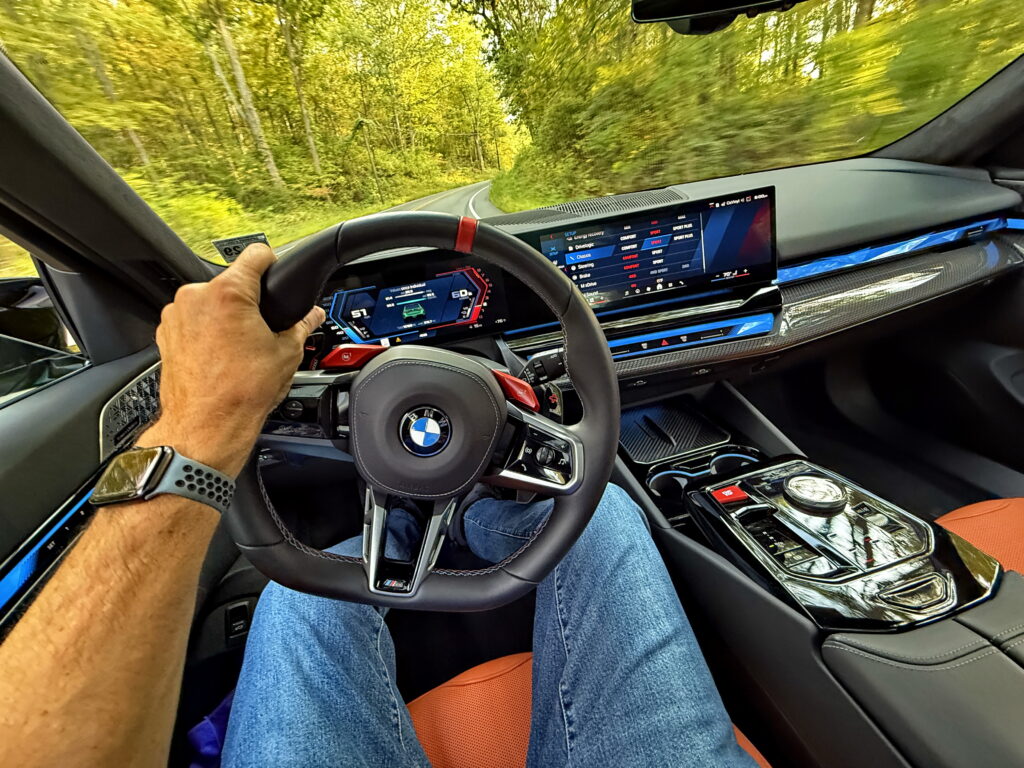
I’m sure if you took this car to a race track that you would notice the weight more (5,530 lbs.), but even when pushing it on a twisty back road, the chassis seems unperturbed by the weight it’s carrying. I never drove this car hard enough on public roads to get close to its limits, but my gut feeling is that it would be a handful on a track without the traction control on. As precise and fun as it is, it also has a bit of a clinical feel to it, and it seems like it would quickly swap ends once it hit the limit of the tire’s adhesion without all the electric nannies. It’s probably a good idea to invest in the optional Carbon Ceramic brakes if you’re buying this car as well.
One interesting discovery with the new M5 Touring is that the suspension is almost always better in Sport setting than Comfort. In previous M cars, I would always leave the chassis setting in Comfort for daily driving or on the highway, but the new M5 bounces around too much in Comfort, with a lot of up and down movement from the suspension. Changing it to Sport limits some of that movement and the ride quality is still acceptable for normal driving.
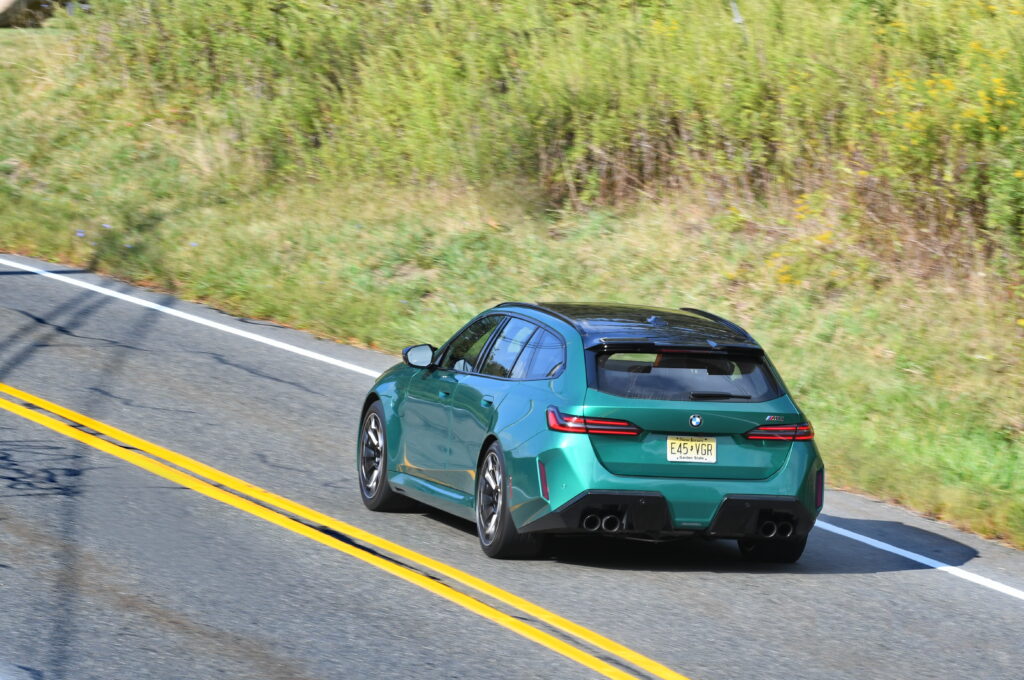
Another interesting discovery is that the car itself rejuvenates the electric battery pretty quickly through just braking and coasting. I drove most of the time with Energy Recovery in the Mid setting. If you put it in the Max setting, the engine braking is so strong that it really feels as if you’re driving a fully electric car. I’m sure there are times when you’ll want to use it, but I found it too abrupt for my driving tastes.
The bottom line for me is that the new M5 Touring stills feels and drives like an M5, though that feeling has changed over the years. You have to be willing to embrace technology to be happy owning this car, but you can get into it knowing that the technology hasn’t totally filtered out the driving experience. The measuring stick for me with any car I test is if it’s the type of car that I’ll choose the long way home that hits the back roads instead of just sticking to the interstate, and this car passes that test.
I also think that if I were buying an M5 I would choose the Touring. I think it looks cooler than the sedan and It only weighs around 150 pounds more. It also only costs a couple thousand more ($123,900 vs. $121,900) and you get the extra cargo capacity if you need it, though I would do a double-take if I ever saw an M5 Touring with a dresser in the back.
—David Haueter
The post Weekend With A Wagon appeared first on BimmerLife.
]]>The post BMW Receives High Marks From Consumer Reports appeared first on BimmerLife.
]]>As BMW enthusiasts know, BMW can build great vehicles that blend performance, style, and even efficiency in ways that satisfy both a sense of adventure and practicality. CR’s latest car review issue reflects those qualities.
Consumer Reports magazine is a non-profit publication with a strong reputation for independent testing and analysis. They don’t accept automaker ads and publish the details of their research and evaluation standards. According to the magazine, they purchase almost 50 vehicles anonymously and put each one through more than 50 tests. “For every new vehicle we purchase for testing, our team of experts log thousands of miles on public roads and highways. To push each car to its limits in a safe environment, we also drive it on the track at our 327-acre Auto Test Center in Colchester, Conn… CR also has a team of analysts who review hundreds of thousands of data points from our annual member surveys to predict how reliable and satisfying new vehicles will be.”
So, while no evaluation system could be considered perfect, CR works to make its results as reliable as possible. BMW shines brightly in those results this year.
The April issue features multiple vehicle categories, with BMW fitting into most of the “luxury” designated ones. These carefully segmented categories come together for the list of “Top Picks” of ten cars that scored the highest in tests. And the only German marque represented in that elite circle? BMW, of course!
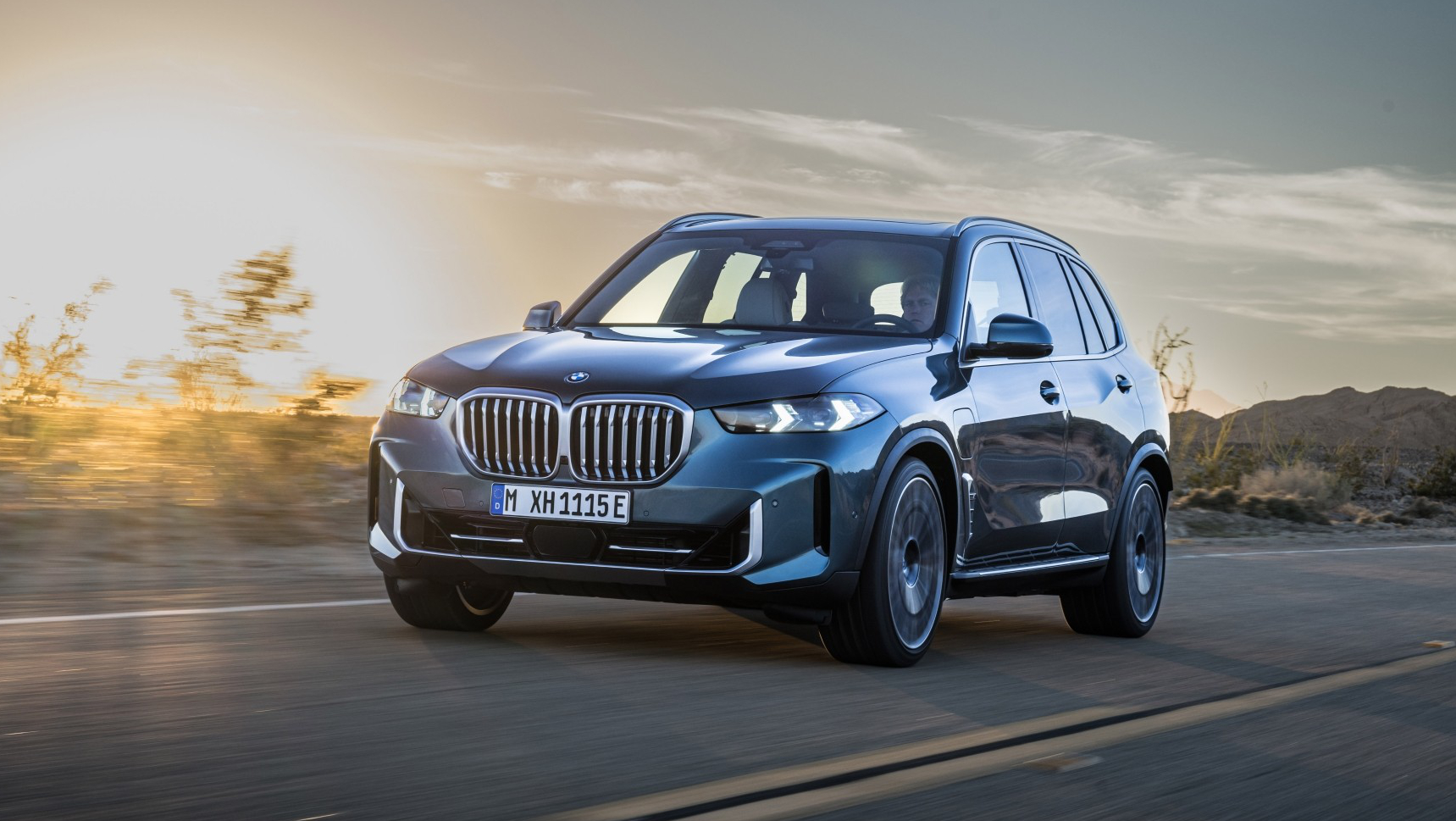
BMW’s X5 / X5 PHEV models earned a coveted “Top Pick” designation, ranking them among Consumer Reports magazine’s top ten vehicles.
In the Luxury Midsized SUV category, BMW’s X5 / X5 PHEV models garnered an esteemed “Top Pick” designation with overall scores of 87 / 83 respectively. “Everything about the X5 says ‘premium,'” the report states. “Both powerful and efficient, the base X5 delivers swift acceleration (0 to 60 mph in 6 seconds) and returns 23 mpg overall—among the highest fuel economy in its peer group. The plug-in hybrid version heightens this efficiency with an electric-only range of 39 miles, bringing real energy cost savings to drivers who routinely travel locally and have convenient access to charging.”
In the more segmented categories, BMW models repeatedly receive high marks and are often the only German marque included.
In the “Satisfying New Models” category, the BMW X5 appears with 83% of owners saying they would buy the model again. In the “Best and Worst Gas Mileage” listing, several BMWs have above-average fuel efficiency. For “Destination Charges” ranking, BMW is listed as having one of the lowest fees.
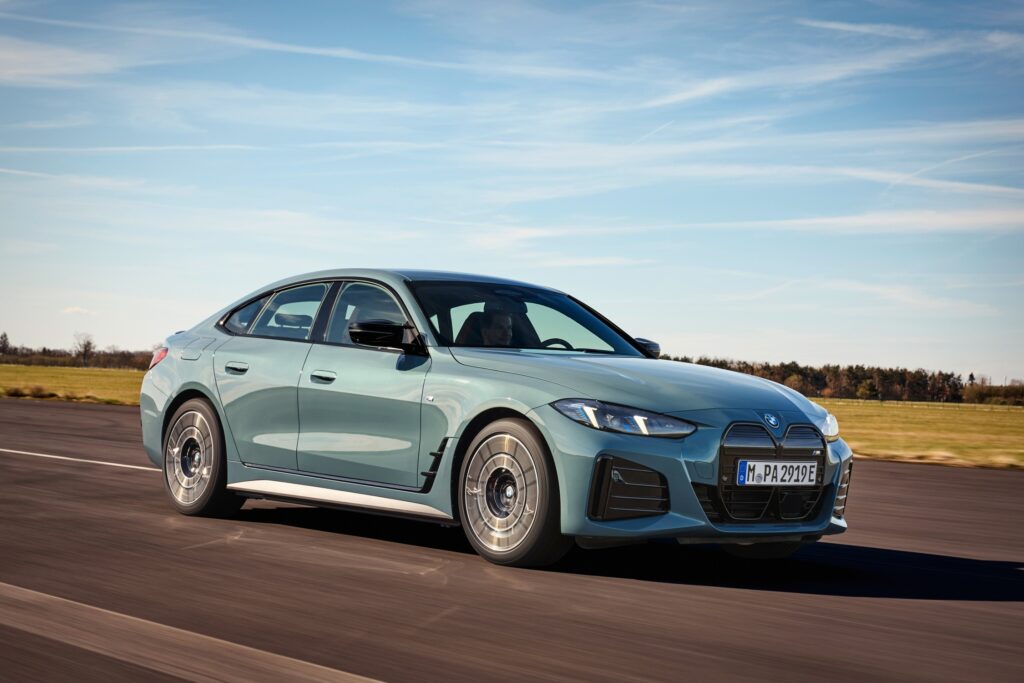
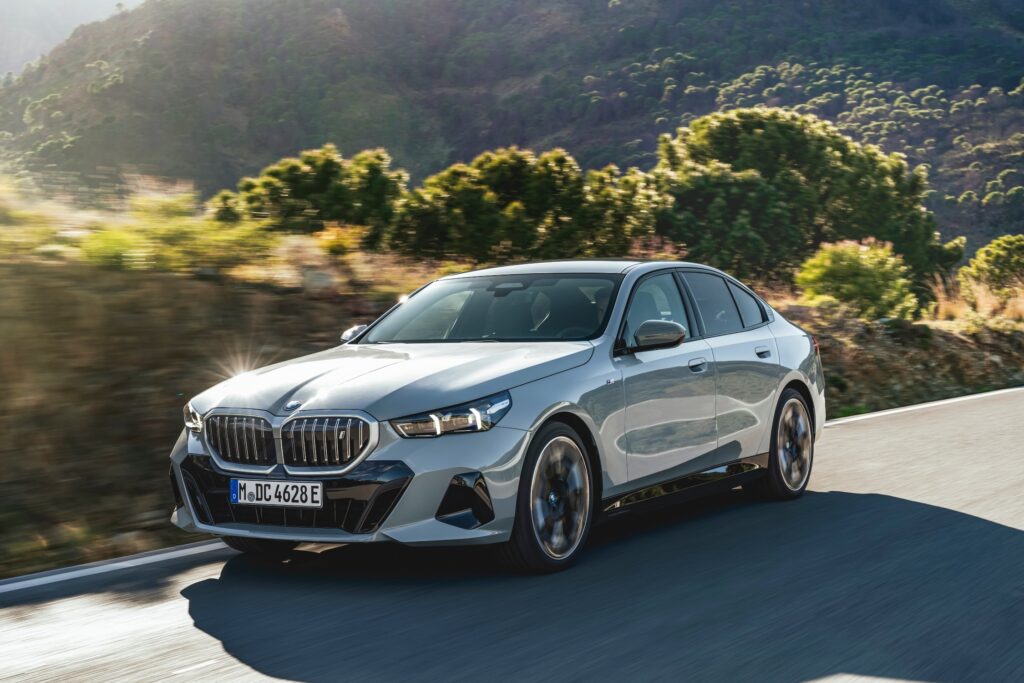
In the key “Most Reliable” category, the BMW i4 ranks in the top 10 of all vehicles. Overall, the magazine reports that BMWs rank quite high in reliability categories for most models.
BMWs also ranked either at the top or close to the top in the specific vehicle categories, including Cars: Luxury Compact, Cars: Luxury Midsized/Large, Cars: Luxury Electric, Sports Cars: 2 Seat, Sports Cars: 4/5 Seat, SUVs: Luxury Entry Level, SUVs: Luxury Midsized, SUVs: Luxury 3-Row, and SUVs: Electric Luxury.
BMWs took the crown in the Cars: Luxury Electric list, filling the top two spots with the BMW i4 and BMW i5. BMW topped the Cars: Luxury Midsized category with the BMW X5. BMW came in a close second in the Cars: Luxury Compact category with the BMW 330i xDrive, Cars: Luxury Midsized/Large category with the BMW 530i, and SUVs: Luxury 3-Row category with the BMW X7.
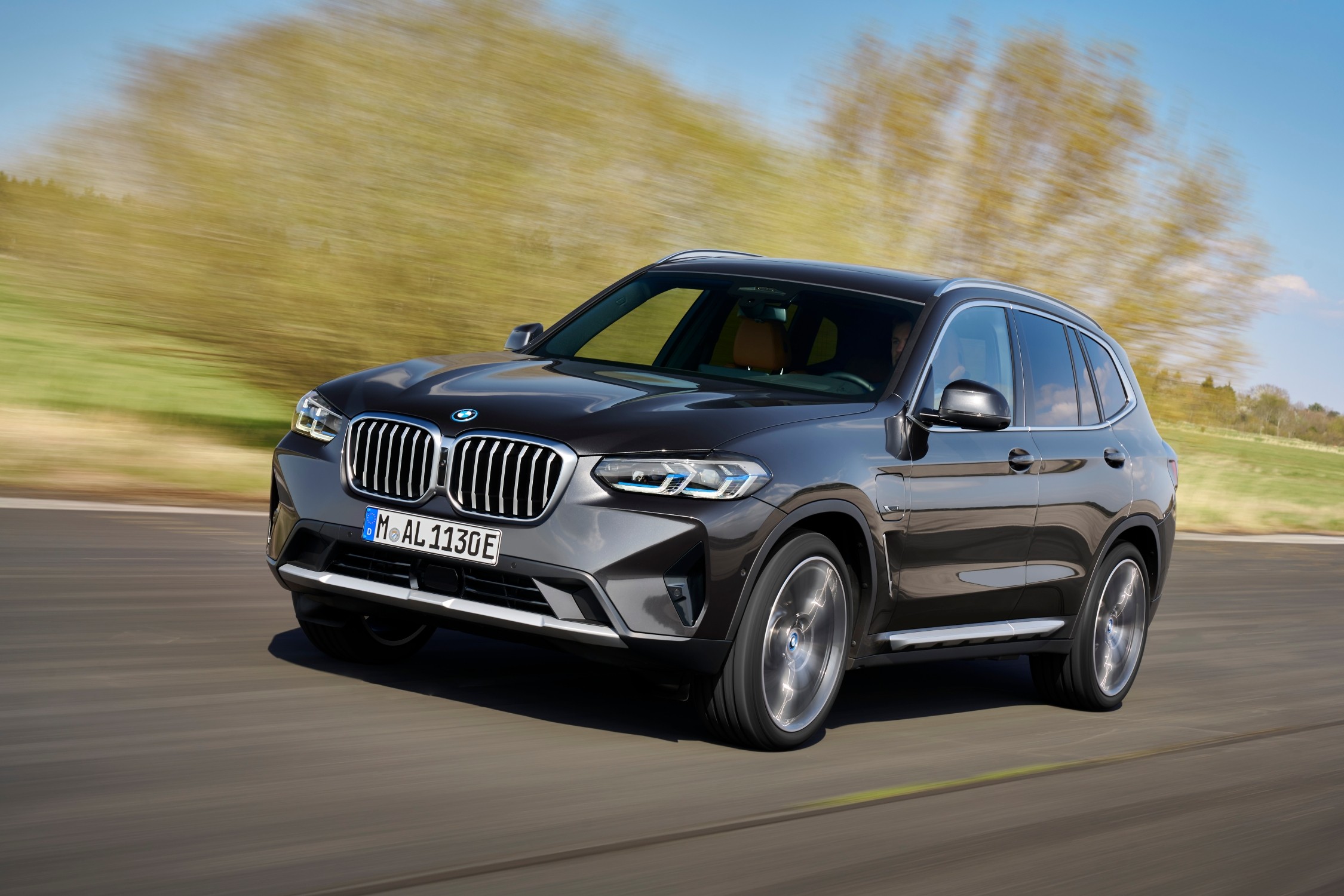
The 2022 BMW X3 was one of ten vehicles (and the only German marque) listed in the “Used Cars We Love” category.
And in the “Used Cars We Love” category, the 2022 BMW X3 appears in the top 10 and is the only German marque listed. “BMW’s luxurious midsized SUV (SAV to us BMW enthusiasts) is both practical and indulgent, blending safety, performance, and comfort.”
However, the true icing on the cake appears when Consumer Reports answers, “Which Brands Make the Best Cars?”
CR ranked 32 automakers from best to worst. Of these, BMW ranked a very close second, only bested by Subaru by a single point. Lexus and Porsche were close behind in the top five. Audi squeaked in at 6th place, but Mercedes-Benz ended up in 23rd place, tied with Lincoln. The rankings combined the testing scores, owner surveys, reliability ratings, safety ratings, and other tested elements.
So sure, BMW Group was only present in this year’s car-ad-laden-why-are-you-reading-this-if-you-aren’t-rich Robb Report with the Rolls-Royce Cullinan II (BMW Group owns Rolls-Royce Motorcars.). But in the more accessible is-this-a-reliable-safe-stylish-fun-awesome car testing of Consumer Reports, BMW really does shine brightly.
Read all the details in the April 2025 issue of Consumer Reports at consumerreports.org
The post BMW Receives High Marks From Consumer Reports appeared first on BimmerLife.
]]>The post Detailer’s Domain G87 M2 – Test Drive appeared first on BimmerLife.
]]>Mike Maravilla of Pit+Paddock borrows Phil’s M2 for a week in August to attend MPACT Motorsports Festival at Pocono Raceway, and reflects on the future of BMW M cars, finding the perfect photo backdrop, and premium aftermarket performance parts and accessories.
“[Phil] Yiu operates his entire life within this tiny percentage of discerning, actionable enthusiasts. He obsesses over every detail; his style—a mix of OEM+ and high-end boutique—is a timeless and uncompromising one that helps his clients immediately aware of two things: 1.) Detailer’s Domain understands the modern enthusiast’s unique needs, and 2.) Yiu can go toe-to-toe with the best of us modding cars. It’s no wonder why his customers often leave with more than a detail.” – Mike Maravilla, Pit+Paddock
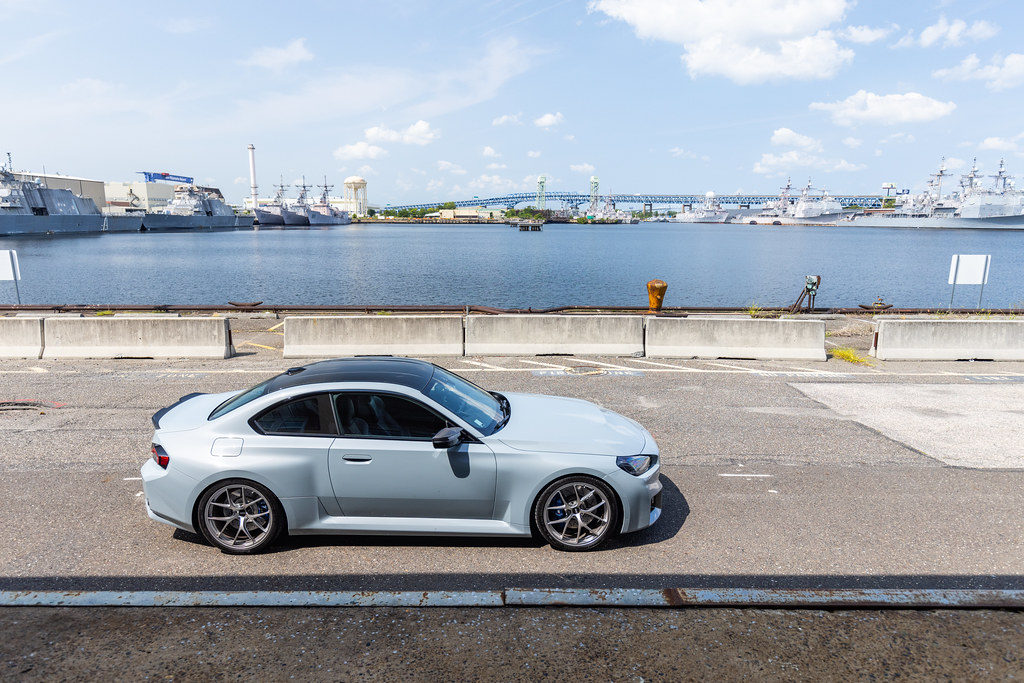
[Photo by Mike Maravilla]
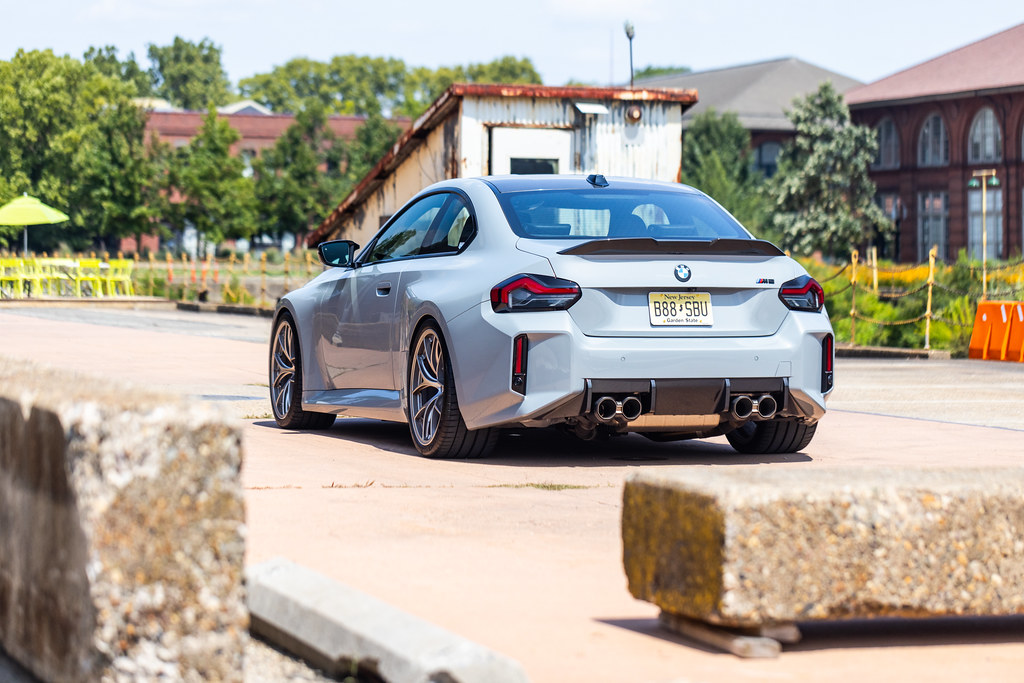
“At the top of that mountain is Detailer’s Domain, a reseller of niche automotive car care products and one of the nation’s best automotive detailing service providers. Its owner, Phil Yiu, has been a die-hard enthusiast for decades. His love for the machine and for maintaining a near-perfect aesthetic is a bit like the chicken and the egg conundrum. Ultimately, both have kept feeding each other to create the unmatched standard that Detailer’s Domain permeates daily. This Brooklyn Grey G87 M2 is the latest toy that Yiu has tickered with, leveraging top-tier BMW aftermarket players like Akrapovič, BBS, Eventuri, KW, and Michelin to help him realize his vision.”
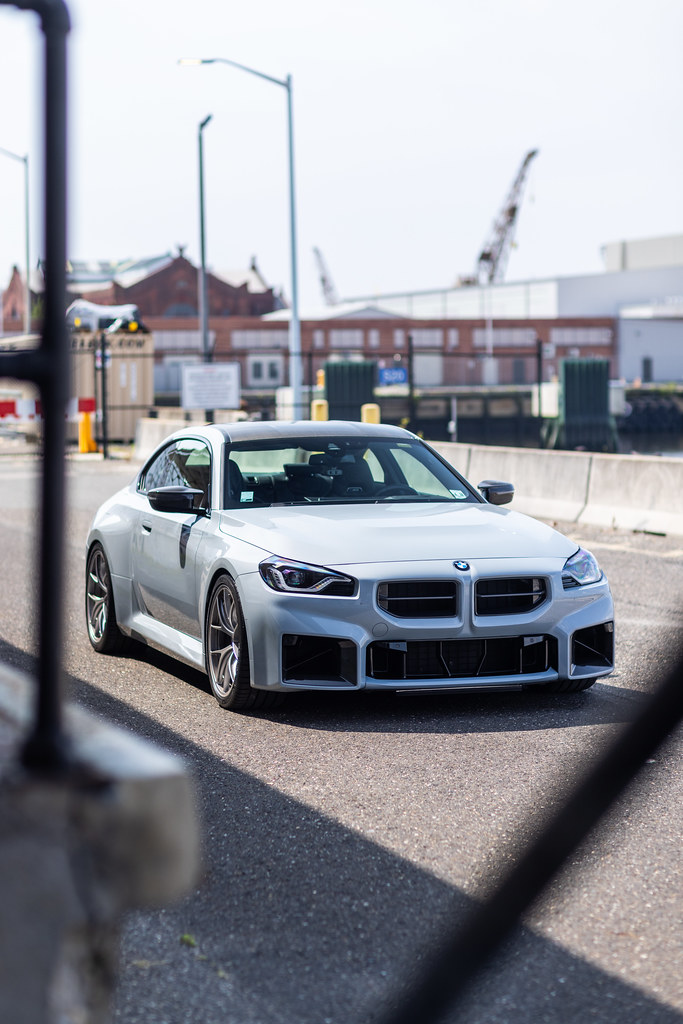
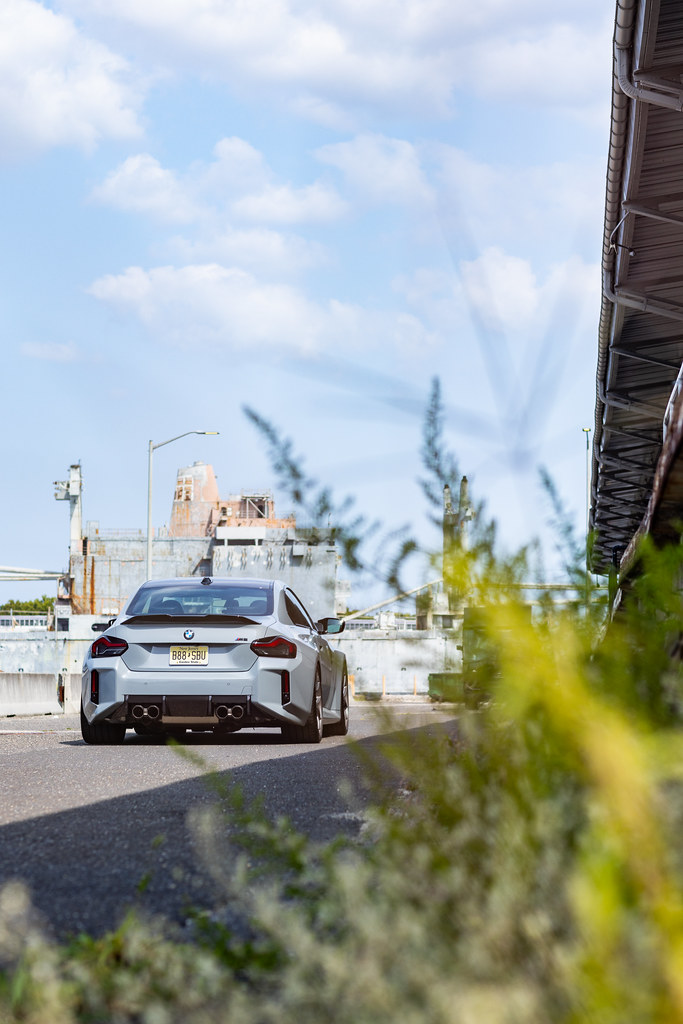
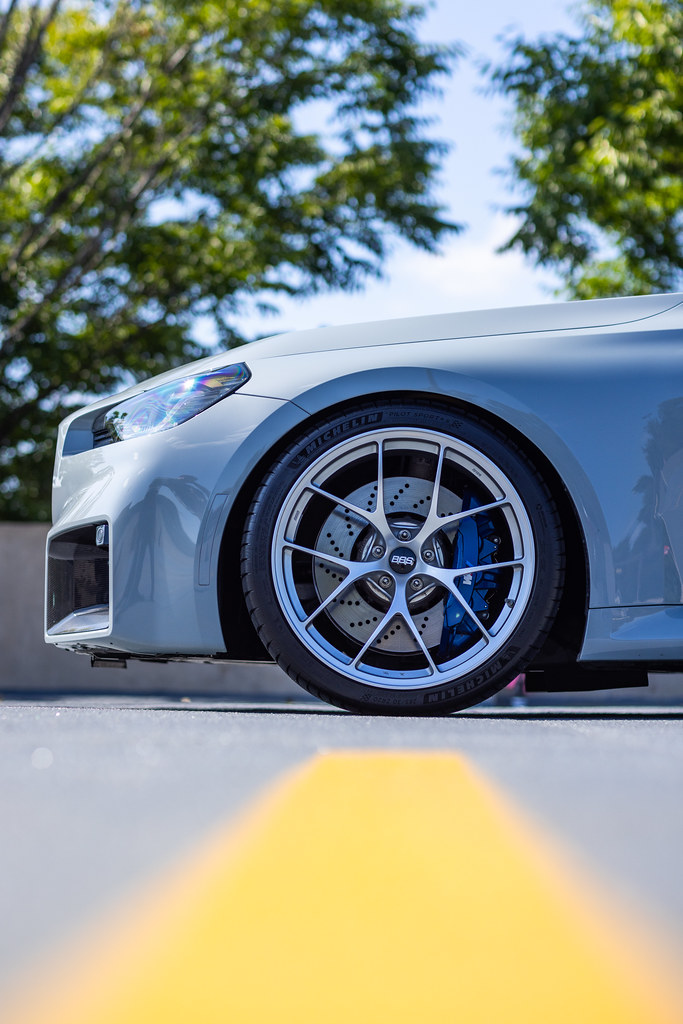
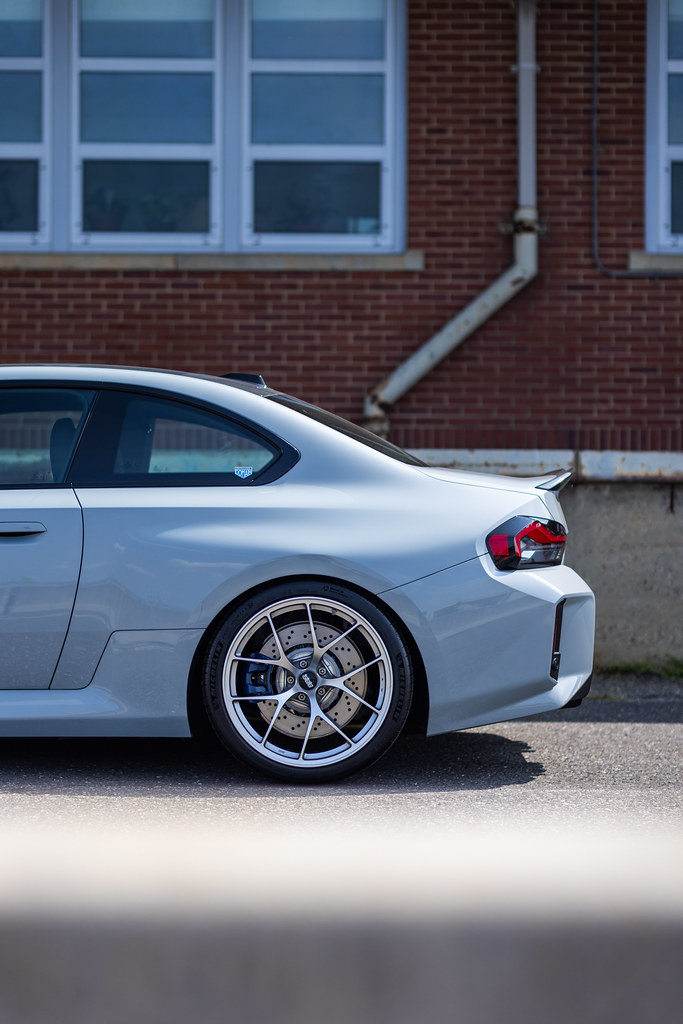
“An invite to showcase Yiu’s G87 M2 at MPACT Motorsport Festival created an opportunity to spend some time with the car. Before the show, I drove up to Norwood, NJ to scoop up the M2. After following Yiu’s progress on Instagram, it was good to finally see the car in person. “Frighteningly perfect” was how I’d describe my first impressions. No joke, this car was better than new; the M2 was a living, breathing testament to the standard that Yiu and his crew uphold every day. It made all the right impressions at the show in front of fellow BMW loyalists.”
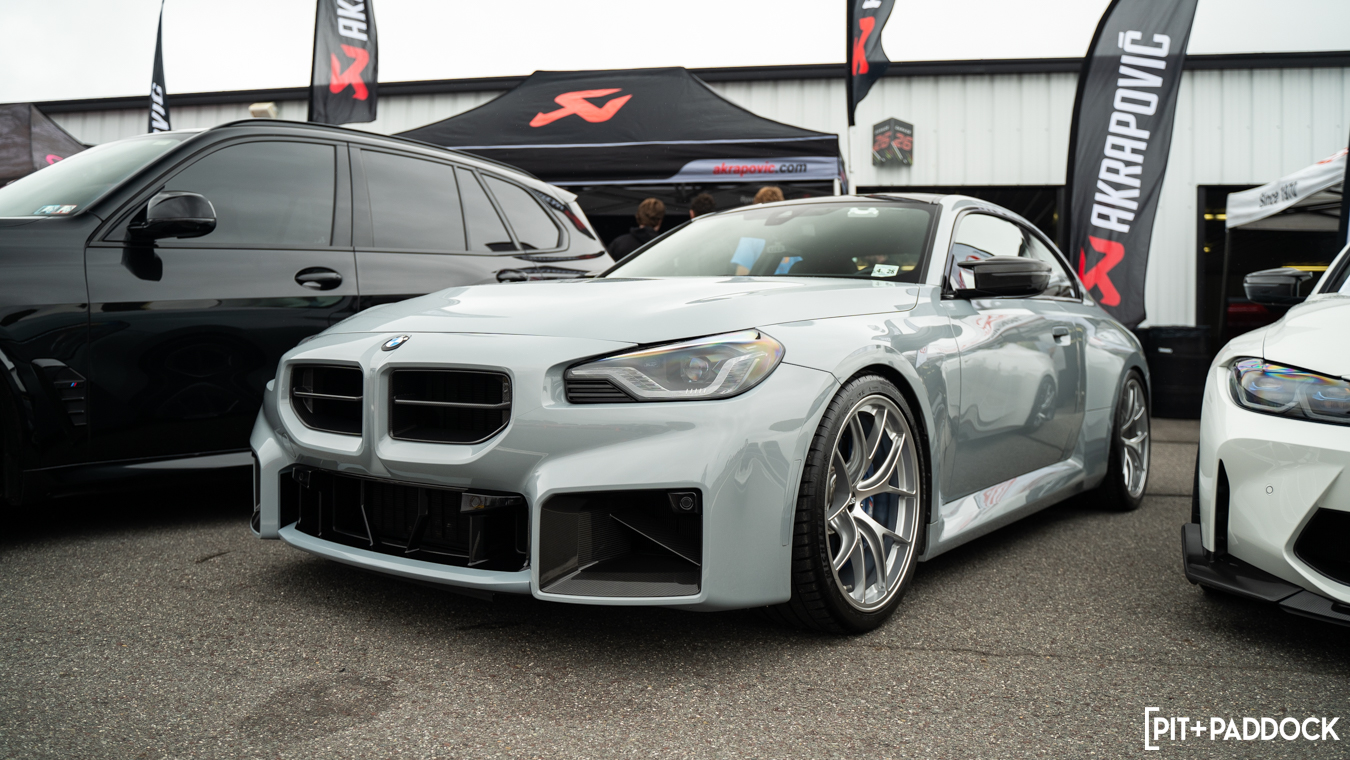
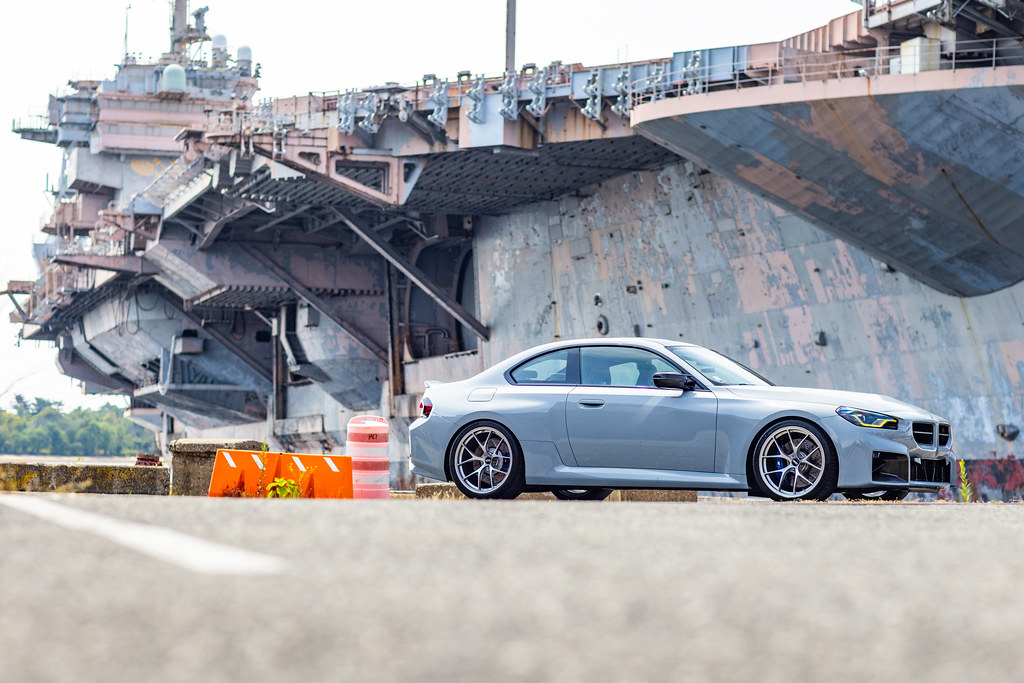
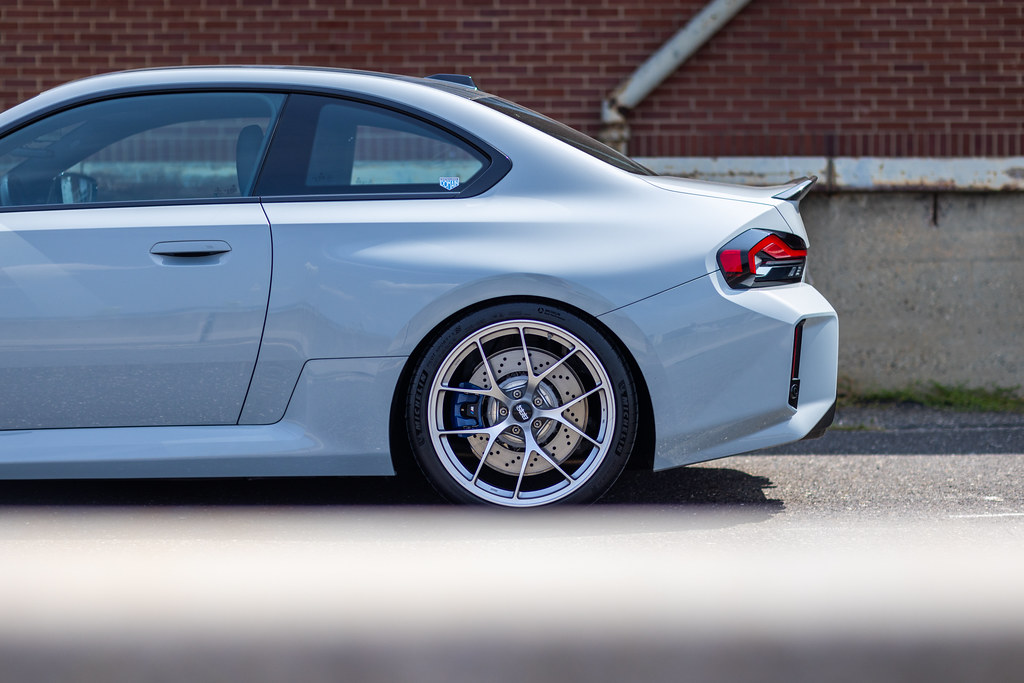
“I maintain that it’s the most important car in BMW’s current M family, so deciding whether the 453hp coupé lived up to the badge was an experiment I was excited to conduct.” Mike continues, “I ultimately chose to take Yiu’s M2 to explore one of Philadelphia’s gems: its Navy Yard. Even though the location may be considered “played out” by the locals, there’s simply no New Jersey equivalent to this backdrop. Nevertheless, this car’s Brooklyn Grey hue and muscular, hunkered-down proportions felt appropriately militaristic for the scene. So off I went, toggling between the M2’s drive modes en route to Philly’s southern extremities.”
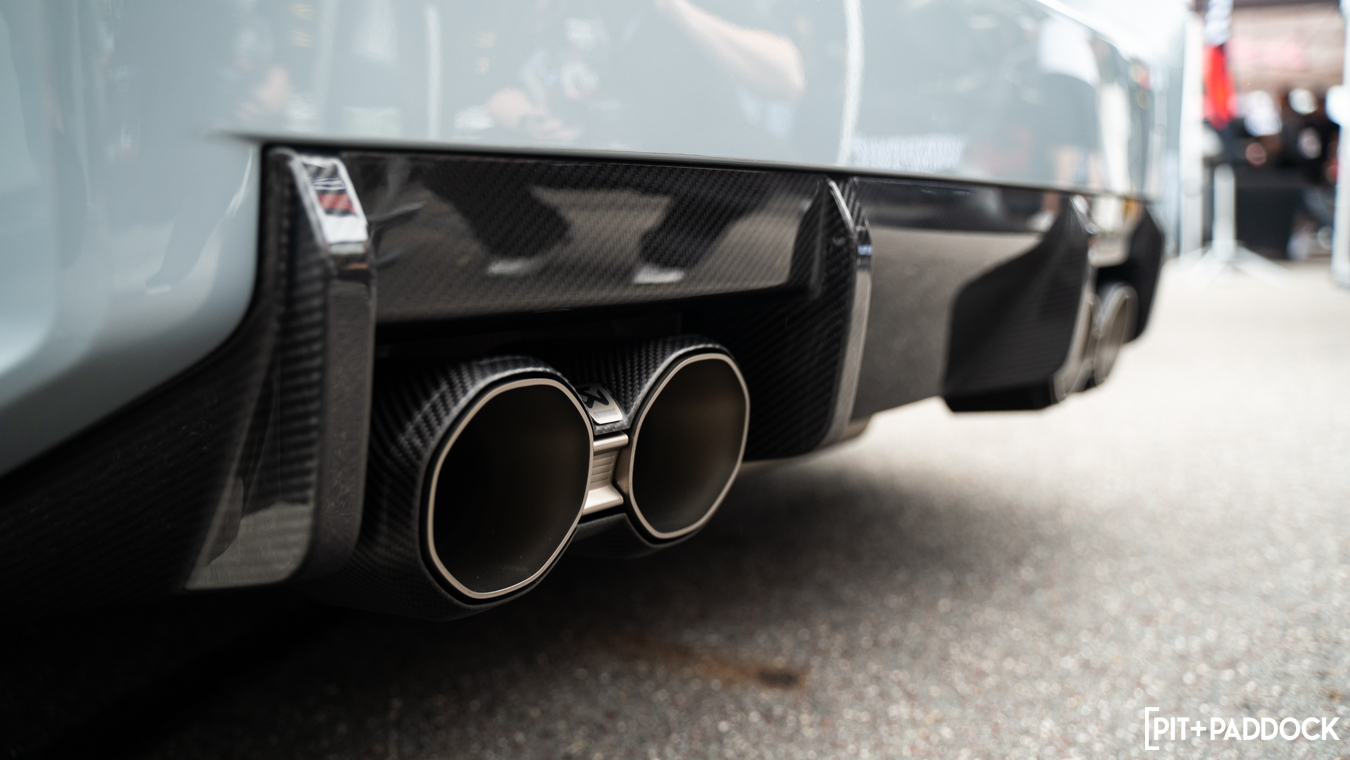
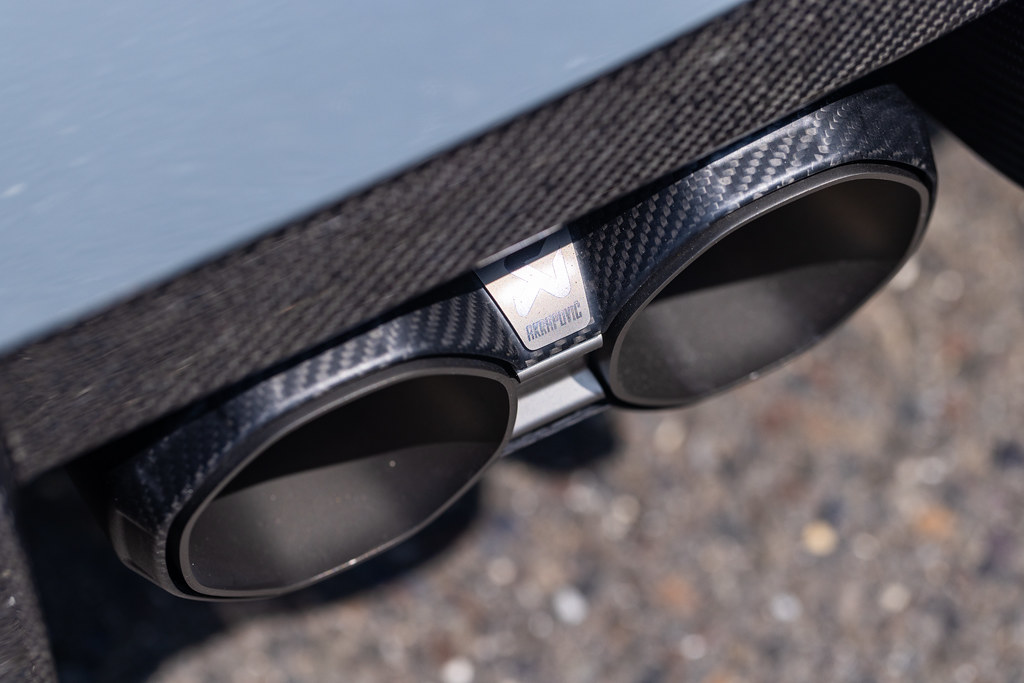
“The M2’s [Akrapovič’] Slip-On Line titanium exhaust (S-BM/T/34H) is far from the loudest on the market, but it is by far the sweetest. The exotic material exudes a tone that no other maker can replicate. It’s also magically balanced; even as the revs climb toward redline, it never intrudes on the Eventuri induction note. The result is an experience that hits you from every angle like sitting in a THX theater. Sonorous and fulfilling, the Akrapovič system provides every excuse you need to keep the M2 on song.”, Mike gushes.
[Photo by Mike Maravilla]
[Photo by Mike Maravilla]
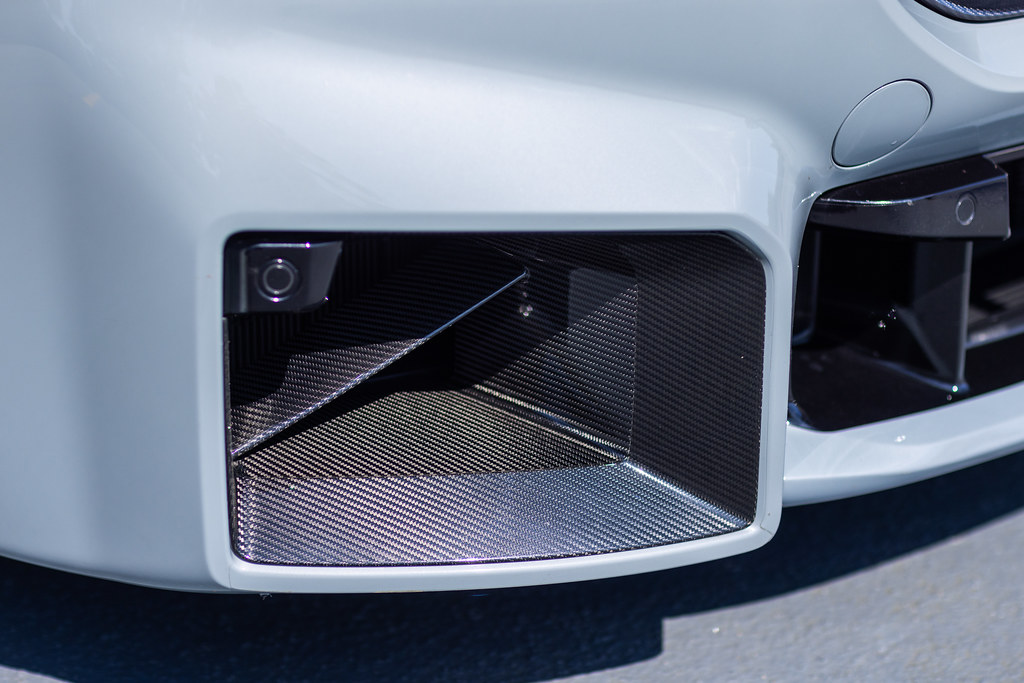
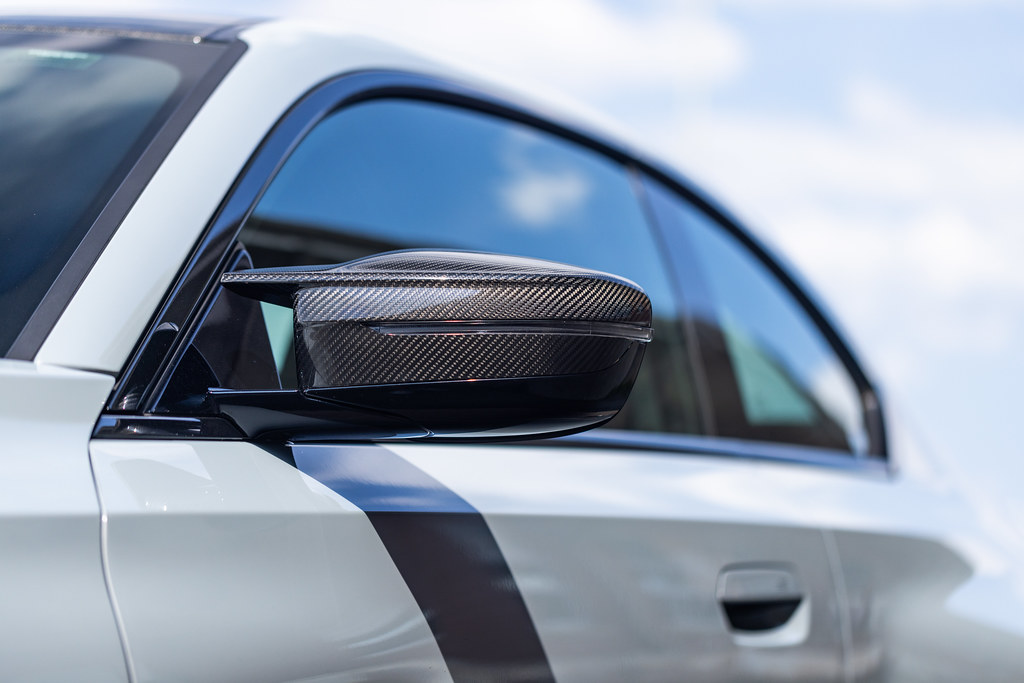
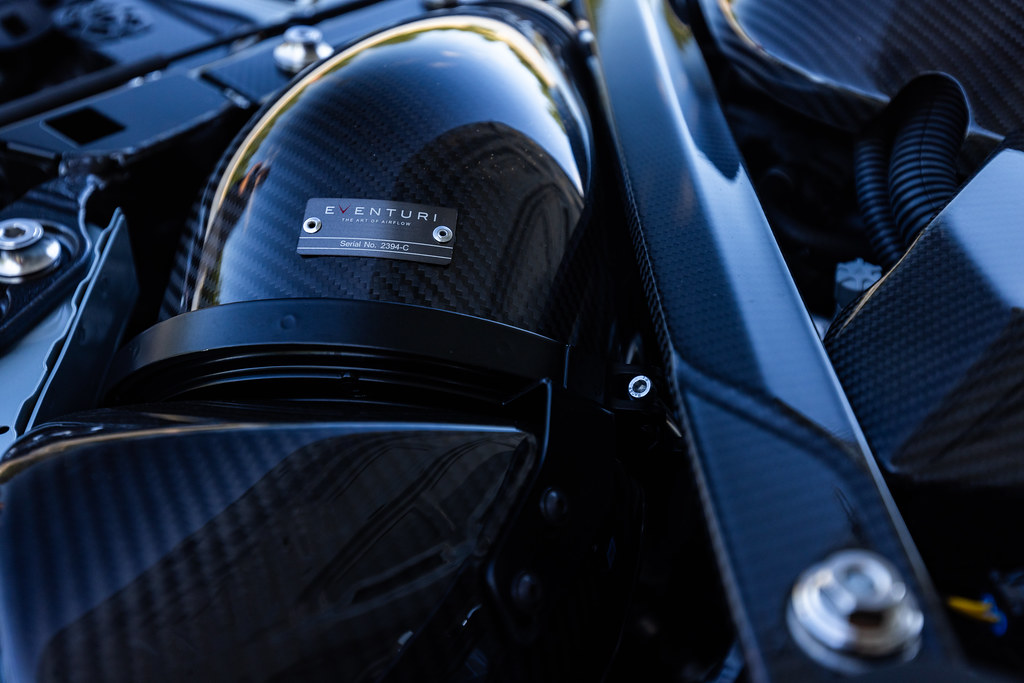
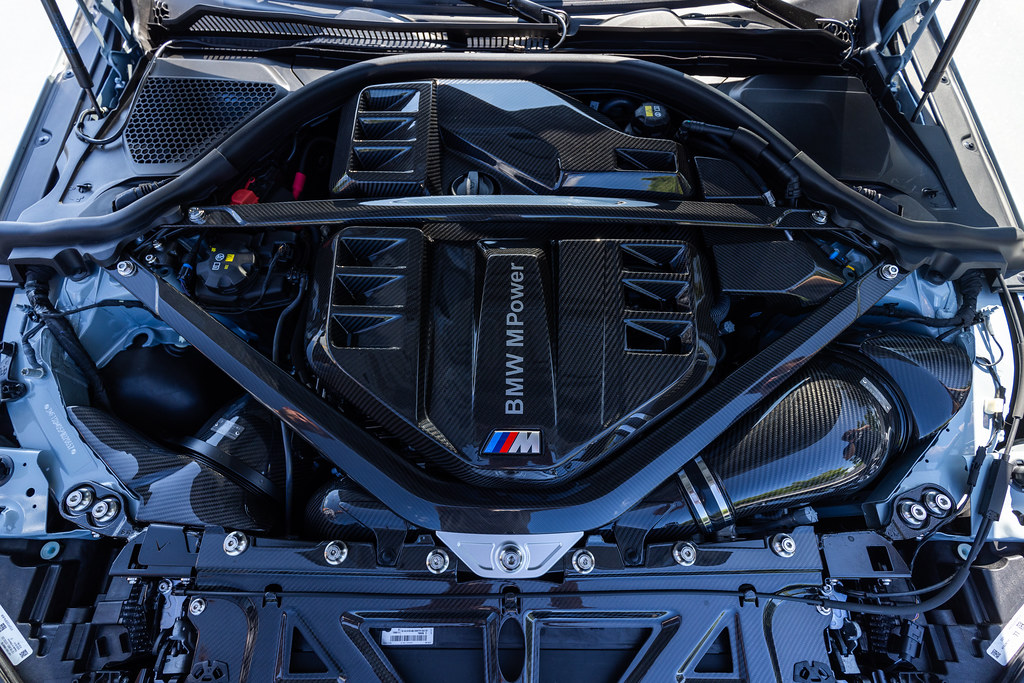
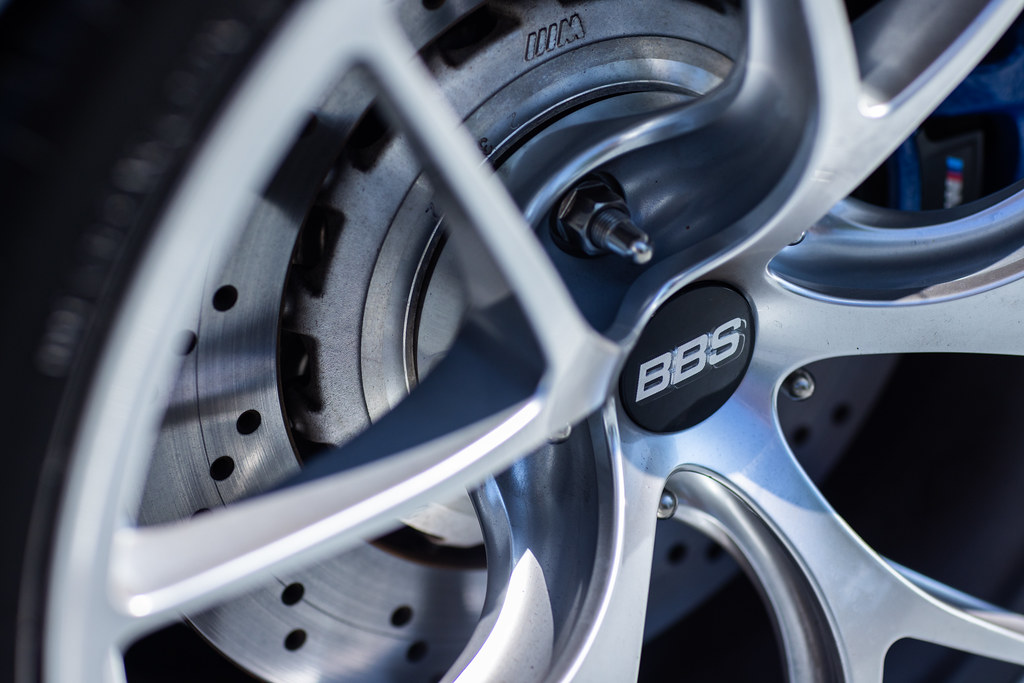
“Admittedly, the car’s new stance made the biggest improvement to the factory’s work. Yiu’s M2 wears 20” BBS RI-D wheels with Michelin Pilot Sport 4S tires—a combination that will never get old on German cars, especially those keen on mixing street and track duty. The front wears a surprisingly meaty 285/30/20 while the rear is virtually square: a 295/30/20. The KW Height Adjustable Spring kit (253200EB)—which is set to max low front and rear—coupled with a Future Classic titanium stud kit, and 5mm spacers up front help tie the whole thing together perfectly.”
Mike rants, “Some could argue that this tried-and-true recipe may be long in the tooth but Instagram has really fooled the masses into thinking that every BMW owner executes a car on this level. In reality, it’s probably 2% of the marque’s total BMW M ownership that can, and an even smaller percentage that actually would actually do it.”
[Photo by Mike Maravilla]
[Photo by Mike Maravilla]
“After spending time a few days with this modern machine, I had to think whether my mind had changed about BMW’s latest M2 or whether I was simply bewitched by its doo-dads like Apple CarPlay.”, Mike reflects.
“Indeed, Detailer’s Domain is one of only a handful of automotive detailers who have broken into the limelight and is deservedly a beacon for any discerning enthusiast across the nation—myself included. Still, after countless builds like this, Yiu manages to approach his work and every car project with a sense of enviable purity. “I’m in this to have fun and meet a lot of car enthusiasts,” he says. Although he’s been tempted by loftier marques, Yiu admits that BMW hits a soft spot and that he’ll always have (at least) one in his stable. Kudos to you, Phil, for everything that you do and what you’ve done with this G87 M2. For the rest of us, it’s one of the best benchmarks to strive toward.” – Mike Maravilla
See more photos and the full article here.
The post Detailer’s Domain G87 M2 – Test Drive appeared first on BimmerLife.
]]>The post A V10 BMW M5 Touring Is A Happy Place appeared first on BimmerLife.
]]>“A superlative sportscar, packed in a sporty, but never showy bodywork” – that’s how BMW M described the first BMW M5 Touring in 1992.
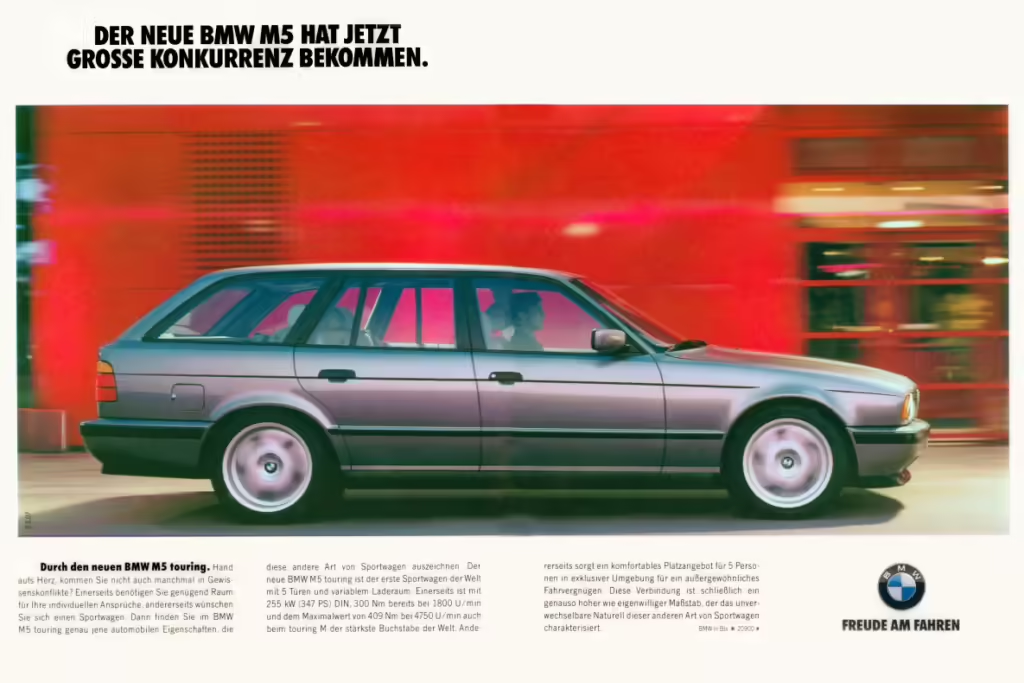
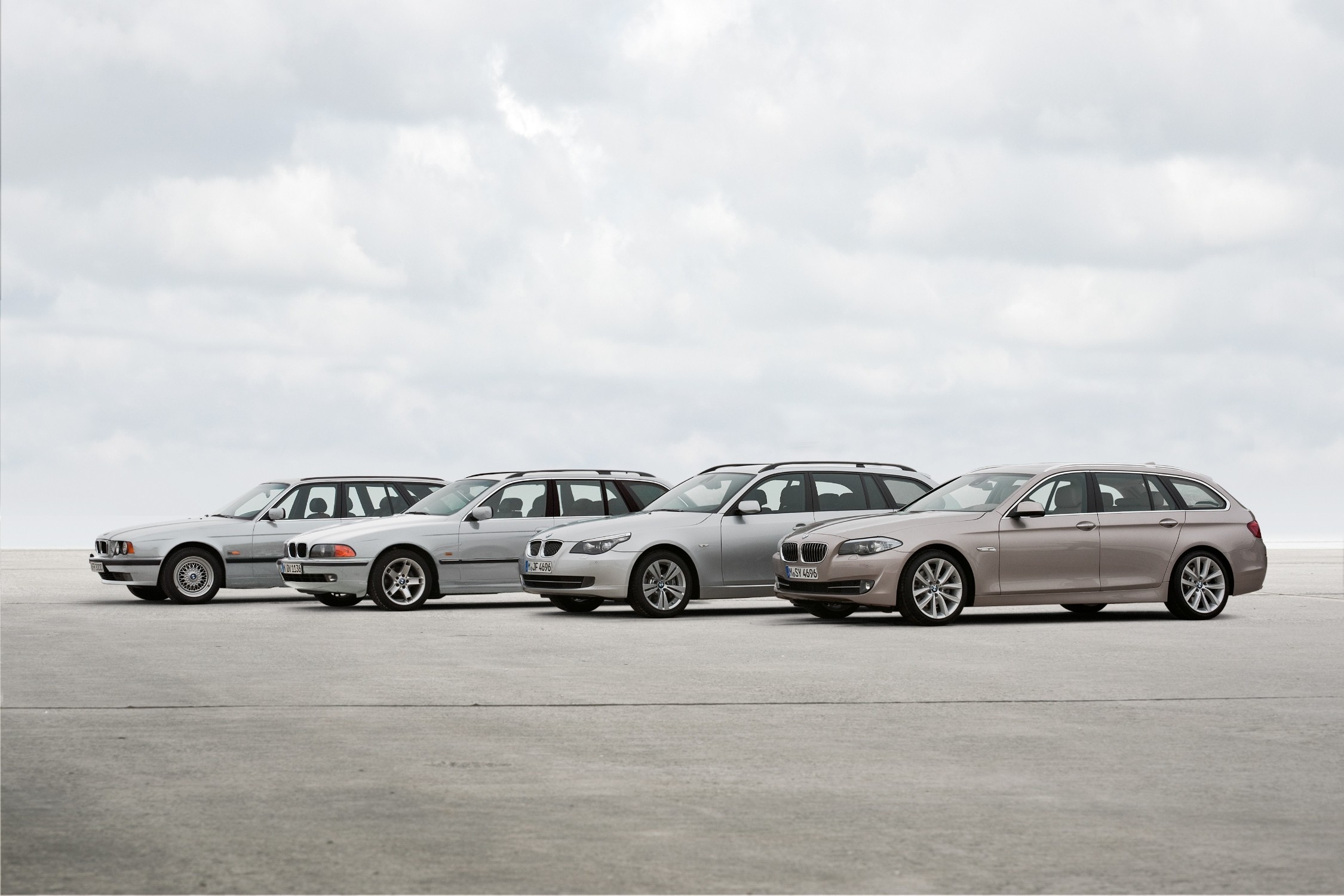
A sleepless night takes me on a deep dive into BMW history. Non-M 5-Series tourings lined up by generation for a press photo make me smile and giggle, disturbing my dog, Cota, who wonders why the lights are on and I’m not in bed. Who wouldn’t want an M5 wagon as a daily driver? Tell me you’ve never fantasized about squandering savings on a motor-swapped 5-Series touring, a DIY M5 touring of your own? I have, and you’re being dishonest if you say you haven’t.
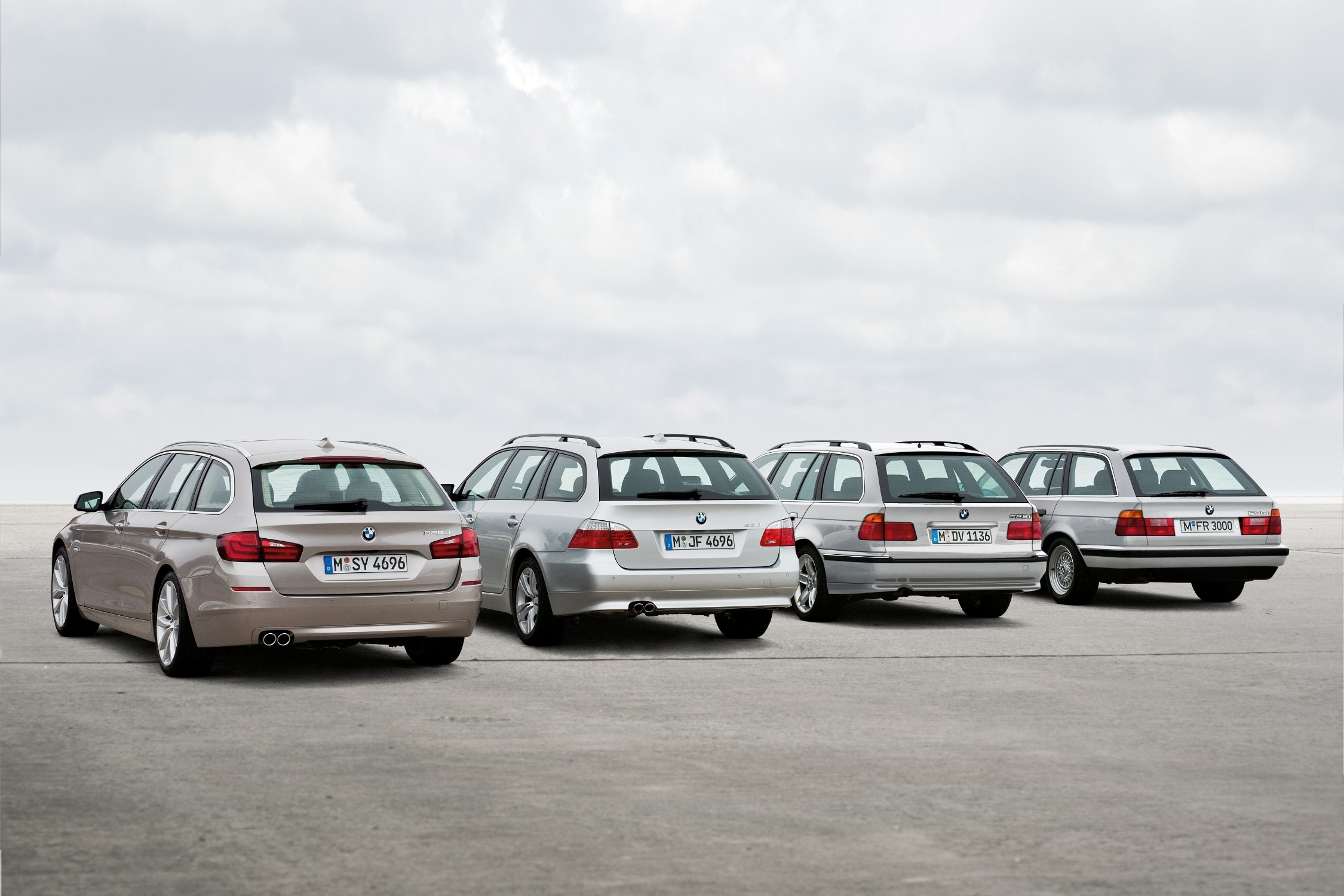
“The E60 M5 was arguably the car that ignited the ‘arms race’ of contemporary super saloons. It was the first such vehicle to use a V10 petrol engine, and the headline figure of 500bhp was extraordinary at the time. Enthusiasts had scarcely had time to lift their jaws from the floor when the E61 Touring version arrived in 2007.” – Collecting Cars
The E61 M5 Touring stats are impressive even by today’s standards. 5L V10. 507 hp with 383 lb-ft of torque. 0-60 in 4.7 seconds (or less). Launch control. Not very demure. Not very mindful. Not in the slightest.
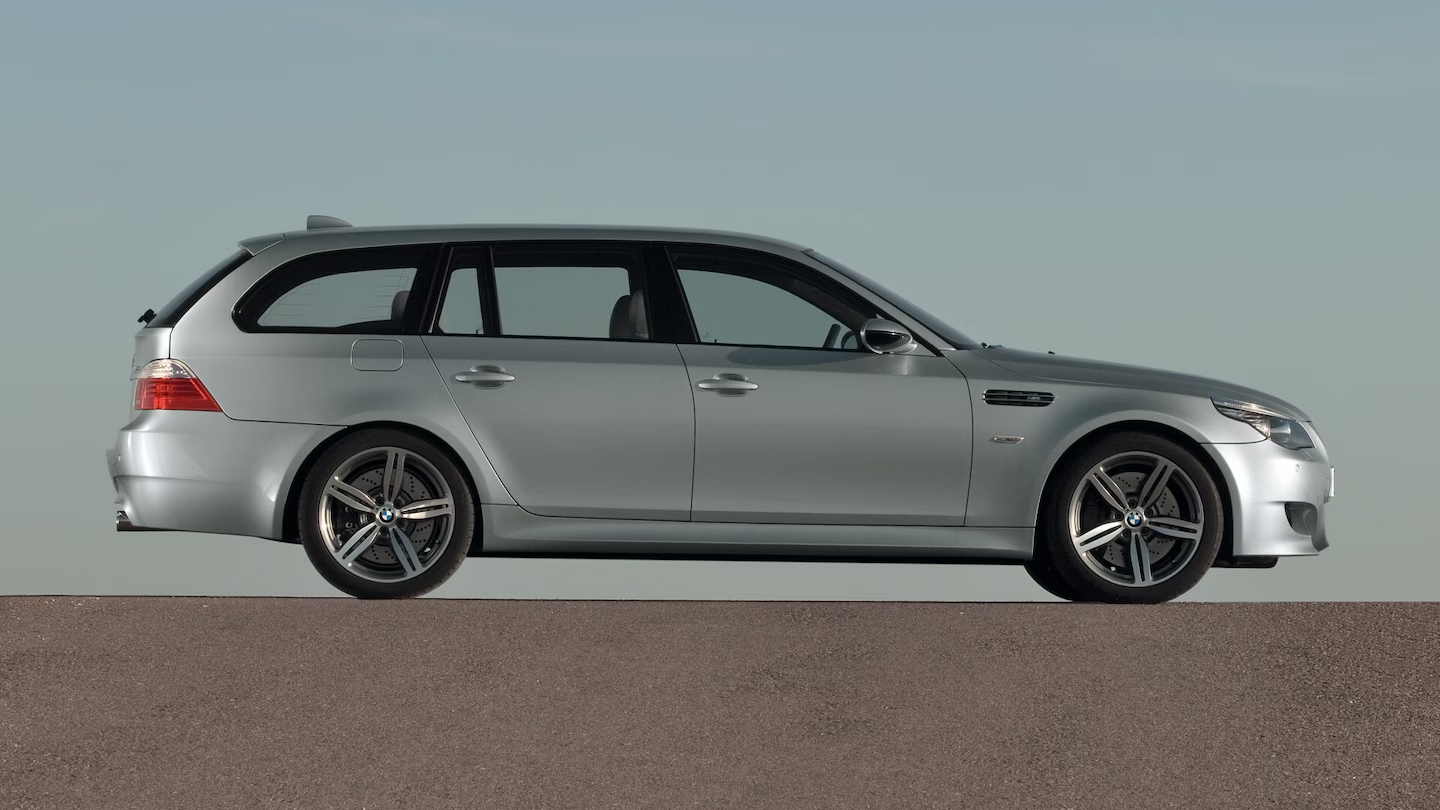
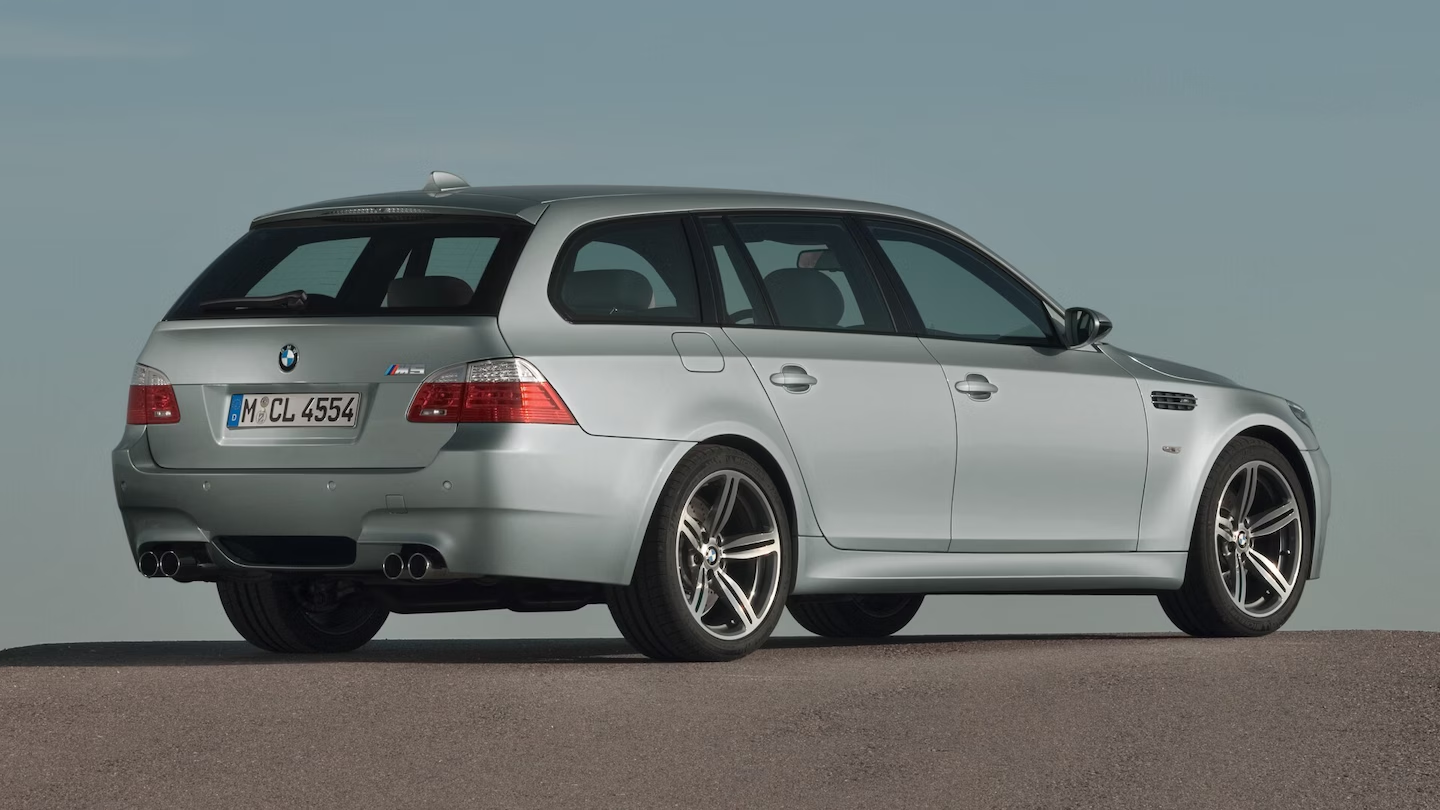
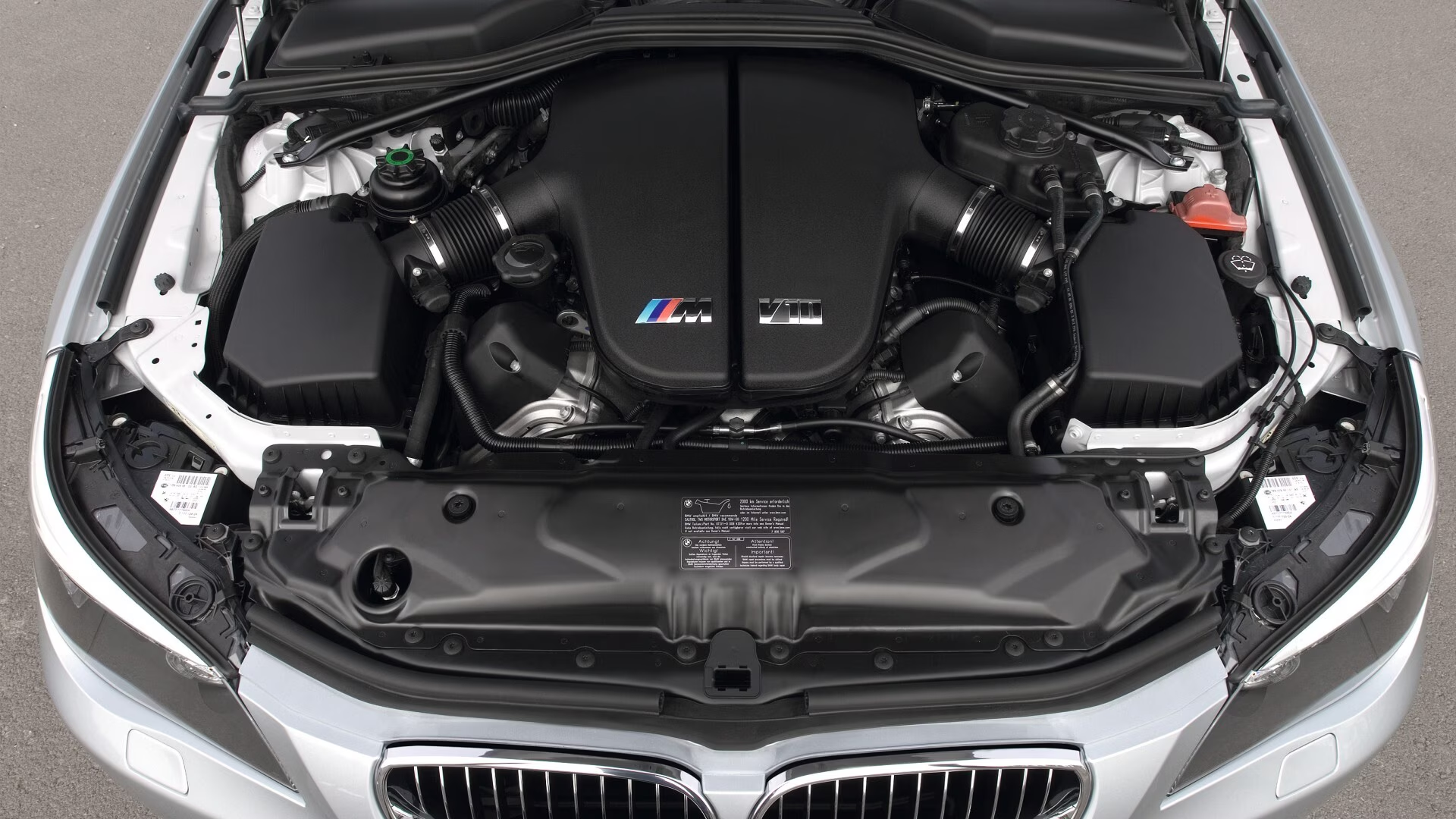
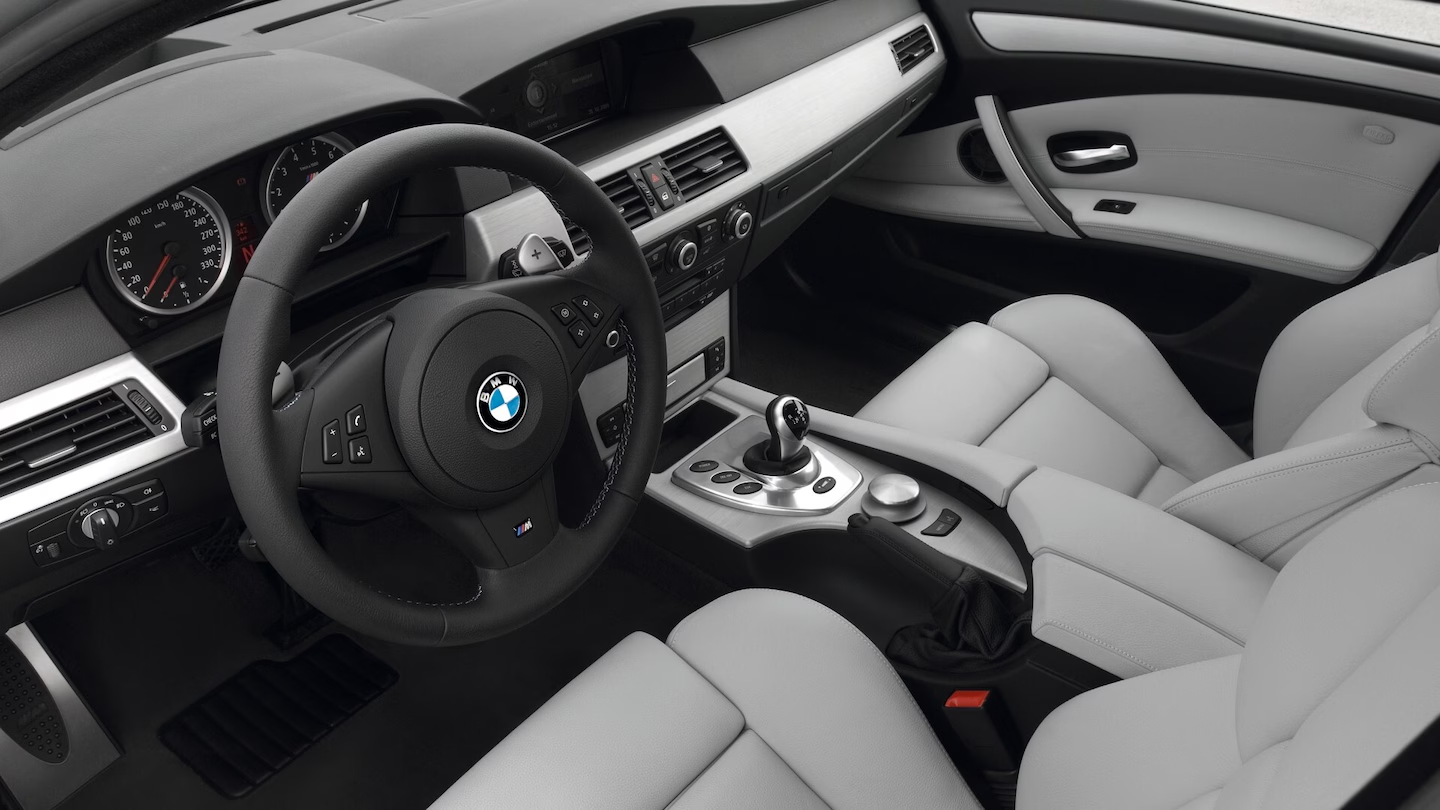
It’s now two hours before my alarm will go off, and I’m re-watching a video where Chris Harris reviews his new-to-him E61 M5 Touring, and I fall in love all over again. With the car, not Chris. I hope you enjoy the watch as much as I do, even the second time around. – Cat Choe
“Chris Harris is very good at talking about cars. Knowledgeable, entertaining, and frequently witty, it’s clear why he’s had success in the video review format. However, when discussing his newest acquisition, the E61 BMW M5 Touring, he exudes an infectious excitement reminiscent of a thrilled 10-year-old—and we say that in the most complimentary manner possible.” – Carscoops
The post A V10 BMW M5 Touring Is A Happy Place appeared first on BimmerLife.
]]>The post Road & Track – Is the BMW X5M Competition a Better ‘Wagon’ Than the Incoming G99 M5? appeared first on BimmerLife.
]]>While the upcoming BMW M5 Touring (G99) wagon has been the hot topic as of late, are we overlooking an equally impressive and capable car that’s already available from BMW? Will Sabel Courtney from Road & Track thinks so, and his argument is thought provoking, even for a hot hatch and wagon enthusiast like me.
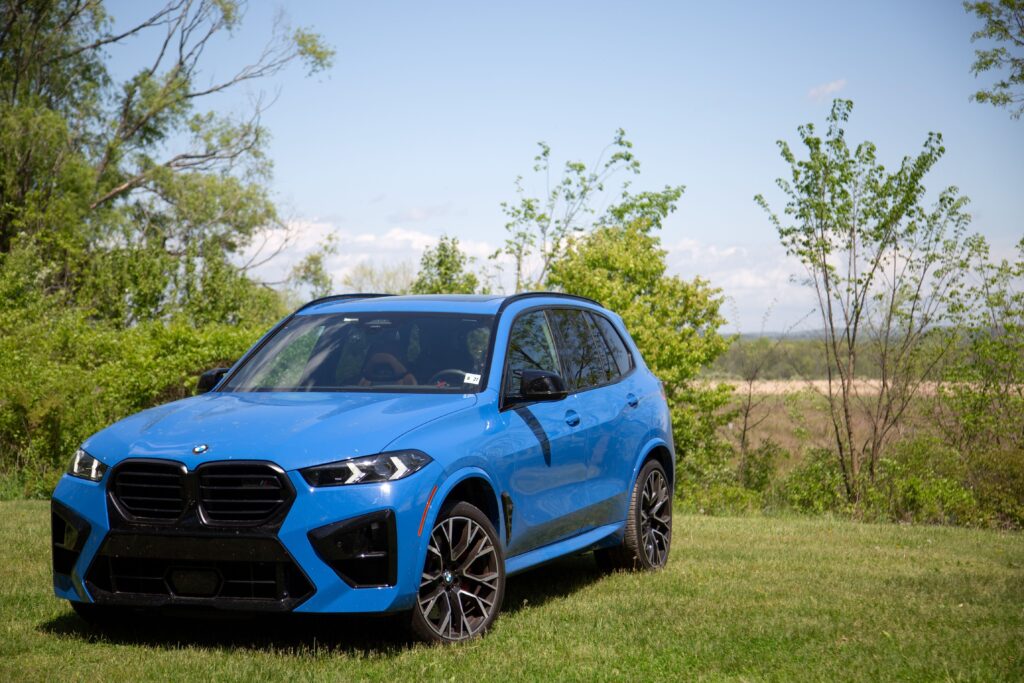
The initial argument against the G99 M5 wagon lies in it’s powerplant – the hybrid, turbocharged V8 that it coincidentally shares with another large BMW SUV, the XM. “While I haven’t driven the new M5 yet, I have driven the vehicle that uses the same powertrain: the BMW XM. That giant SUV is confounding for many reasons, but perhaps the most vexing is how, well, unpleasant it is to drive. It defaults to electric power in Hybrid mode, and feels reluctant to engage the V-8 — and when the eight-pot does fire up, either because the battery runs low or because you goose the right pedal, the transition often feels jerky and unpleasant. It only feels coherent when being driven at max attack — something that happens rarely, given the power and mass involved. After experiencing the XM, my concern over the G90 M5 is quite palpable.” – Will Sabel Courtney, Road & Track
He continues, “The X5 M, on the flipside, never feels inconsistent from behind the wheel. M’s master craftsmen have done a mighty job of turning the X5 – which, to be fair, is already one of the more enjoyable crossovers to drive — into a full-throated performance product.”
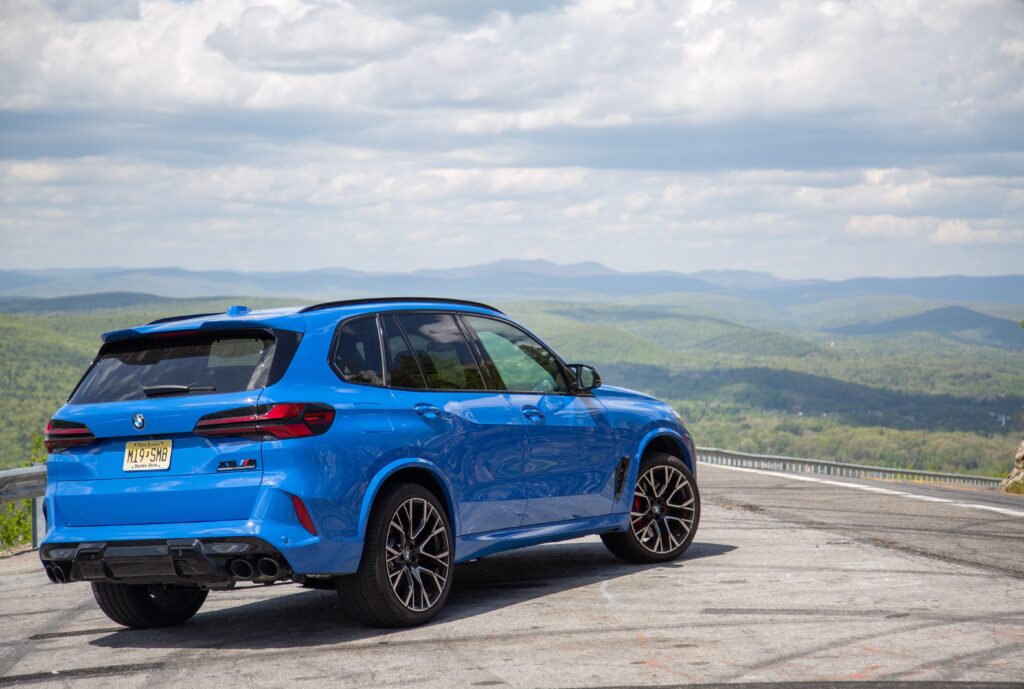
BMW X5 M Competition
The G99 M5 wagon weighs in at a hefty 5530 pounds, while the F95 X5 M Competition is nearly identical, but lighter at 5,498 pounds. The G99 M5 offsets its weight with a whopping 717 hp and 738 lb-ft of torque, the F95 X5M 617 hp and 553 lb-ft of torque.
The data is that, just data. How does that translate to seat-of-your-pants feel and which side are you on? Read more of what Will has to say here.
The post Road & Track – Is the BMW X5M Competition a Better ‘Wagon’ Than the Incoming G99 M5? appeared first on BimmerLife.
]]>The post BMW Overtakes Tesla Sales in Europe – Is Elon to Blame? appeared first on BimmerLife.
]]>Elon Musk’s often controversial outspokenness was once considered a marketing asset, overshadowing online banter poking at build quality inconsistencies and Cybertruck memes, his handling of the social media platform previously known as Twitter amongst other things, has soured Tesla owners, some claiming to have sold their cars because of him.
James Morris from Fortune magazine credits BMW’s success to the growing lineup of electric vehicles such as the iX1, iX2, iX3, iX, i5, and i7, even the upcoming Neue Klasse sedan, while Tesla’s big movers are limited to two models, the Model Y and Model 3.
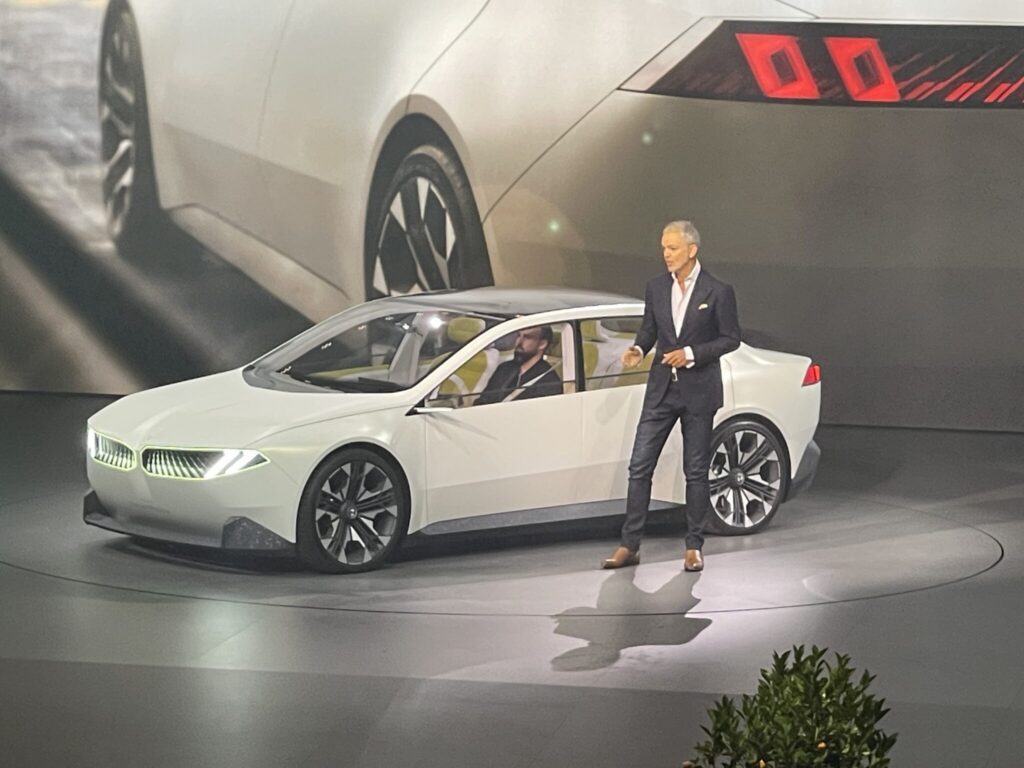
“The more premium i5 is gaining traction – garnering particular interest because the 5-series represents the core of what BMW is all about – Autobahn-conquering super saloons. But the electric i5 continues the model’s main strengths – solid performance, comfortable ride and capable range.” – James Morris, Fortune
James continues, “… it’s clear the gap between [Tesla] and other automakers has narrowed, with Chinese companies also catching up fast. BMW probably won’t be at the top of the BEV sales rankings every month from now on, but it looks like Tesla’s days of always having a clear market lead are over.”
The post BMW Overtakes Tesla Sales in Europe – Is Elon to Blame? appeared first on BimmerLife.
]]>