The post Anyone? Anyone? | Hello, Virginia; Spicoli, I’m Gonna Miss You appeared first on BimmerLife.
]]>However, I don’t know how to figure that out. In California, you just have to be here through one noticeable earthquake and you’ll be accepted. There’s probably a rite of passage here, too, maybe a secret handshake, but no one talks about it. I get by using “Dude!”, “Righteous!”, and “People on ’ludes should not drive” with reckless abandon. I also wear my slip-on Vans with flames, age-appropriate or not.
Am I going to miss California? Some of it, sure; I’ll miss the sunny days, beach walks, and easy access to high-quality Mexican food. I’m not exactly sure how I’m going to deal with the loss of grilled fish tacos, crispy carnitas, and Cadillac margaritas strong enough to be considered disinfectant, but I will survive… probably. Worst case, I’m perfectly capable of making the margaritas myself.
I’ll miss a lot of the car culture, too. I have a feeling that as good as the local Cars & Coffee may be on the East Coast, it is unlikely to draw from the same universe of vehicles. In the last 90 days or so, there were seven original GT-40s, some from each of three generations, at one show, four Paganis and three Koenigseggs at another, and so many McLarens at a third that no one even stopped to look at them; everybody, including me, went directly to the white-over-green 21-window VW bus instead.
Will I miss the traffic? No, not at all. Having a 45-minute drive take an hour and a half is just stupid, as is the fact that you can’t really predict how long your drive will actually be. As far as I can tell, the local chapter of the Anti-Destination League has a secret daily e-mail list wherein they announce where all of the impaired should meet to drive. Because of this dichotomy, we leave early and know every decent coffee roaster near our friends’ houses so that we can duck in and waste some time before we were actually supposed to show up. (It’s rude to show up early, but even worse to get drafted to help when you do. If I wanted to help make dinner, I would have brought a sharp knife, a decent pan or two, and an apron with neither ruffles nor floral print.4)
How bad is it? When I moved to south Orange County in the mid-Nineties, I could make it to downtown San Diego in a little over an hour; now I plan on two. One day, the Friday before a holiday weekend, it took over six hours.
There are a bunch of tracks there, too: Thermal Club, Chuckwalla, Buttonwillow, Willow Springs, Auto Club Speedway, Irwindale, the Porsche Experience Center, plus Laguna Seca, Sonoma, or Spring Mountain if you want to drive a little farther. But every one of them is a proctological nuisance to access in heavy traffic.
In contrast, where I live now, it’s about an hour and a half of easy driving to get to Summit Point.
Even California’s back roads aren’t really back roads anymore; they’ve been taken over by urban sprawl and fulfillment centers. A buddy put together a tour of fun SoCal driving roads last year—basically, he turned a Butler Motorcycle Map into a loop—but most of the fun parts lasted 10 minutes or less, linked by clogged freeways, lines of trucks, uncoordinated traffic lights, and bumper-to-bumper buffoonery.
It’s not that there’s no traffic where I am now; there is, but it’s easy to circumvent. The immediate area is walkable. Our homeowner’s association runs a shuttle bus to the Metro, which gets us either into the fun parts of DC or to Reagan Airport, and the city itself has a shuttle bus that loops to most of the places we actually like to go. Or we go the other direction and the traffic is next to nothing.
So this was a good move, in more ways than one. Our townhouse has a garage, which is weird enough for the area, but it’s also a two-car garage. Weirder still is that it has ten-foot ceilings, which means a lift easily fits. Which means all three cars have indoor parking. Which means that Moby, the Mercedes; TWUBBL, the Dinan 3; and Hopper, the 911 are all semi-officially Forever Cars.
Given the potential garage issue, they almost weren’t. I was considering a Hyundai Ioniq 5N, in part because Hyundai poached Albert Bierman, former chief engineer at BMW M, to run their motorsports program. But while the N is electric, comfortable, stupid quick, and quieter than a nun’s fart, it just isn’t very engaging. Oddly enough, our Hyundai sales guy tacitly agreed. Just to be clear, he didn’t talk us out of the 5N, but his engagement with his own cars–a modded Mustang GT and a wildly modded Audi S5 that isn’t even vaguely street-legal—made our decision clear.
We have new back roads to explore, and fun, fast, familiar cars to do it in. I’ll let you know how my new Virginia license holds up
- At least I don’t think so. Unless of course I cheesed Satch off with one too many grievously obscure references or antiquated vocabulary choices.
- Why, yes, I am a cockalorum of some magnitude. Thank you for noticing.
- Uh-oh: two potential problems and three footnotes in a single sentence. What have I done?!
- Sure, I can spatchcock the turkey, but do you really want me to use your garden shears to do it? And can I borrow them for the drive home? I may need to spatchcock some of those Anti-Destination Leaguers as well.
The post Anyone? Anyone? | Hello, Virginia; Spicoli, I’m Gonna Miss You appeared first on BimmerLife.
]]>The post The E39 Alternator Surprise appeared first on BimmerLife.
]]>When the 2022 episode happened, it was dusk and rush hour was approaching. Although I’ve written that you may have just 45 minutes or less of battery capacity in a car like an E39 before it wigs out, in truth, I didn’t really know. I pulled into a rest area, thought about the situation, and elected to play it safe and have the car towed home.
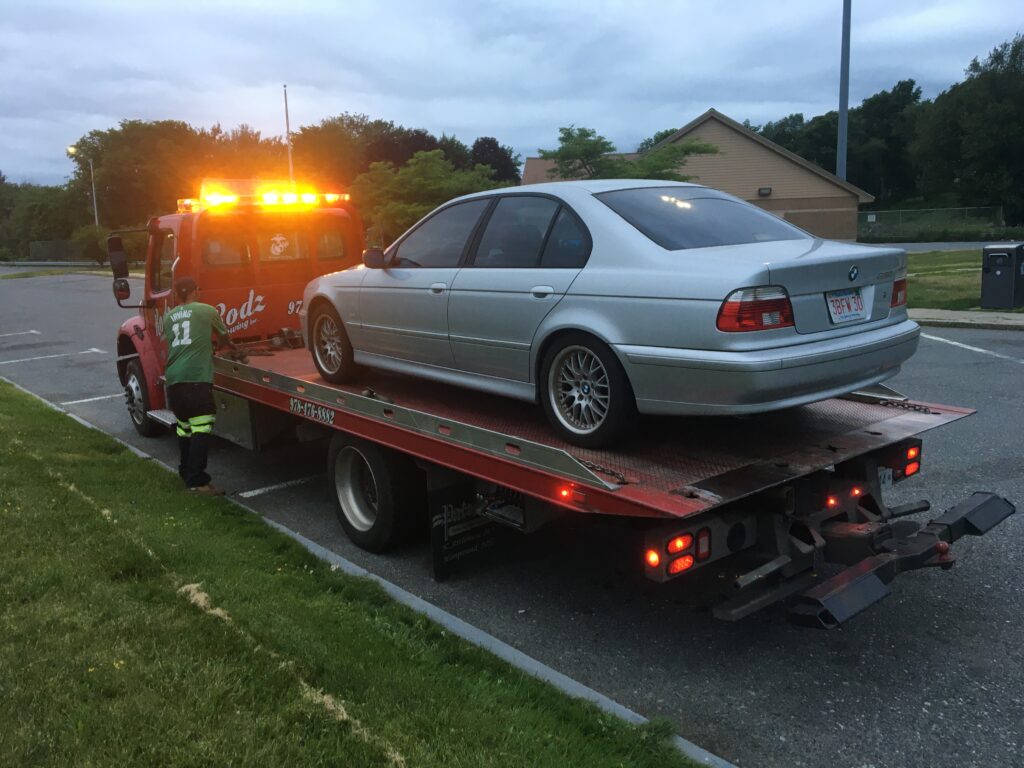
2022. Oh the indignity!
Once the car was in my garage, I elected to look at the brushes on the voltage regulator, as that’s what I was used to doing on E24/E28/E30-era cars where the regulator is held onto the back of the alternator with just two little screws and you can get it out in five minutes. In the E39, it’s quite a bit more involved to remove the regulator in situ, but I did, and found that the brushes were badly and unevenly worn, as were the slip rings. I replaced the regulator, and have been driving the car for the past 3.5 years.
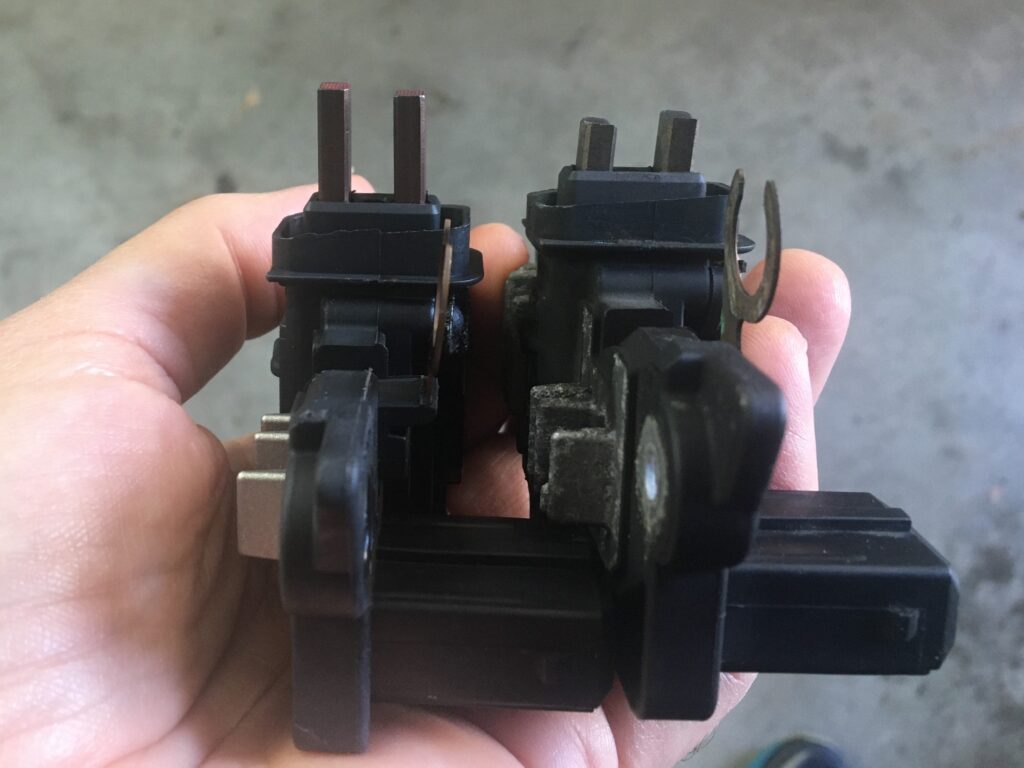
2022, new and old regulators and brushes.
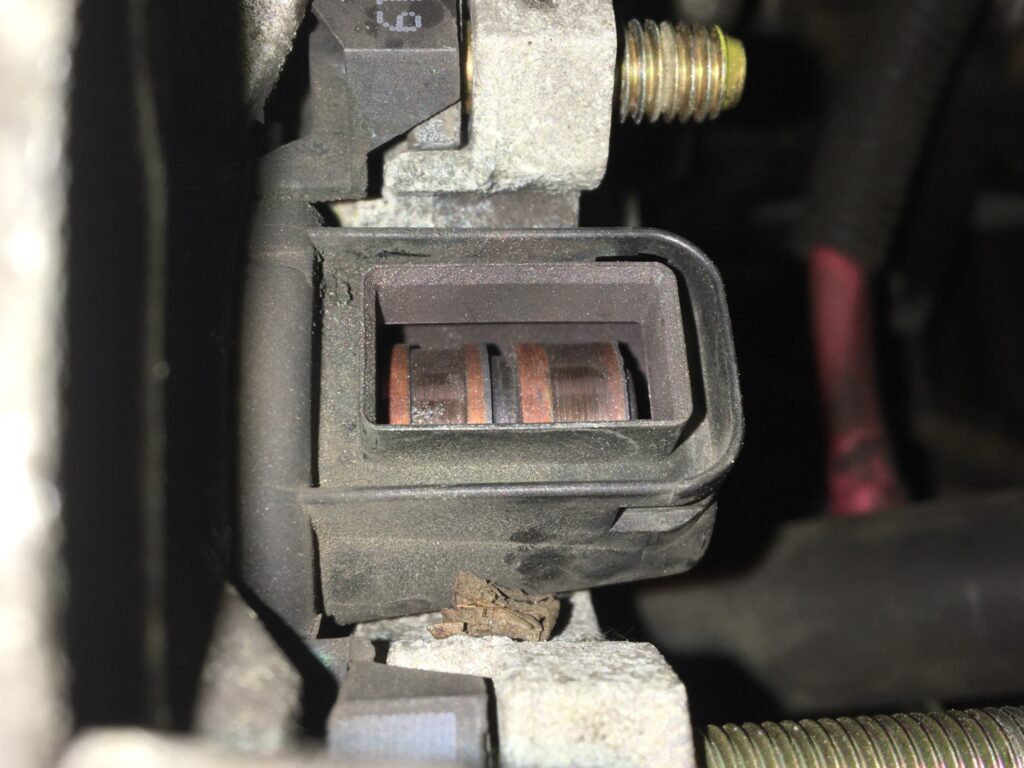
2022, grooved slip rings
Fast-forward to last week. Maire Anne and I drove up to Nashua NH to drop off her sewing machines for service. We took the E39, which was unusual because it’s kind of incumbent on me to provide “stories-free” transport when we’re both together, so we usually take either her Honda Fit or a very well-sorted vintage car, but for some reason I was feeling like the E39. The 40-minute drive up to Nashua was flawless, but as soon as we began heading back, the battery warning light came on. Maire Anne has been around me long enough to know exactly what that means and what the options are.
“What are you going to do?” she asked. “Call for a tow?”
(To state the obvious, an E39 isn’t a vintage car like a 2002 where, if you have a spare alternator (which I didn’t), you can probably swap it, even in winter, in like 10 minutes. It’s located lower in the engine compartment, there’s more stuff in the way, and you have to deal with releasing the tension on the serpentine belt. )
I thought about how my 45-minute battery life estimate stacked up against the 40-minute zero-traffic drive on the way up.
“We’re going for it,” I said.
We burned down Rt. 3 and I-95, watching the voltage on the cig lighter like a hawk. Down and down it went, falling below 12, 11, 10, into the unimaginable single numbers. I was amazed that the car was still running. When we got off I-95 at the exit for our home town of Newton, I felt home-free, as if the car died, our son Ethan could’ve grabbed the battery jump pack from the garage, driven it the two miles to us, and I could clip it onto the battery for an ounce of reserve capacity. But we made it. Incredibly, as I turned left to pull onto our street, the directional dash light stopped flashing and the audible clicking stopped, indicating that things were beginning to be affected by the low voltage. A few seconds later, most of the dashboard warning lights came on—things like brake and airbag warning lights that have nothing directly to do with voltage.
As I pulled in the driveway, the cigarette lighter voltmeter read an astonishingly low 6.5 volts.
And it had been 42 minutes since the battery light came on. I guess that 45-minute number I pulled out of my butt a decade ago is pretty accurate.
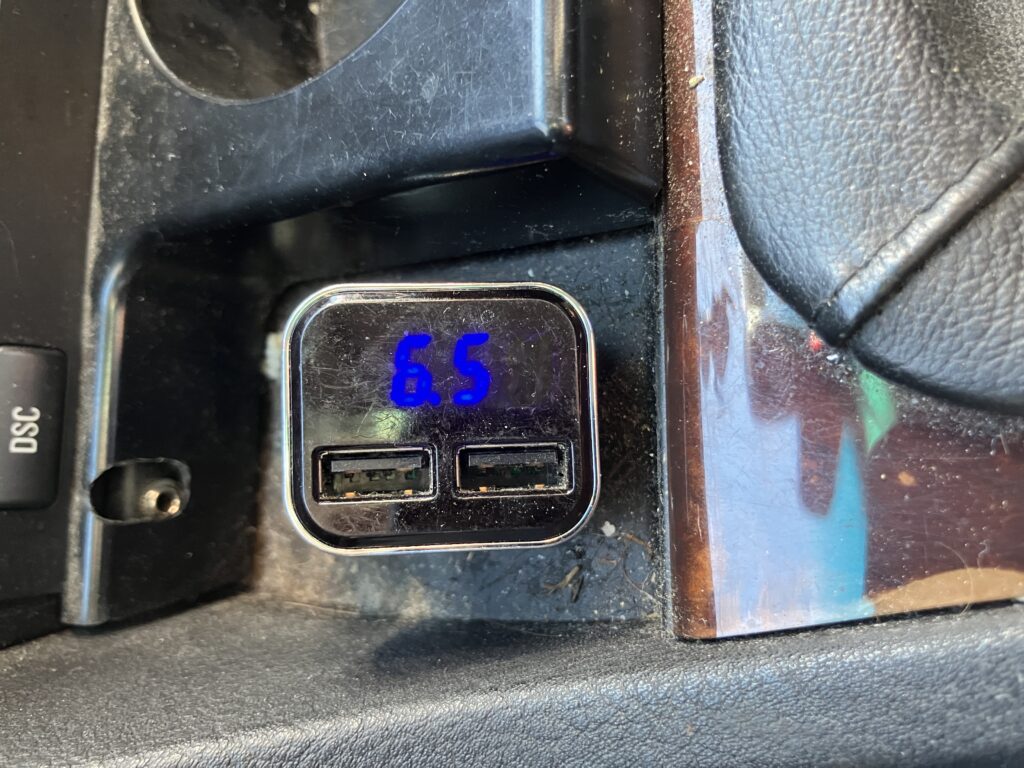
Totally not kidding about the 6.5 volts.
Interestingly, when I shut the car off and put a voltmeter directly across the battery terminals, it read 11.5 volts. I’m not sure exactly what mechanism was causing it to read so much lower at the cigarette lighter.
I pulled Bertha and the Lotus Elan +2 out of the garage, restarted the E39 with the jump pack, backed it into the garage, pulled the Lotus back in, and left Bertha to fend for herself in the driveway.
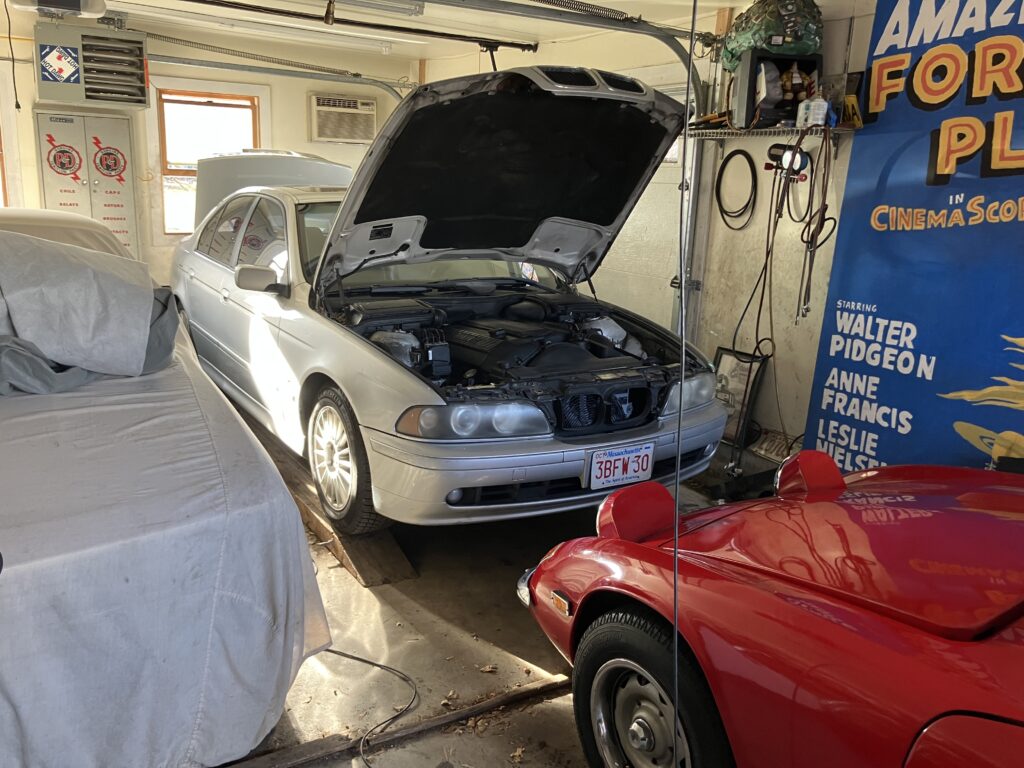
This is against the natural order of things.
I yanked out the alternator to do a proper post-mortem. This is what I found—one of the brushes had broken clean off from the voltage regulator, and there was visible damage to the slip ring.
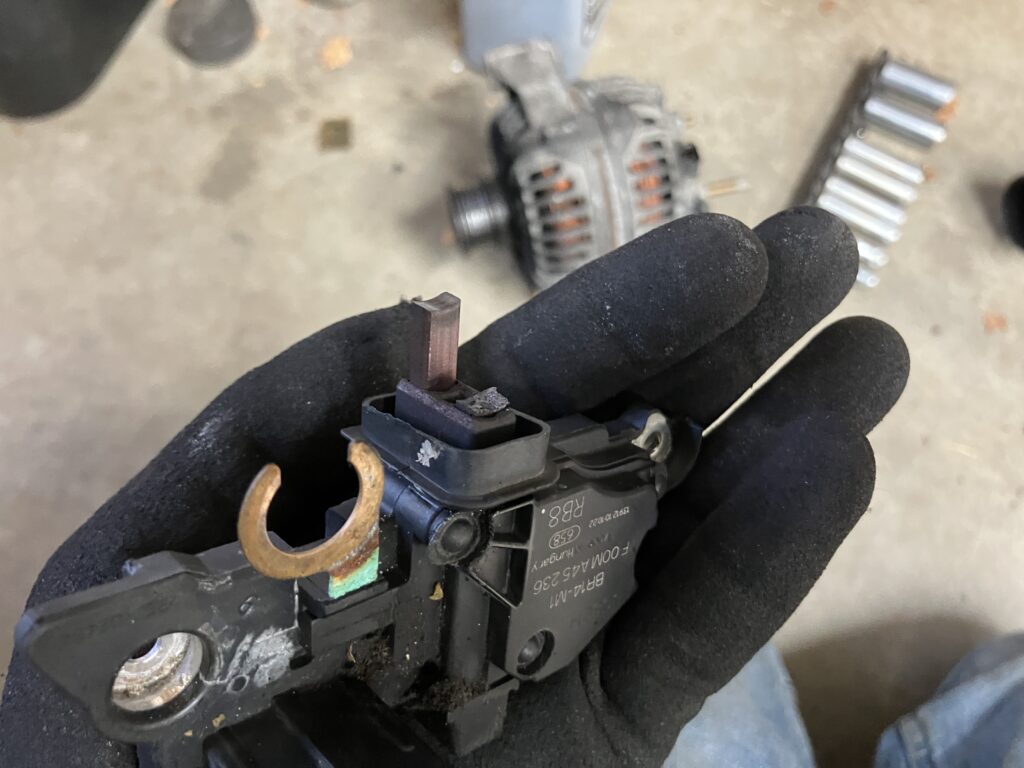
Way not good #1.
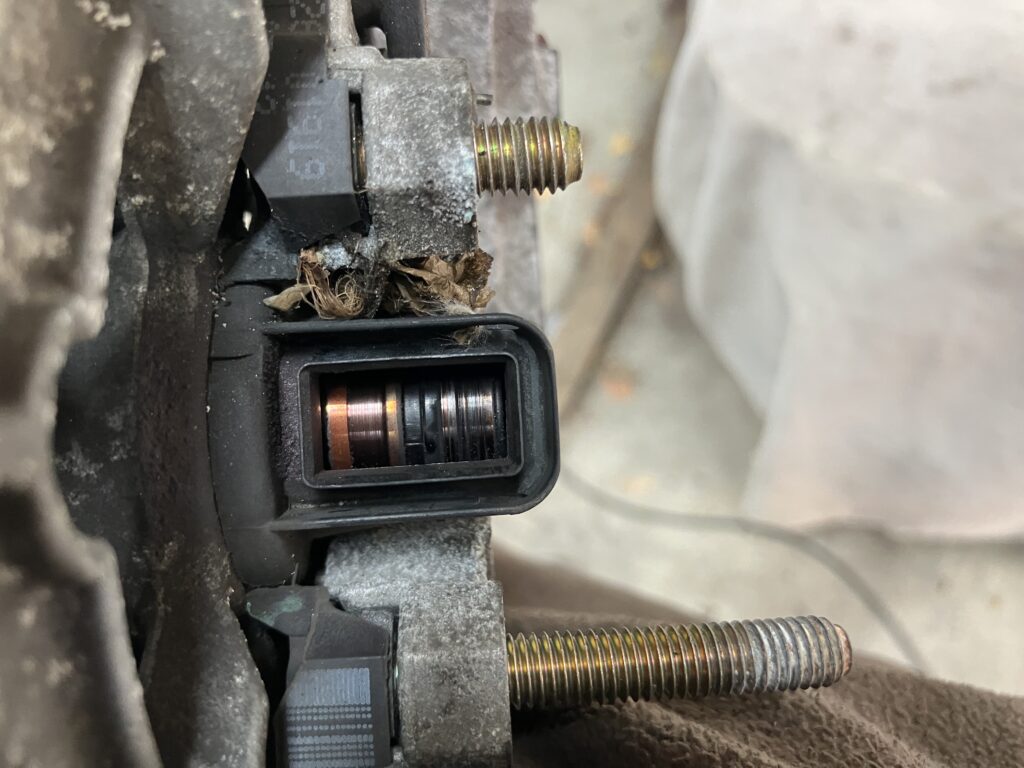
Way not good #2.
Whether the slip ring caused the brush to break, or the broken brush damaged the slip ring, it was clear that this time I needed to replace not just the regulator but the alternator as well.
But what to buy?
I and others often complain bitterly about the poor quality of replacement parts for older cars. The mechanism behind this is that when cars are still under warranty, the manufacturer is on the hook to replace broken parts for free, but as the cars age out of warranty, there is zero incentive for the manufacturer to actively police the quality control/assurance process of whoever they’re buying “genuine/OE” parts from. And it’s even worse with aftermarket parts, as the oft-touted phrase “OEM quality” means absolutely nothing. With alternators, you have the additional choice of buying not just new or used, but rebuilt. The OE alternators on E39s were Bosch and Valeo. The Bosch rebuilds have a reputation that’s, shall we say, spotty, and brand-X web-based click-and-buy rebuilds can be nothing more than a coat of paint. The preferred path is using a local rebuilder you have experience with, but I no longer have one. The cost of a new Bosch or Valeo ($389 and $317 respectively on FCPEuro) gave me pause, as those numbers represent 20 percent of what I could probably sell the E39 for, but I was very hesitant to buy something either used or rebuilt. Of course there are the new brand-X eBay and Amazon alternators in the $100 to $150 range, but looking at the Amazon ratings, I always see a tail of one-star reviews with comments like “worked for a month, then died.”
Then I saw that FCP had another new brand—SEG, who reportedly bought Bosch’s alternator and starter business in 2018. FCP listed a new SEG alternator with an overstock price of $240. That sounded good, and I dragged it into my FCP cart, but I was put off by the fact that I could find virtually no online reviews or ratings of SEG alternators. I decided to sleep on it.
In the morning (last Monday, three days before Christmas), I decided that I needed to get something on order and on the way to me. I called up my FCP cart on my laptop prepared to click and buy, and was stunned to see the “overstock” label gone and the price risen to $334.
No no no no no no no!
Desperate to get something in motion but not wanting to spend over three hundred bucks, I looked on eBay for used alternators within a small radius of me. I found a Valeo alternator reportedly from an 81,000-mile Z3 out in central Massachusetts at a salvage yard I’ve done business with before. I looked directly on their website, and saw that their no-eBay no-fees pick-it-up price was a shade under a hundred bucks. I called to make sure they had it, then shot out there (in the no-stories Honda Fit :^). In addition to the Valeo having low miles on it, the fact that it had been removed from a likely-not-driven-in-winter Z3 gave it a nice corrosion-free appearance.
When I got home, I was about to install the Valeo in the E39 when I thought that there would never be a better time than now to pull the back cover off it and check the regulator. It was a little different than the Bosch, but still easy to do. Unfortunately, the brushes on the regulator looked like this:
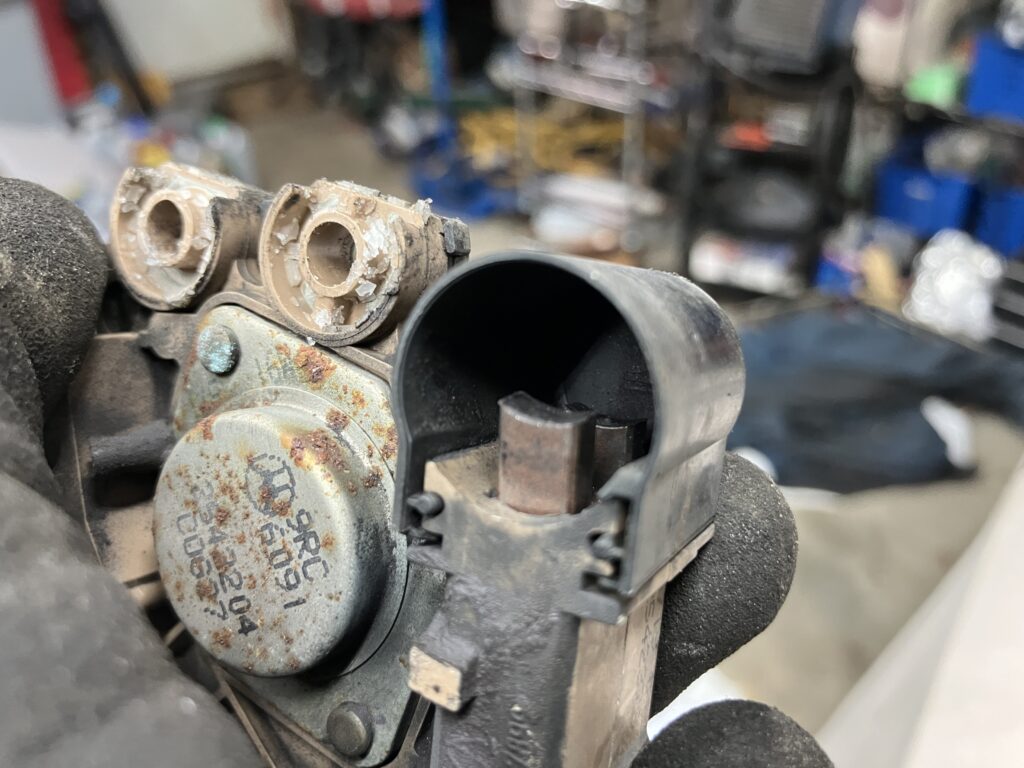
THAT’s concerning.
I slid the dust cover off the brushes so I could see them better. It made them look even worse.
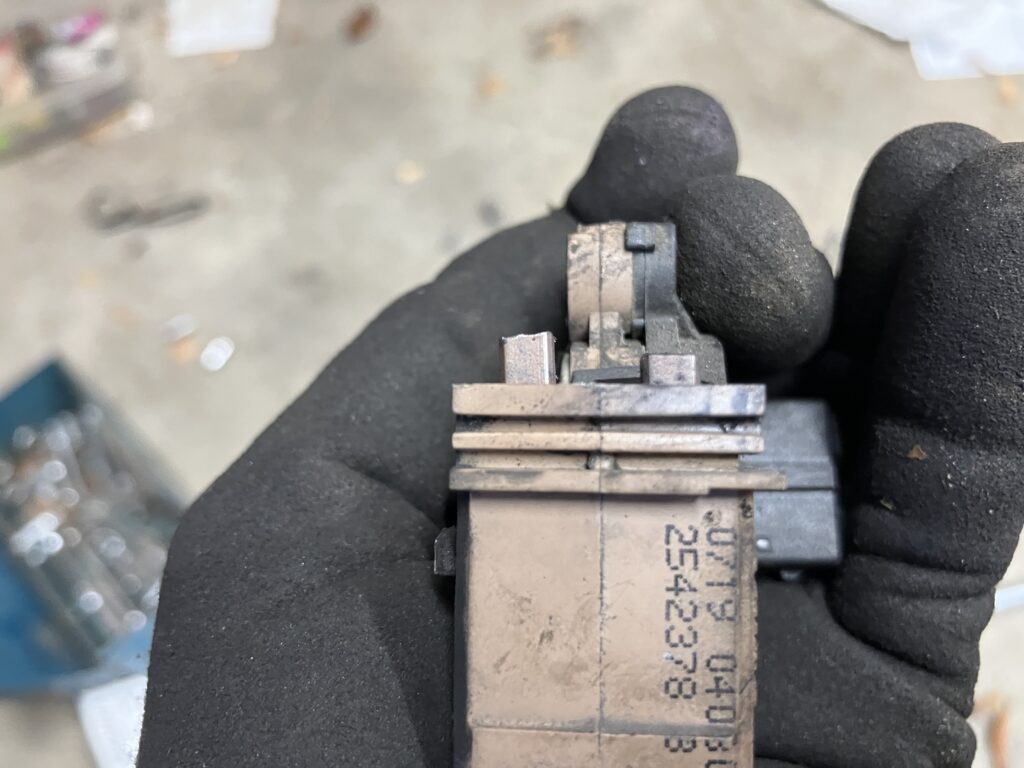
Do those look like they have 81,000 miles on them to you?
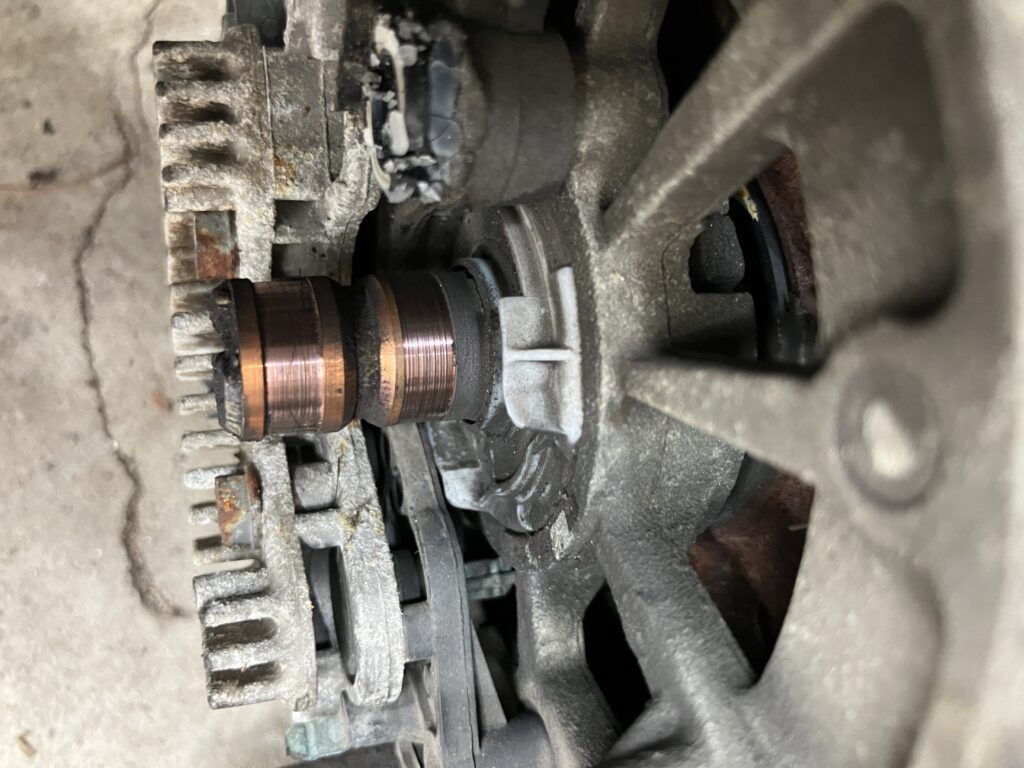
The slip rings didn’t exactly look 81k-fresh either.
I thought that clearly the thing to do was—as I did with the original alternator—just buy a new regulator / brush pack, install it, and be done with it. I went upstairs to the laptop, searched, and was stunned to find that while you can buy a new Bosch regulator for an E39 alternator for as low as $35, the going price for one for the Valeo (part number 12317551153) was closer to a hundred bucks.
Damn!
I thought about what to do, and decided that, in the short term, I just needed the car running again. I returned the regulator and brush pack to the Valeo (and when I did, carefully verified that the short brush was still being pushed backward into its housing, indicating that it wasn’t so worn that it was in imminent danger of not making contact), mounted the alternator in the car, buttoned everything back up, and tested that it worked (it did).
On the one hand, getting the car back up and running in an afternoon for a hundred bucks wasn’t a bad outcome. But having had the alternator die on me twice due to regulator problems, the Valeo’s worn brushes didn’t exactly instill confidence. I did a deeper search on the Valeo regulator, and found that RM European and AutohausAZ had them for under three figures. With a discount code, the AutohausAZ price came in at $79. I swallowed what was slightly bitter in the cup and clicked and bought. When it arrives, I’ll install it.
Out of curiosity, I looked again at the online trail of the alternator I bought. The VIN of the car it was from was listed, so I googled it. I found the bids.cars site where the salvage yard likely bought it. It was listed as having 81,000 miles there. So I don’t think that the salvage yard did anything deceptive in selling it to me.
But it goes to show: Whether new, rebuilt, or used, you pays your money, and you takes your chances.
—Rob Siegel
Rob’s new book, The Best of The Hack Mechanic, is available here on Amazon, as are his seven other books. Signed copies can be ordered directly from Rob here.
The post The E39 Alternator Surprise appeared first on BimmerLife.
]]>The post Self Propelled | Some Skills Transfer in Both Directions appeared first on BimmerLife.
]]>My wife, Carol, is fond of telling friends, “As a cook, Mike’s a pretty good mechanic.” It’s not that I can’t cook; recipes are like shop-manual procedures: Just follow ’em to success. But cooking is just not something I really like to do. I have, however, been known to bake—cakes, cookies, brownies etc, following those cookbook or mix-box instructions.
Early in our marriage, the first thing I baked for Carol was her birthday cake. We lived in a trailer—not a “mobile home,” a trailer, one with a five-degree list to starboard.
Thus the layers came out of the oven lopsided, and had to be carefully aligned to prevent the Leaning Tower syndrome. I finished icing the cake just before Carol arrived home from work.
“Mike, the frosting is beautiful,” she said. “Did Margie [our next-door neighbor] do it?”
“No, I did.”
“Where did you learn to ice a cake like that—your mom?” (She was a great cook, by the way.)
“Nope. You really don’t want to know.”
This conversation continued for a few more exchanges; then I finally revealed where I had learned my transferable skill: applying auto-body filler. As I explained to Carol, frosting is about the same consistency as filler, and sets up at about the same rate. “You’re right,” she mused. “I didn’t want to know.”
Going back even further, like most junior-high boys of my generation, I took wood shop, making the requisite foot stool and turning a gavel on the wood lathe. While not planning a woodworking career, I enjoyed the class. Those skills came in handy when I acquired a 1949 Fiat woody station wagon: structural wood, not trim. I was able to reconstruct the doors, whose mortised horizontal ribs had rotted ends where they joined the doors’ perimeter frame, plus other wood problems. Although I hadn’t learned cabinetry skills in my ninth-grade wood shop, I wasn’t afraid to tackle the wagon’s woodwork. And the time spent on the wood lathe taught me how to turn some attractive shift knobs for my cars.
After many years of teaching myself auto-body work, I enrolled in an evening auto-body class at our local vocational school. But having recently acquired an acetylene torch set, I registered for a welding class first, wanting to learn how to use that torch without hurting myself. I learned torch and arc welding, and later MIG welding, becoming reasonably competent; my welds weren’t always pretty, but they stuck. (Besides, that’s what a grinder’s for.) That skill stood me in good stead when repairing the ravages of 30 salty Ohio winters on my 2002—and I didn’t even burn out my grinder smoothing the welds.
When the Ocracoke Preservation Society asked members to make small paintings of Ocracoke-themed scenes for a fund-raising art auction, I wanted to participate, but my painting abilities run more to cars and houses. However, I unlimbered my torch and brazed sheet metal together to picture Ocracoke’s iconic 1822 lighthouse, framed by two L-shaped steel rods. Not only did it sell, it garnered one of the highest auction bids!
From another direction, I learned how electrical circuits function by sorting out problems—and installing new accessories—on my cars long before I ever had to do any household wiring. When we built a detached garage, I decided to wire it myself. I borrowed a household wiring book from the library, bought the requisite materials, and proceeded to wire six circuits, plus 220 volts for my compressor.
An actual electrician came out to run the drop from the house to the garage and check my work. He passed my wiring with flying colors. It’s still functioning properly after 48 years, so I must have learned something.
My primary responsibility as an Air Force civilian involved planning logistical support for Air Force units, especially when deploying from their home base to support a contingency. That involves determining what spare parts must accompany the deploying unit, allowing them to continue functioning for up to a month without resupply.
Choosing which parts to send is a detailed process, and begins with determining those parts that either need regular replacement (think oil filters on cars) and those parts that have a history of failure—based on maintenance records—for a particular aircraft. The completed deployment kit must be as compact as possible, but still contain—with a high probability of success—the parts necessary to “keep ’em flying” for that critical first month.
Those skills transferred neatly to my automotive fleet. I keep a small notebook in each car’s glovebox, noting any repairs made or replacement parts installed. Based on that information, over time I can predict when an individual part’s likelihood of failure starts to increase. If I have a long trip coming up, I can either make the repair/replacement in advance, or at least carry the part along, just in case.
It’s always the one you didn’t bring that you need.
The post Self Propelled | Some Skills Transfer in Both Directions appeared first on BimmerLife.
]]>The post The 2025 BMW X3 M50 Is the Pick of the Litter appeared first on BimmerLife.
]]>Now in its fourth generation, the 2025 X3 is all-new, with updated engines and a more modern interior than its predecessor. The biggest for the 2025 X3 is the exterior design, which takes a lot of design cues from the all-electric iX. BMW describes the design as “almost monolithic.” The front-end is the most obvious change, but thankfully the X3 grille is a lot less awkward looking than the one on the iX. As expected, the new model is longer (by 1.3 inches) and wider (by 1.1 inches) than the previous X3, but it’s also lower (by one inch). At 4,535 lbs, it also weighs more.
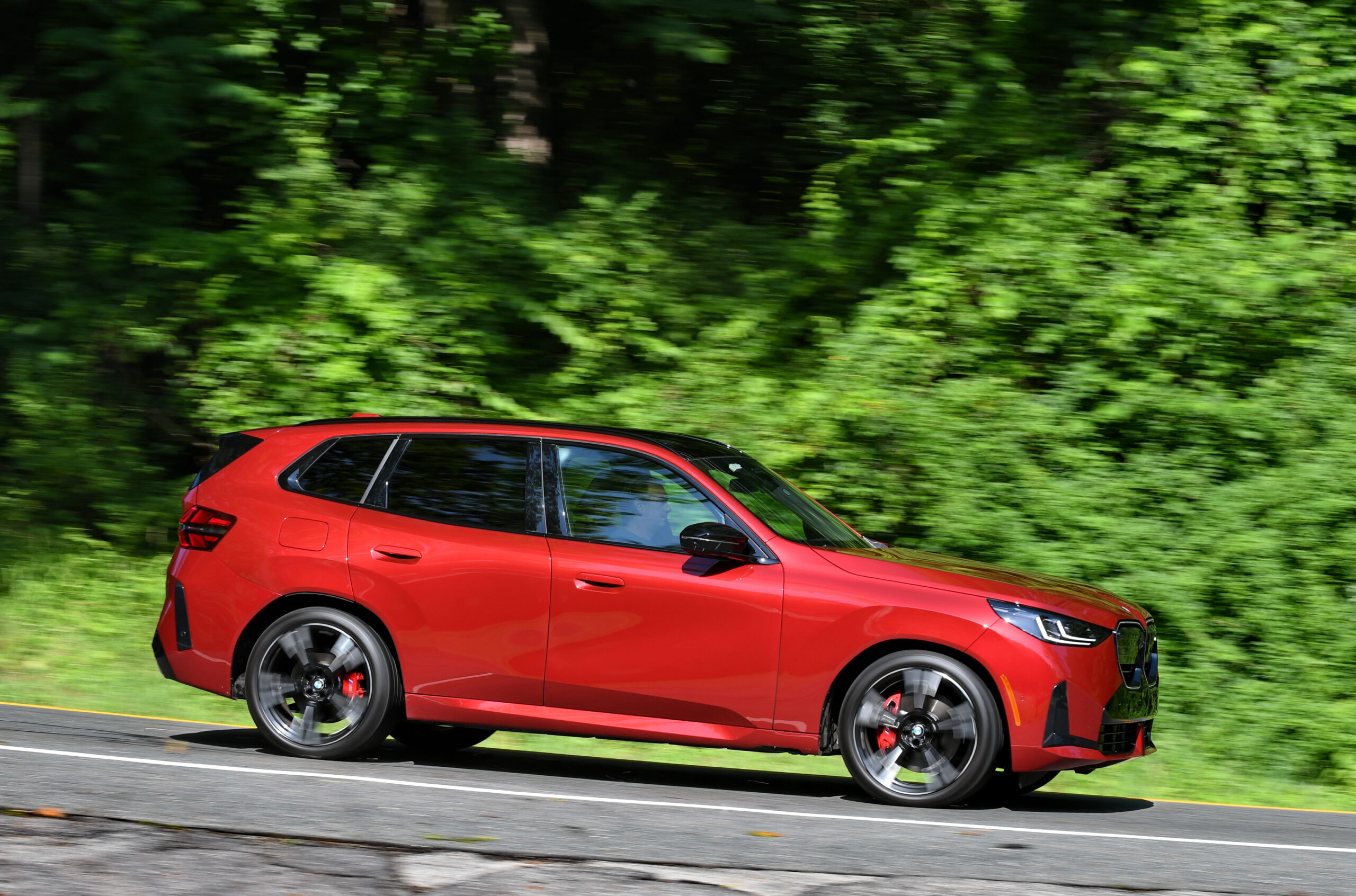
The new X3 M50 xDrive looks great in Vegas Red Metallic. Photo: David Haueter
The updated twin-turbocharged inline-six-cylinder engine under the hood of the new X3 M50 xDrive is fantastic. It now features the 48V hybrid system, which consists of a crankshaft-mounted starter generator that delivers more responsiveness and quells turbo lag. Power output on the X3 M50 xDrive is up to 393hp and 428 lb-ft of torque, and 60mph comes in 4.4 seconds if you use all of it. That’s only around a half-second behind the 503 hp X4 M Competition Package., which brings up another change in direction with this model.
You’ll notice that the X3 M50 xDrive has dual exhaust pipes that are very reminiscent of the shape of full-on M models, like the previous X3 M. This is intentional, as BMW says in the press release that it’s “a nod to the position of the new X3 M50 xDrive.” That makes it sound like there will be no X3 M model coming with this generation, which makes sense considering the performance level that the X3 M50 xDrive has reached. That said, we can’t rule out a full M version in the future.
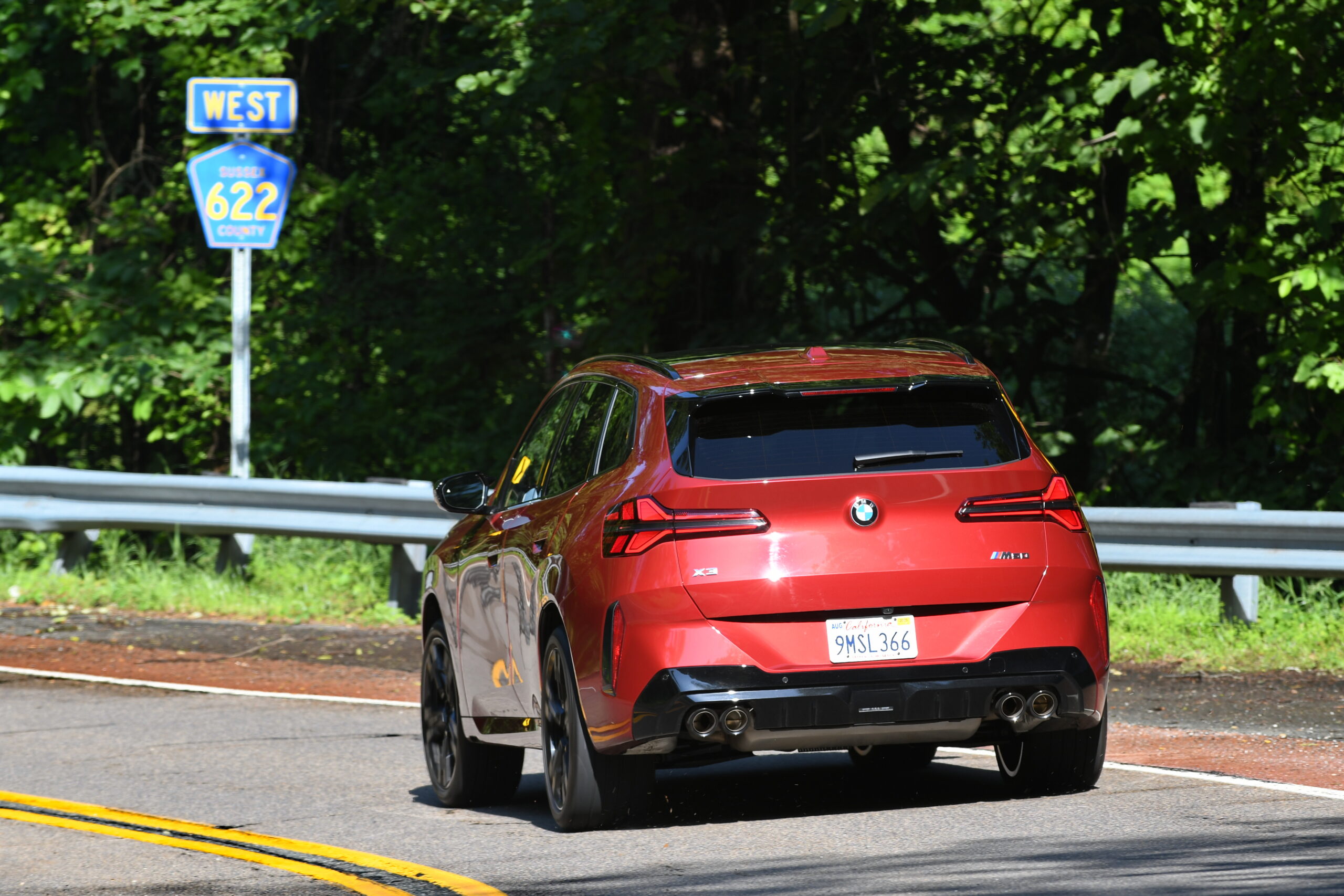
Quad exhaust with round tips is a nod to M models. Photo: David Haueter
Adding to the M-ness of the X3 M50 xDrive are the Adaptive M Sport suspension, M Sport brakes, an M Sport differential on the rear axle and 20-inch wheels, all of which come standard on this model. If you look closely, you’ll also notice the kidney grill has horizontal bars, which is traditionally a design element of the full M versions. You can also get the X3 M50 xDrive with either all-season or performance tires, and our test model was equipped with Goodyear Eagle F1 rubber.
Other notable updates to the X3 M50 xDrive that enhance performance are increased body rigidity, a wider rear track, and modifications to the double-joint spring strut front axle and five-link rear axle that BMW says increases precision when turning into corners. A 19 percent increase in the caster offset of the steering axles is also said to improve straight-line stability.

The new X3 cockpit is minimalistic and modern but is easy to adapt to and has a lot of practical touches. Photo: David Haueter
Settling into the driver’s seat, the minimalistic interior of the new X3 becomes obvious; there are few buttons and the big screen across the dash dominates everything and houses nearly every function. The good thing is that everything is very intuitive and easy to adapt to, though it may take time and practice to remember where everything is in the iDrive menu. Once you do figure it out, you can customize the main screen to make the features you use most often easier to access.
There’s a lot of practicality built into the interior, and some thoughful touches. I really like the panoramic moonroof and there’s a lot of storage options in the doors and center console. There’s also a decent amount of storage in the rear with the back seats down. I was able to fit my mountain bike without taking the front wheel off, which was definitely a surprise, and with the back seats up there’s good leg and head room for passengers. And the front seats are supportive and comfortable. It’s a nice place to spend some time.
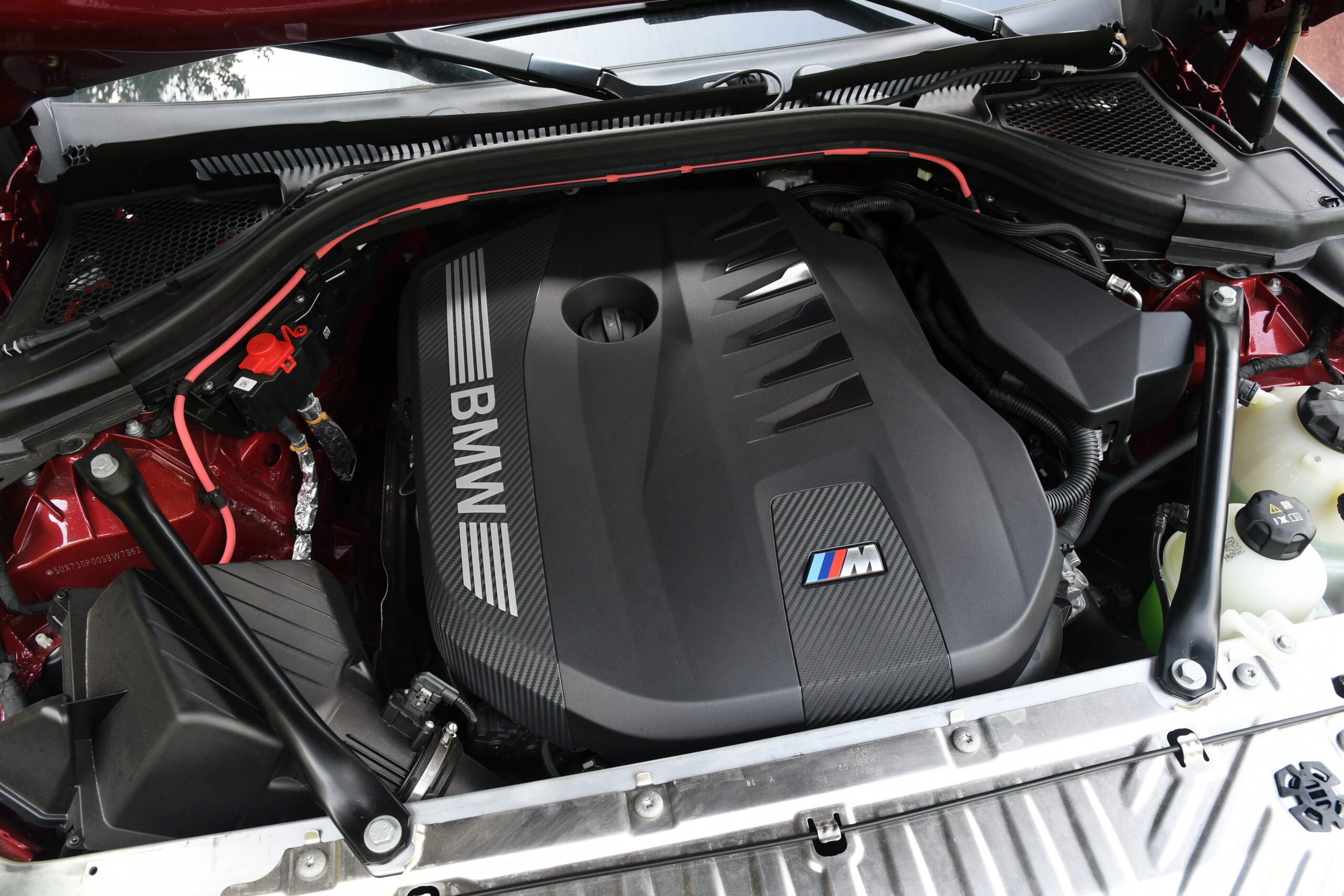
The twin-turbocharged 3-liter inline-six makes 393hp in the X3 M50 and is one of the best engines in the world right now. Photo: David Haueter
The X3 M50 xDrive is quiet, fast and comfortable on the highway, and the ride quality in Comfort mode seems to be more compliant than in previous models. Being comfortable on the highway is expected in an SUV, but the new X3 really impresses on a back road. Over the generations, the X3 has always been competent, but the new M50 xDrive raises that ability to another level.
Perhaps it’s the wider track or the improved suspension kinematics, but this new X3 is nimble and fun to drive. It feels very precise and planted with a lot of grip when you turn into corners and body control is fantastic for being as heavy as it is. It really drives more like a sports sedan than an SUV. The engine and transmission work in perfect harmony and the brakes felt strong. That said, like most BMWs the brakes are a bit overboosted, but you quickly get used to how much pressure you should apply in different situations.
My week with the X3 M50 xDrive was cut short by a non-repairable flat tire, but to fill the week out BMW loaned me an X3 30 xDrive. That made for an interesting comparison.
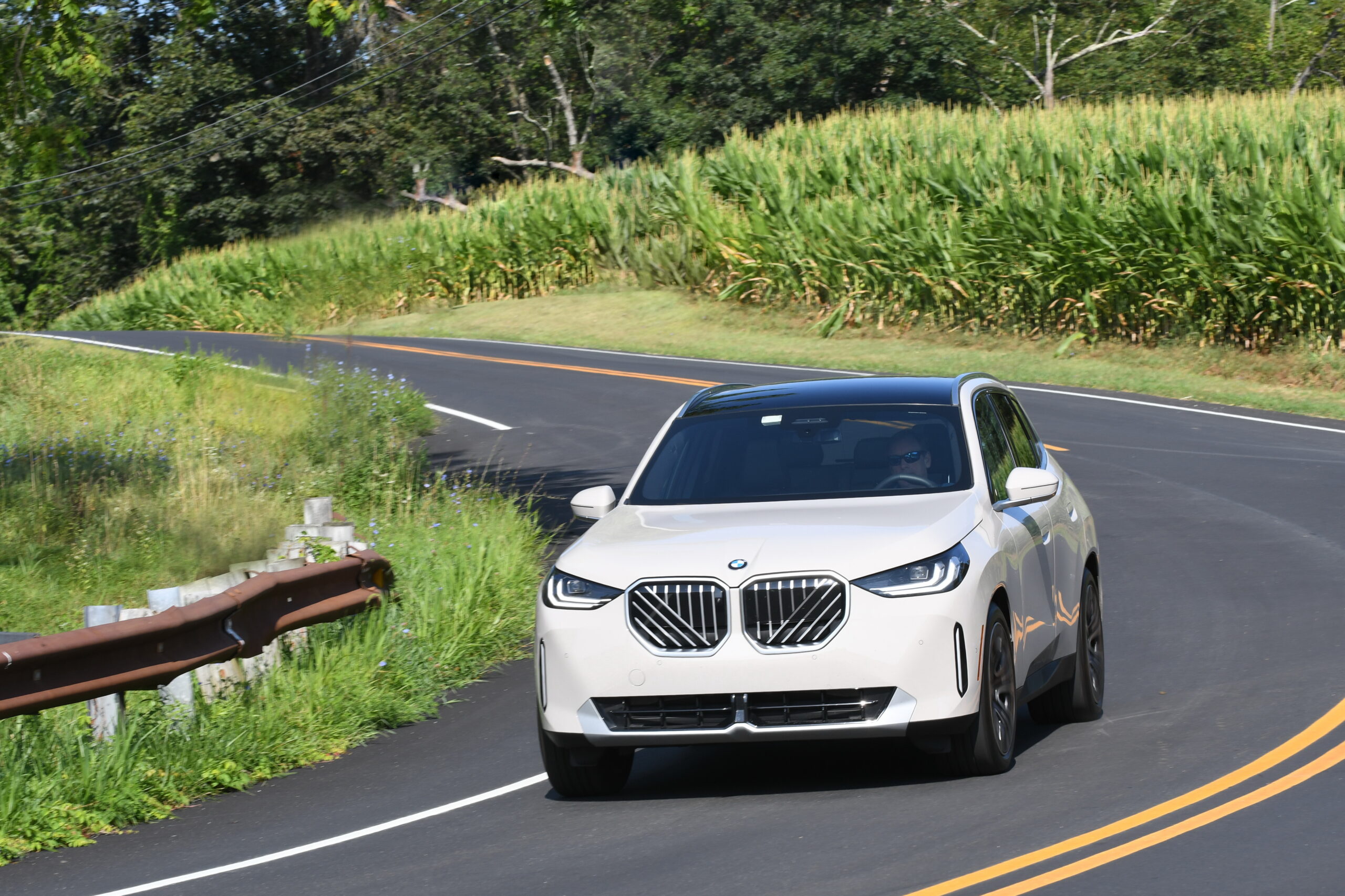
The new X3 30 xDrive has a lot less horsepower than the M50 model but is still fun to drive and more economical. Dune Grey Metallic is a new paint color. Photo: David Haueter
The X3 30 xDrive is powered by the two-liter turbocharged four-cylinder that’s in other models like the 330i and 530i and makes 255hp compared to the M50’s 393hp. It’s not as exciting to have a four-cylinder under the hood, but the X3 30 is plenty quick for a daily driver SUV and pulls strongly after some initial turbo lag, getting to 60mph in a very respectable six seconds. It’s also more efficient with fuel economy (33mpg on the highway) and is still fun to drive on back roads, though you can’t power out of corner exits like you can with the M50. In terms of design, I’m not a fan of the grille of the X3 30 xDrive with its mix of diagonal and vertical bars, but if you order it with the M Sport package ($2,200), the grill is blacked out. You can also order the X3 30 xDrive with Dynamic Damper Control ($550) and get it with performance tires. The base price is $50,900, a pretty substantial savings compared to the X3 M50 xDrive’s $65,900 cost of entry.
Still, I would pick the X3 M50 xDrive as the best all-around SUV in the BMW lineup. It has a great blend of performance and practicality and blurs the lines between sports sedan and SUV. It’s the model to get if you really want an M3 but need something more practical with usable space, and it has what is probably the best six-cylinder engine in the world under its hood. But if you’re just looking for a fun to drive SUV that’s not necessarily going to be driven like a sports car, the X3 30 xDrive is also a great choice. BMW did a really nice job with both of these new SUVs.
The post The 2025 BMW X3 M50 Is the Pick of the Litter appeared first on BimmerLife.
]]>The post Enter Now To Showcase Your Car In the BMW Classic Cars and Caffeine at the 2026 Amelia Island Concours appeared first on BimmerLife.
]]>The M Chapter secured 50 spots for the Cars & Caffeine showcase as part of the BMW Classic display. Whether you have a vintage, classic, or modern car, we all live and bleed BMW. This opportunity will allow BMW CCA members to showcase their car at the historic Amelia Island Cars & Community event, which takes place on Sunday, March 8th, 2026. Please note that we are asking all participants to spend the weekend at this prestigious event, preferably Friday thru Sunday.
With 2026 being a huge anniversary year for several historic cars, we are looking for the following show-worthy BMWs: M3, 6 Series, and 1602-2002, as stated below:
- 40th Anniversary : BMW M3 (E30, E36, E46, E9X, F80, G80)
- 50th Anniversary: BMW 6 Series (any variant)
- 60th Anniversary: BMW 1602-2002 (any variant)
Please note that this registration doesn’t guarantee you one of the 50 allocated spots.
All submissions will be vetted and accepted members will be notified shortly after registration closes. There will also be a waitlist in case of any cancelations.
Your final date to sign up is Friday. January 10th. Click the flyer below to register.

The post Enter Now To Showcase Your Car In the BMW Classic Cars and Caffeine at the 2026 Amelia Island Concours appeared first on BimmerLife.
]]>The post Tech Talk | Preventing Destruction, To Lower or Not, and Sunroof Problems appeared first on BimmerLife.
]]>N55 DISASTER PREVENTION
I own a 2018 M2 (F87) and love it. I keep my cars for ten years or more and am a big believer not only in regular “old school” maintenance but preemptively replacing parts that have higher failure rates.
I replaced the plastic charge pipe early on several years ago, and I am considering replacing the plastic “Mickey Mouse” flange (thermostat to cylinder-head hose) and adding a crank-seal guard. What are your thoughts regarding these? Can you recommend any other replacements that may help prevent costly repairs in the future
Mort Kahlenberg
Atlanta, Georgia
As one N55 M2 owner to another, I have found that these two failure items usually occur only when neglected. The Mickey Mouse ear flange does get soft over time due to its material; if you do ever remove it and it shows signs of being brittle, then it is very wise to replace it. I think by the time you are at the 75,000-mile mark, it should be considered for preventive replacement. However, I have seen them go for much more mileage (100,000-plus). Once they are removed, we discover the true integrity of the part.
Same with the serpentine belt: If there are signs of cracking or fraying on the edge of the belt, replace it. I will say that BMW belt life has improved considerably in the last fifteen years, but they can still fail by or before the 100,000-mile mark. Also, a failing idler pulley could cause the belt to fail and get sucked into the front crank seal, so I think the guard is a good idea for peace of mind. Maintaining the engine with a known good serpentine belt and healthy pulleys can prevent belt failure.
As for other replacements, I recommend a new water pump by 100,000 miles. I do not trust an electric water pump as far as a I can throw it, so I replaced the one in my wife’s M2 at around 65,000. But other than that, the N55 is solid and requires relatively low maintenance.
LOWERING A FIVER—OR NOT
I have a 2001 530i five-speed with sport package. I love this car and how it rides, but I would like to lower it, especially in the front—just a little bit to close the fender gap. The rear ride height is fine. Do you have a suggestion?
Also, my driver’s-door window regulator is making cracking or popping noises, and I am afraid it is about to go. Can you recommend an available replacement that is a high-quality part? I have been told that most of them will not last a month.
Rob Walshe
Morrisville, North Carolina
When it comes to lowering the car, you must do it in conjunction with both axles—you should not just lower the front a little, because that will induce more rake into the chassis geometry, and can make the car feel unstable. Also, the only way you are going to lower the car is to use an aftermarket spring kit, which comes as a set, front and rear. If you only want to lower it a little bit, then I would recommend an aftermarket OE replacement spring or one that will only lower it no more than half an inch. Most aftermarket “sport suspension” springs will lower the car over an inch in the front and half an inch in the rear. Also, changing the springs will change how the car rides; it may not be noticeable to some, but if you are pleased with the way the car drives and rides now, please understand that changing the springs and lowering the chassis will affect it.
As for the window regulator, there is no upgrade that I am aware of. If you buy it from BMW, then it comes with a two-year unlimited-mileage parts warranty whether they installed it or not. Hope this helps.
X3 SUNROOF WOES
On my 2018 X3 (G01), my sunroof “pops” when it is opened after it has not been opened for several days. When this occurs, the interior headliner associated with the sunroof often bunches up instead of retracting the several inches as it should. The popping is loud and smacks of a significant mechanical interference. It has been doing this for several months, and so far, nothing has broken, but I am worried. I did apply Gummipflege to the gaskets between the moveable glass panel and the larger glass panel that retracts farther back; I thought this might resolve the problem, and it did not re-occur for several days, but eventually the popping came back.
Dave Lenderking
Wilmington, New Jersey
Sunroof popping noises are never good—however, it is tough to determine what exactly is causing the popping without entirely removing the sunroof cassette. My concern is that at some point it is going to pop and stop moving, and you will not be able to close it, so please beware of this risk.
You will most likely need to take it to someone who is familiar enough with the sunroof cassette to diagnose the issue. While it may be possible to remove the retractable glass part, you still might not be able to see the defect with it still installed in the car. Assuming that you do get the cassette out of the car, it may be determined that the failed part is not serviceable, meaning that there is no separate replacement part, and you will have to replace the entire cassette, glass excluded. I just had this experience with an F13 6 Series, and the repair was $3,500 at the dealership—with discount. I recommend that you prepare for the worst-case scenario.
The post Tech Talk | Preventing Destruction, To Lower or Not, and Sunroof Problems appeared first on BimmerLife.
]]>The post The Mini Column | When the Dragon Calls, I Answer appeared first on BimmerLife.
]]>My first MOTD venture came nearly 20 years ago, and I have witnessed many changes since. During the early years, all of the cars at the event were first-generation BMW Group Minis and classic Minis. Through the years, as subsequent generations have been released, the variety of new Minis has increased in number compared to the classics.
For many years, I drove my R53 to the Dragon, and my R58 Coupe has also made the trip. This year we took the F54 Clubman. Every time we take a different Mini, it creates a fresh experience. The Clubman is, by far, the easiest to pack. The R58 proved the most difficult, since we could only use duffel bags to pack everything we needed.
My first year at Fontana Village was a challenge; the resort was completely booked, and I could only find an available nearby campsite. The rainy weather made staying in a tent miserable. Now we reserve the same cabin near the center of the resort every year, close to all the big events. Our neighbors also renew the same cabin units year after year, making it feel a little like a second home.
These are the type of friends I may not see for an entire year, but when we come together again, it feels like I just saw them yesterday.
One of our neighbors has two Corgis that are lovingly called “barking potatoes.” We first met them when they were puppies, and now we play with them as adult dogs. So even with our neighbors’ pets, we see their growth over time, and create more memories. We coordinate a dinner one night, sharing dishes among nearby neighbors, and finish the night around a campfire, swapping stories of our lives from the past year.
I return annually for the people, the scenery, and the relaxation—I learned years ago that such car events are about the people first, and the cars second. The cars are the common thread, the catalyst to meet so many great folks over the years.
The mountains provide a tranquil, scenic backdrop for the trip, with outstanding driving roads for enthusiasts and cruisers alike. There are planned drives throughout the nearly week-long MOTD schedule, and volunteers lead a small group of Minis on planned routes to nearby towns. Most drives incorporate a stop at a restaurant, and it is a great way to see the area and meet people. The scenic drives are also great because they allow us to be a part of a small caravan without the fear of being lost. We go on the same drive every year, but we make new friends and catch up with the drive leaders who graciously volunteer.
I have always believed that a vacation is a time for events and experiences that you cannot complete every day due to time spent at work. In previous years, the cell phone service was non-existent, so being away from social media and constant connectivity was a bonus. While the cell network has expanded over the years, I try to limit my time online. I want to take in the solitude of the mountains and soak up all of the car sounds in the background. The time off also means getting to drive to new areas and see vistas and views that I cannot experience from my desk at the office.
Even after all these years, I never tire of attending Minis On the Dragon, or remembering the time I sat in the middle of a tent in the pouring rain, or next to a roaring fireplace under blankets, feeling so toasty and warm. Each year holds its own special memories, and no matter which Mini from our stable makes the trip, each enhances the event for that year. If you have never attended, please plan to come some year. We want to make new friends and welcome all of the first-time attendees. The culmination of great driving roads and nights by the campfire make Minis On the Dragon a great vacation spent with Mini friends.
At Top: The Tail of the Dragon, photo via William Klos/Wikimedia Commons

The post The Mini Column | When the Dragon Calls, I Answer appeared first on BimmerLife.
]]>The post Racing Lines | Roebling Road BMW CCA Club Racing Finale Saw Broken Track Records, Close Racing appeared first on BimmerLife.
]]>
Jason Phillips and Liam Harrow run nose-to-tail [David Williams photo]

Michael Kerner (315) and Kirk Olsen (221) were both class winners [David Williams photos]
Cristopher Lindner won I-Prepared in an E36 M3. Keith Primozic (E36 M3) won PWR3, finishing just ahead of class competitor Cameron Nipper, who drove an F22 M235i-R. Primozic said later that he’d battled with Nipper throughout the event.

John Park (81) and Turner Hilliard (126) battled in all three sprints [David Williams photo]
Todd Brown, who did not race on Friday, drove his C-Mod E46 M3 (shown in the lead photo) for the Saturday and Sunday sprints. He was on a mission: “Before Roebling,” he said, “I thought I had no chance to win the C-Mod National Championship, since Robert Chang was fourteen points ahead of me. I would need at least five other C-Mods to compete against me, win both 150 percent point races, and have the other C-Modified cars complete over 50 percent of those races.” Chang did not run at Roebling, but there were enough C-Mod cars in the pack for Brown to take the title if he won the races. He gave notice in qualifying by breaking the C-Mod track record that McCleneghen had set on Friday, running a blistering 1:10.374.
Blistering was an apt term for tires as well; Roebling Road is known as a tire-eater, and it retained its reputation in December. Racer Charles Harding said, “I don’t really know what the heck is going on with that track surface. When I won there after the repave, I thought that my 1:12.2 time would stand for a good while, with track curing in, degradation, etc. In fact, one year after the repave, all the times across the board went down by a second! But for Todd and Frank to throw down a 1:10 and a 1:11 was really strong—seems the track has picked up grip, as if the asphalt aggregate has become rougher, at least for a couple of heat cycles on stickers. Then they drop off super quick, and front-left-tire cording was the flavor of the day.”

Frank McCleneghen won M2 Spec in two sprints [David Williams photo]

Sri Haputantri took the overall win in the enduro [David Williams photo]
The Sunday sprint was the feature race, and five cars remained in C-Mod; Brown had to win ahead of all of them to take the title—and he did just that, winning overall and leading a five-car C-Mod train ahead of Harding (E46 M3), Haputantri, Glenney, and Harrow. His points put him exactly half a point over Chang for the season championship. (Note that championship standings are subject to review, and were not yet official at deadline time.)

Bert Howerton won Spec E36 in two sprints [David Williams photo]
Mike Hinkley, the long-time Tarheel Chapter race chair, is stepping down from his role. He was given the Spirit of Club Racing award for his many years of service to the chapter and the BMW CCA Club Racing program, Ross Karlin served as competition steward, Mark Connoly and Steve Whitcomb served as tech stewards, and Larry Fletcher served as the timing-and-scoring steward.—Brian Morgan. Roundel motorsports editor
Lead photo by David Williams
The post Racing Lines | Roebling Road BMW CCA Club Racing Finale Saw Broken Track Records, Close Racing appeared first on BimmerLife.
]]>The post Safety Third | The Great E30 M3 Parts Fiasco appeared first on BimmerLife.
]]>In 2022, a good friend of mine decided to sell the crown jewel of his E30 M3 collection, a freshly painted 1988 Zinnoberot M3 shell, along with his lifetime horde of parts. The shell was a roller with a Ground Control suspension, a short-ratio differential, and stock wheels—and two trailer loads of parts came with it, including several S14 engines that could be built to everything from stock 2.3 to a 2.7-liter DTM-style motor.
Several Getrag 265 transmissions were also present, including an ultra-rare dogleg gearbox. All in all, there were nearly enough new-old-stock (NOS) parts to finish the car inside and out, including several carbon-fiber air boxes, a dashboard, seats and covers, an M Tech II steering wheel, early-style taillights, a fuel tank, and so on. Most were still sealed in original BMW boxes with white-and-blue parts labels plastered on the side. I get a little giddy when I see NOS BMW parts, especially E30 M3 parts.
Then there were all the used parts, small fasteners, and brackets. The latter can often be maddeningly difficult to find, such as S14 alternator bushings and air-conditioner compressor brackets.
I thought that the numbers were good; the $80,000 trade-in credit I gave toward a hot-rod air-cooled Porsche 911 I was selling made sense, at least on paper, even considering the money and time it would take to assemble and finish the M3. When I was done, it should easily be worth north of $85,000, depending on how I finished it, and the remaining parts could sell for nearly as much. What BMW-phile wouldn’t jump at the opportunity to build what could fundamentally be a new-old-stock E30 M3? Even my cynical voice of reason couldn’t find fault with the plan. I could sell off the parts I wouldn’t use to fund the build, and if I needed out of this venture, I could sell it all and get my money back. I’d done well buying E30 parts lots in the past; it could only be better with unobtanium E30 M3 parts, right?
Well, the real world had other things in mind.
First were the sheer logistics of inventorying and storing two 24-foot trailer loads of parts; the inventory alone took up an entire 50-by-25-foot hangar and countless hours to lay out, photograph, and catalog everything. Then there was the project itself, which needed to be worked into the shop schedule after I decided which S14 engine to assemble and use.
Anyone who’s done it knows that the last 10 percent of a project can require 90 percent of the work, the finishing touches required to make it 100 percent complete. Fear of selling off something I might need put most of the parts in purgatory until I finished building the car, which wasn’t happening fast.
The timing wasn’t great, either. I made this deal in January 2022, a month before Russia invaded Ukraine. Shortly after that, cracks started to fracture the enthusiast-car boom as consumer confidence waned and capital became more expensive. The E30 M3 market had also shifted, moving from an old-school enthusiast-driven demographic to a spectator model mirroring the Porsche air-cooled boom; the good old days of the S14.net and R3Vlimited forum communities had given way to the Internet-dating models of Bring a Trailer and other online marketplaces.
I got scared and posted the car and parts as a lot, just trying to get my money back. The only inquiries I received were lowball offers, or those that were predatory in nature.
In hindsight, I should have posted it as a no-reserve auction on Bring a Trailer and hoped for the best, but the thought of running that auction gave me tremors. It would have likely required taking a week off work to keep up with the questions and comments. Instead, I did the worst possible thing you can do in business: nothing. I pulled the listing, put the parts in storage, and sat on them while the market went down and my capital cost went up. I clung to the notion that I could finish the M3, sell the other parts, and still break even—but as the service business suffered, the M3 became less and less of a priority. When it came time to close the shop and give up the space, I sold everything for 50¢ on the dollar to a good friend, eating several years of holding costs. It turned out to be the single greatest loss I ever took.
On a positive note, at least those parts went to a good friend instead of a speculator, and the M3 will ultimately get finished. When it’s done, it will bring countless smiles, and keep another example alive of what is arguably the most important model in BMW M GmbH history.
Meanwhile, I’ll continue to move forward, licking my wounds and learning from the lessons of the past. If nothing else, it’s just another of hundreds of stories and experiences I have yet to tell.
The post Safety Third | The Great E30 M3 Parts Fiasco appeared first on BimmerLife.
]]>The post Re-Resurrecting Bertha (Part V: Heat) appeared first on BimmerLife.
]]>As I mentioned a few weeks ago, the issue with the heater valve was that the Bowden cable controlling it had snapped. Peering into the under-cowl area from the side, I could see the valve, the lever on the back side, and both snapped-off ends of the cable.
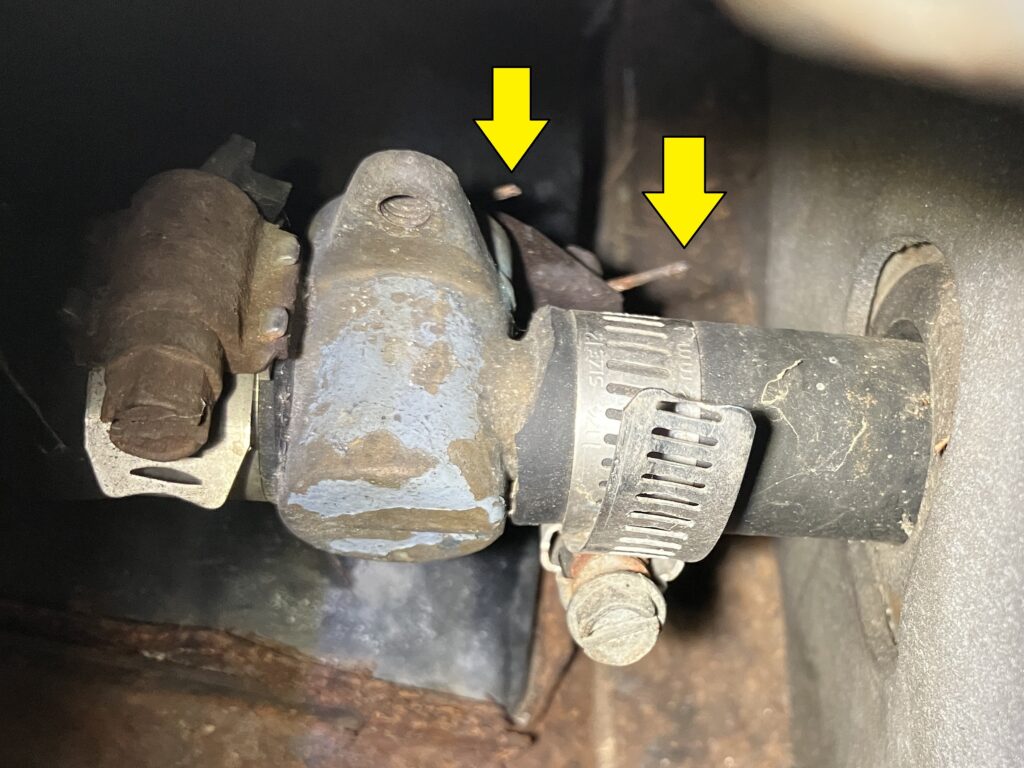
No mystery here.
The lever rotated freely between its off and on positions, so really all I needed to do to get heat was set it to the on position and leave it there for the duration of the winter, but we all know how heat in cars can go from “help me lord I’m freezing” to “Enough! I’m roasting! MAKE IT STOP!” Plus, having owned E9s, E3s, and E24s whose heater box is plumbed always-on, I know how heat continues to pour out of the box even when you have the flaps closed. So if there was an arthroscopic way to stitch the cable back together, I wanted to find it and employ it. I searched on Amazon and found these little barrel-shaped “wire rope clips” that had a hole in both ends and two little Allen screws to tighten down on the ends of the cable. Perfect, I thought—stick one of these between the broken ends, and Bob’s your uncle.
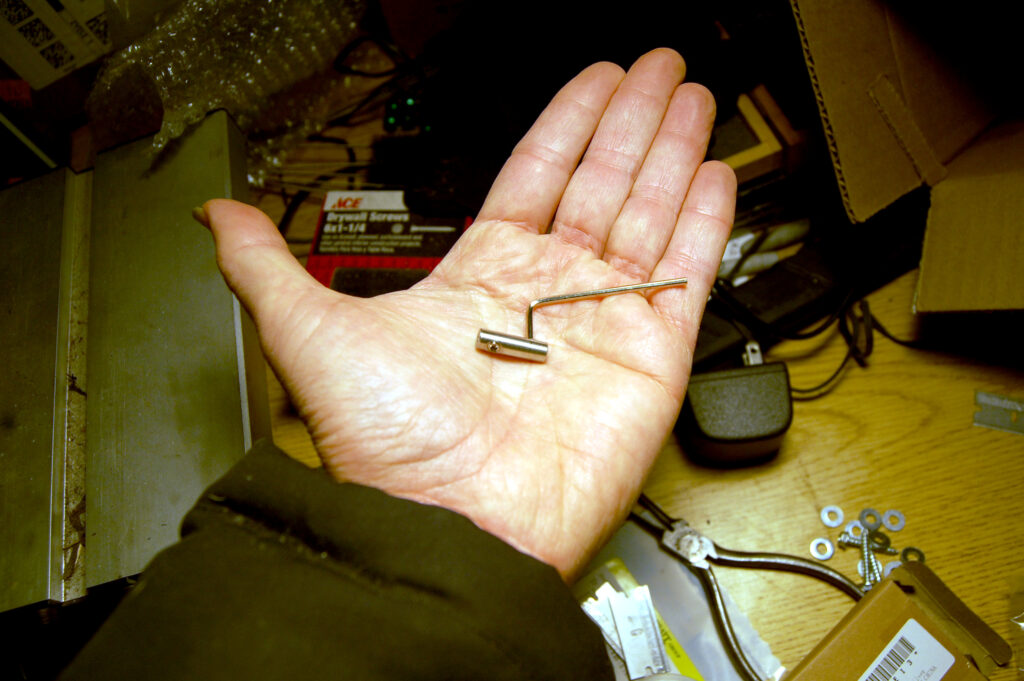
The right kluge for the right job?
Although it seemed trivial, I couldn’t maneuver the barrel into position on both cable ends, so it made sense to me to undo the far end of the broken-off cable, take it out of the car, stick the barrel on it, slide it over the long end, then reassemble and snug everything down. Unfortunately, the little 7mm nut on the end of the lever wouldn’t surrender its 50-year-long death grip, and I could feel its corners beginning to round off it. No problem, I thought—I’ll just undo the little bolt holding the lever onto the valve instead.
I put some torque on the little 7mm wrench, and experienced that sickening feeling you get when a fastener suddenly gives way without going through the screeeee portion of the loosening process. The bolt and the little cylindrical end of the valve it screws into had snapped clean off. D’oh! In retrospect, I clearly should’ve soaked both 7mm fasteners in Silikroil before beginning this operation. Fortunately, the lever itself remained attached to the valve (it’s probably rusted onto it), so at least for now, it can still be used for winter-on / summer-off heater core operation.
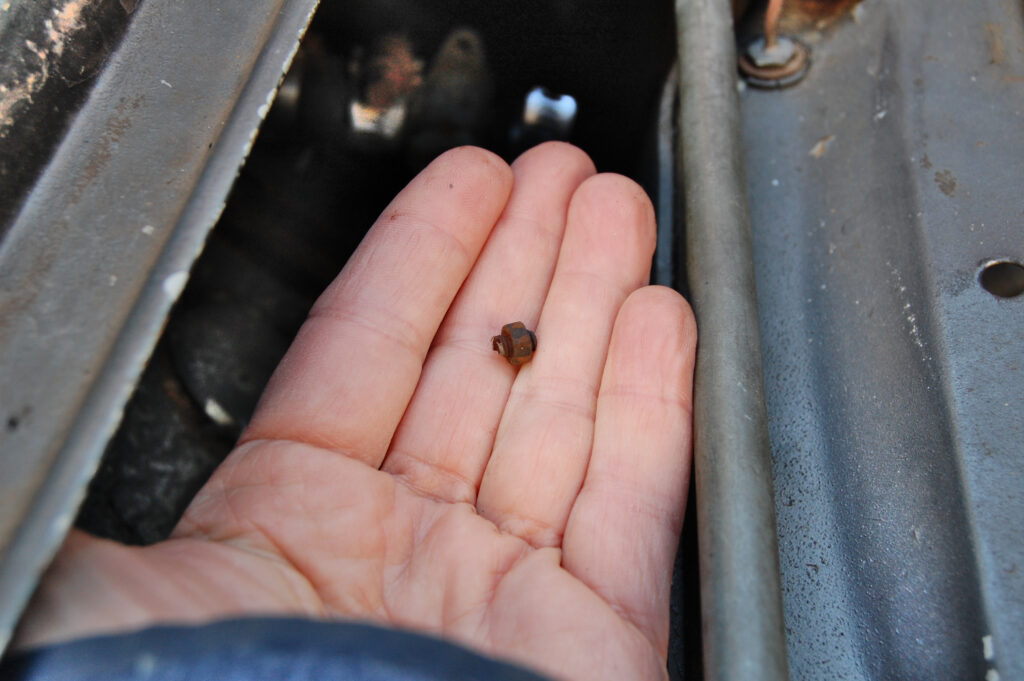
What is snapped can’t be un-snapped.
Next was the issue of the blower fan. I wanted it operational not only to keep my feet warm, but also to keep the windshield defrosted. Unfortunately, to replace the blower fan on a 2002, the heater box has to come out, which is a substantial operation. Further, this car has dealer-installed Behr air conditioning, so that would have to come out in order to pull the heater box. When I revived the car six years ago, I made the rash decision to rebuild the a/c but leave the heater box alone, essentially sticking a thumb in my own eye regarding the whole “while you’re in there you’d be an idiot not to do both” thing. So, yeah, I’m an idiot.
The first thing to do when faced with a non-functional 2002 blower fan is to make sure it’s, to quote The Wizard of Oz, not only merely dead, but really most sincerely dead. It can stick from lack of use, and sometimes, surgically-sprayed Silikroil and a nudge can free it. You can reach under the cowl and poke something like a popsicle stick through the plastic lattice and try to turn the fan blades to judge if it’s seized. I found that Bertha’s fan was completely free. So maybe there was hope.
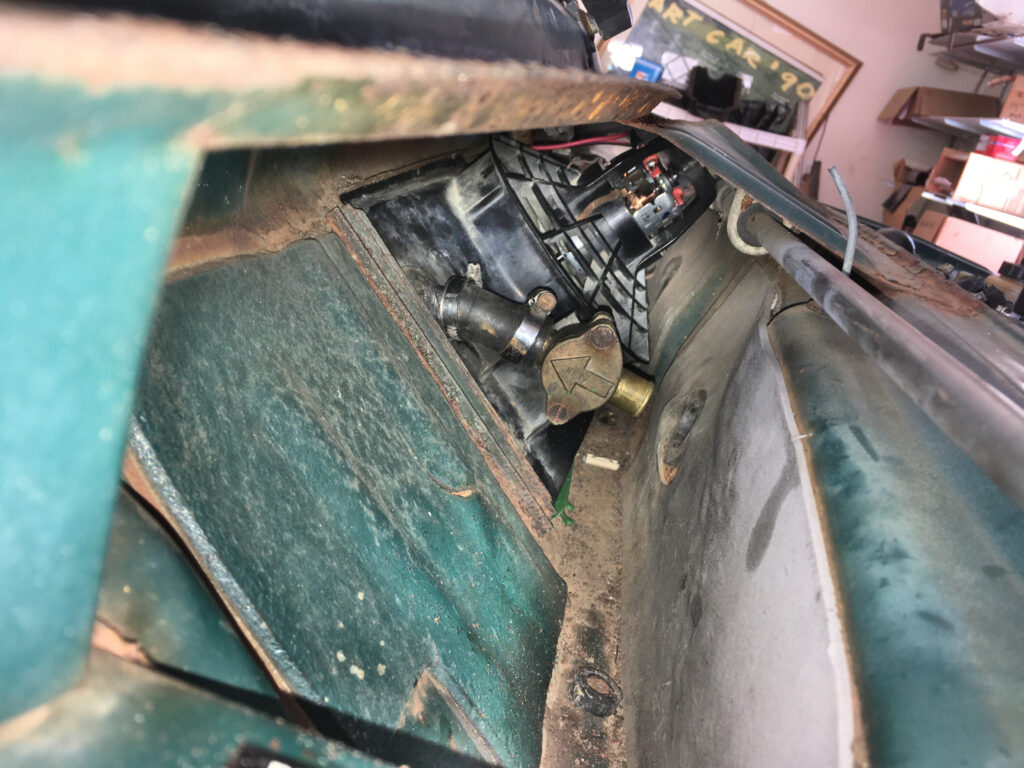
A good view under the cowl of the fan and the plastic heater box lattice it sits behind, this one from Louie my ’72 2002tii. You can see the shiny new fan motor in it, installed when the heater box was removed and rebuilt—work I’d only do on Bertha if it was absolutely necessary.
The next step was to see if the fan is getting voltage. I connected the battery, clicked the key to the ignition position, moved the blower fan slider on the dashboard to high, and carefully positioned my two multimeter probes through the hole in the middle of the cowl cover and on the terminals. I was surprised to find there was no voltage at the motor. This usually isn’t what happens. As I described here, when I was readying the Bavaria for sale this summer and wanted to address its dead blower fan, I found that the fan turned freely and there was voltage to it, but it was still clearly dead. I removed it and found that the brushes had seized up in the rectangular channels they slide in, so they weren’t making contact with the rotating armature. I was able to free them and resurrect the fan. (So it wasn’t most sincerely dead :^) Unfortunately that trick wouldn’t help me here, because the Bavaria, like the E9, E30, E24, and most other cars, has the huge advantage that the blower motor can be withdrawn from under the hood.
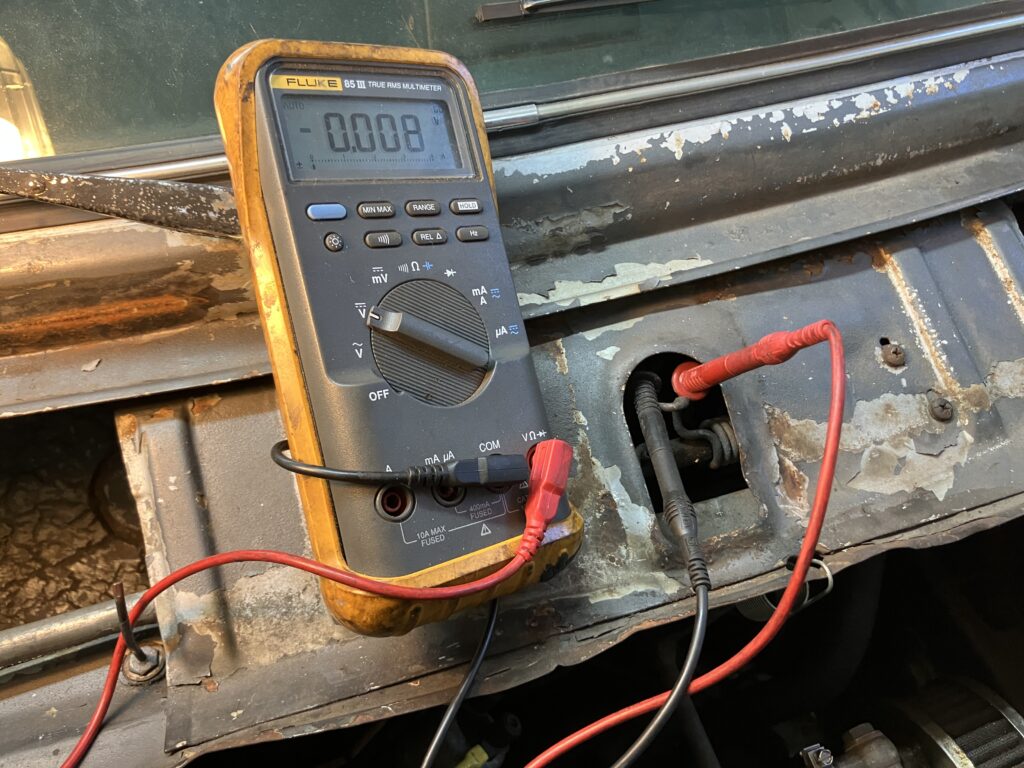
As the husband said in the old Kellogg’s cereal commercial, nuttin’ honey.
When the fan isn’t seized and there’s no voltage to it, there are two paths to take. One is to see if there’s an easy answer to why there’s no voltage. The other is to temporarily hot-wire the fan directly to the battery and see if it springs to life. Normally I would do the second one first (I always want to jump to the end of the mystery and know if I need to put a replacement component on order), but the lack of voltage surprised me, and would need to be fixed anyway to have a working fan.
I thought the most likely culprit would be the contacts on the slider switch on the dash, which would be a bit of a pain to deal with. I mean, there was effectively zero chance it could be something as simple as a popped or non-contacting fuse. I would’ve seen that six years ago.
Wait, I WOULD’VE seen that six years ago, right?
One of the many odd things about Bertha is that, at some point before I bought it in Austin the spring of 1984, someone had rewired the fuse box and paid little attention to the original numbering, so what circuit is on what fuse is always a mystery. I squeezed each fuse from the contacts at the ends while rotating them around to make sure that the contacts weren’t either loose or dirty. While I was doing this, I inspected each fuse. A break in the middle of the little gold-colored metal strips is usually really easy to see against the plastic of the fuses. I didn’t see anything, and mentally replayed the “You didn’t think it was gonna be that easy, did you? / You know, for a moment there, yeah, I did” scene from Kill Bill. (I guess I’m in movie mode today.)
I was about to move on when I thought “Let’s be certain.” I set the multimeter to measure resistance and to beep when there’s continuity (meaning very low resistance), and one at a time, put the probes on the ends of each fuse. Beep… beep… beep. I got to fuse #11 and… silence.
Gotcha.
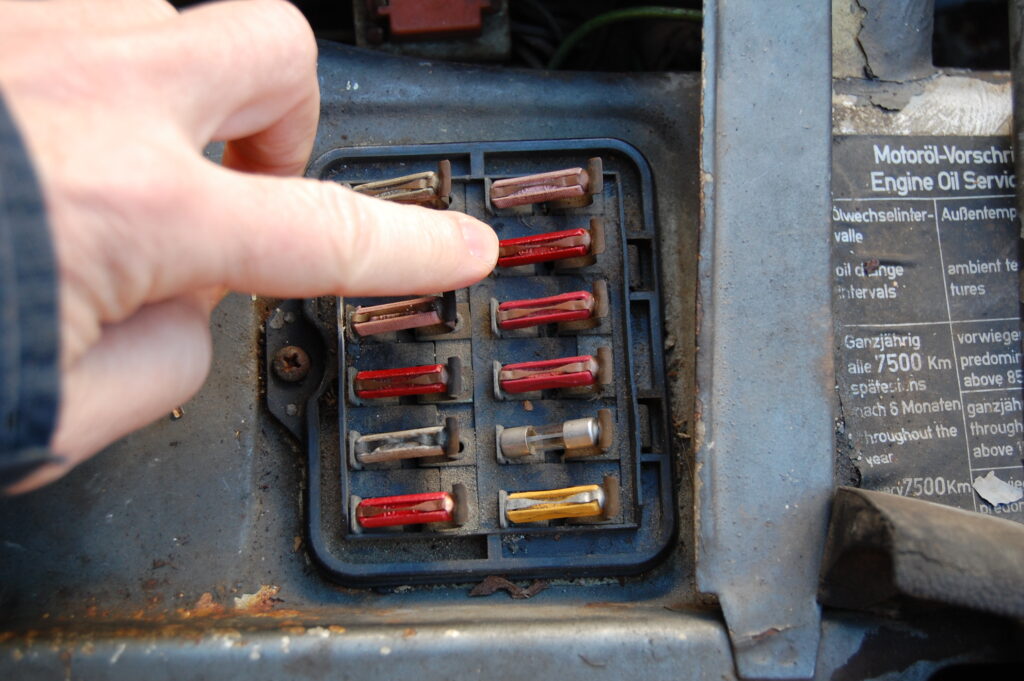
You!
I looked carefully at the red 16amp fuse, and saw what looked more like a crack than the characteristic melt-through of a blown fuse.
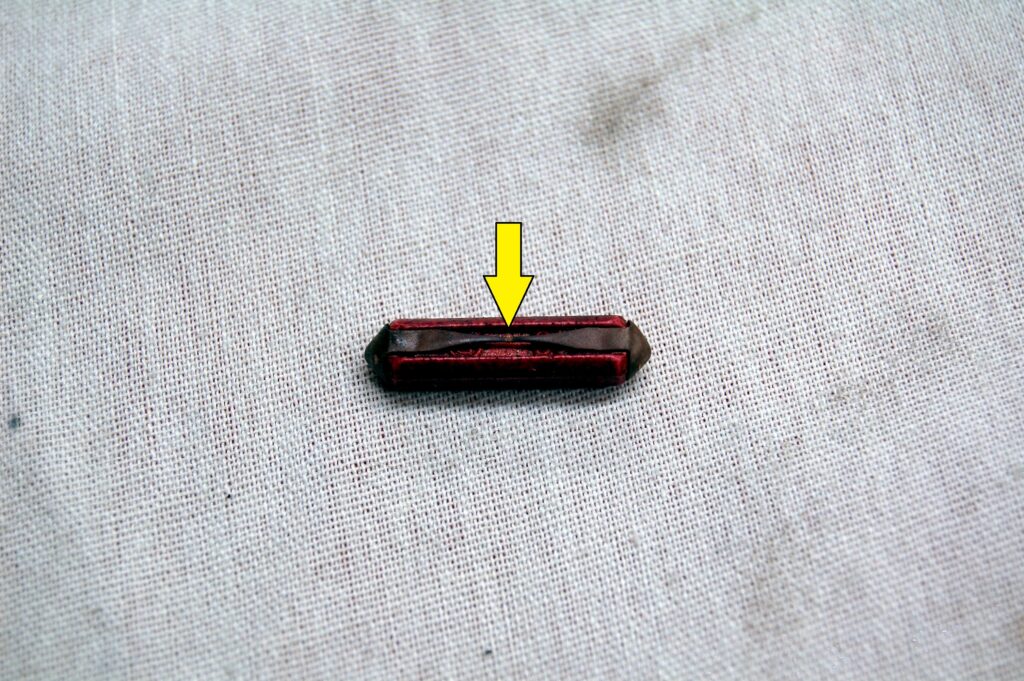
See it? No? Neither did I.
I replaced it with a new 16amp fuse, and the blower fan squeaked somewhat reluctantly back to life. I was stunned.
Now, let’s be clear. There are usually multiple reasons to rebuild a heater box. The most acute is when the heater core is leaking, as was the case with Louie (the Ran When Parked car). Actually, I take that back—the most acute is when there’s rodent contamination, and any air flow through the box, including fresh air flow, is gag-worthy. But on a 50-year-old car, it’s certain that the foam has long since worn off the flaps, so even when the flaps are closed, gobs of air are getting past them. This means that, in the summer, hot humid outside air streams in and fights your hard-won working air conditioning, and in the winter, cold air fights the heat. So, when you remove the heater box for any reason, you clean it, re-line the flaps with new foam, and make bloody sure the fan works without squealing. So, in finding that my fan actually worked, and without any rodent stink or heater core leakage, I’d taken heater box removal and rebuilding off the table.
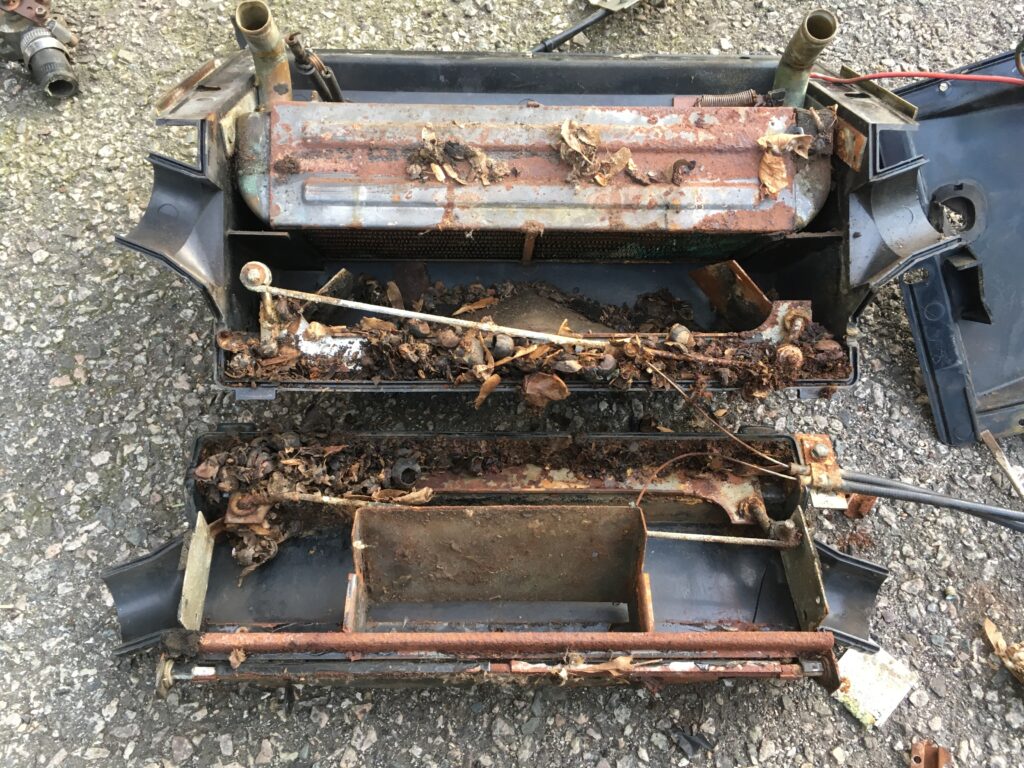
Louie’s heater box when I rebuilt it in 2017 due to a leaking heater core. Remarkably, it didn’t smell like rodent. I wouldn’t be in the least surprised if the inside of Bertha’s looked similar. And I’m glad that, for the moment, I don’t need to find out.
So. Bertha now has binary-under-the-hood-switched-on-and-off heat fighting for dominance against a fair amount of cold air coming through the degraded foam on the flaps, and a working though squeaky blower fan. Given where we are at the end of 2025, I’m calling it success and taking the win.
—Rob Siegel
____________________________________
Rob’s newest book, The Best of The Hack Mechanic, is available here on Amazon, as are his seven other books. Signed copies can be ordered directly from Rob here.
The post Re-Resurrecting Bertha (Part V: Heat) appeared first on BimmerLife.
]]>